Story of NavIC – crucial indigenous SatNav system
by rohit | Feb 8, 2025 | Courses |
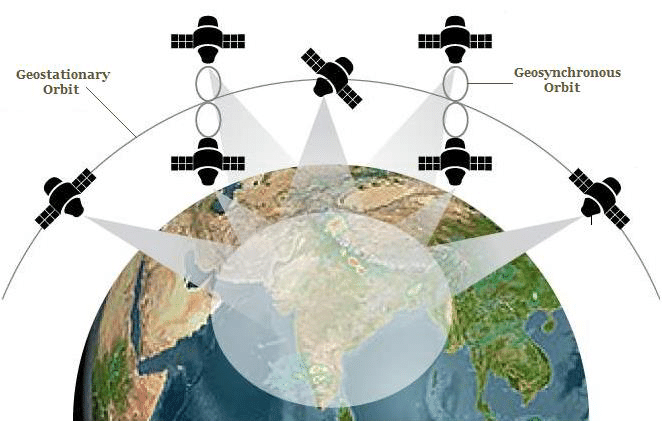
About Story of NavIC – crucial indigenous SatNav system:
-
- India’s NVS-02 navigation satellite partially failed on February 2 due to engine non-firing, marking another setback for the Indian Regional Navigation Satellite System (IRNSS), or NavIC.
- Conceived after the 1999 Kargil War, NavIC aimed to establish a seven-satellite constellation by 2016 for defence and civilian use. However, only five of the 11 satellites launched since 2013 remain fully operational.
- Despite ISRO declaring the constellation complete in 2016, failures and replacements have plagued the ₹2,250 crore program.
- Failures in IRNSS Satellites
- Atomic Clock Malfunctions (2016 Onward)
- Failures reported in rubidium atomic clocks used in IRNSS and ESA’s Galileo GNSS.
- Each IRNSS satellite has three atomic clocks.
- In July 2016, ISRO confirmed all clocks on IRNSS-1A had stopped working
- Despite this, ISRO stated the navigation system’s overall performance remained unaffected.
- Clocks in IRNSS-1C, 1D, 1E, and 1G also developed issues over time.
- Satellite Launch and Deployment Failures
- IRNSS-1H, launched in 2017 to replace IRNSS-1A, failed as its heat shield did not detach.
- The latest satellite, IRNSS-1K (NVS-02), suffered an engine failure in 2025, leaving it in a sub-optimal orbit.
- Overall Impact
- Out of 11 IRNSS satellites launched, six have faced failures, affecting India’s indigenous navigation system.
- Current Operational Status of NavIC Satellites
- ISRO’s 2023-24 annual report says that following the launch of NVS-01 on May 28, 2023, five NavIC satellites are operational – IRNSS-1B, 1C, 1F, and 1I, and NVS-01 (IRNSS-1J).
- However, according to some estimates, 1C is only partially operational due to the presence of the old series of atomic clocks that were reported to be malfunctioning.
- Satellite Generations and Clock Issues
- First-generation IRNSS satellites (1H and 1I) carried modified European clocks.
- Next-generation satellites (NVS-01 and NVS-02) use a mix of indigenous and foreign clocks.
- NVS-02 (IRNSS-1K) failed due to an engine malfunction.
- Importance of the NavIC System for India
- Key Services Provided by NavIC
- Standard Positioning Service (SPS): For general and commercial use.
- Restricted Service (RS): For defense forces.
- Offers positioning accuracy better than 20 meters across India and up to 1,500 km around it, with dual-frequency capabilities in L5 and S band.
- Strategic Importance for Defense
- NavIC ensures reliable positioning data critical for defense applications, unlike global systems such as GPS, which have military-encrypted services primarily for US and allied forces.
- Global navigation systems (GPS, GLONASS, Galileo, Beidou, QZSS) are mainly developed for military use, and NavIC provides India with independent and secure navigation.
- Commercial and Consumer Adoption
- For NavIC to become widespread, ISRO plans to partner with commercial service providers, including mobile phoneand vehicle manufacturers
- Qualcomm, a mobile chipmaker, agreed to incorporate NavIC support in some chipsets in December 2023.
- Future Plans for Expansion
- ISRO intends to launch three more second-generation satellites (NVS-03, 04, 05) to enhance the NavIC system and ensure continuity of services, despite setbacks like the NVS-02 engine failure.


