
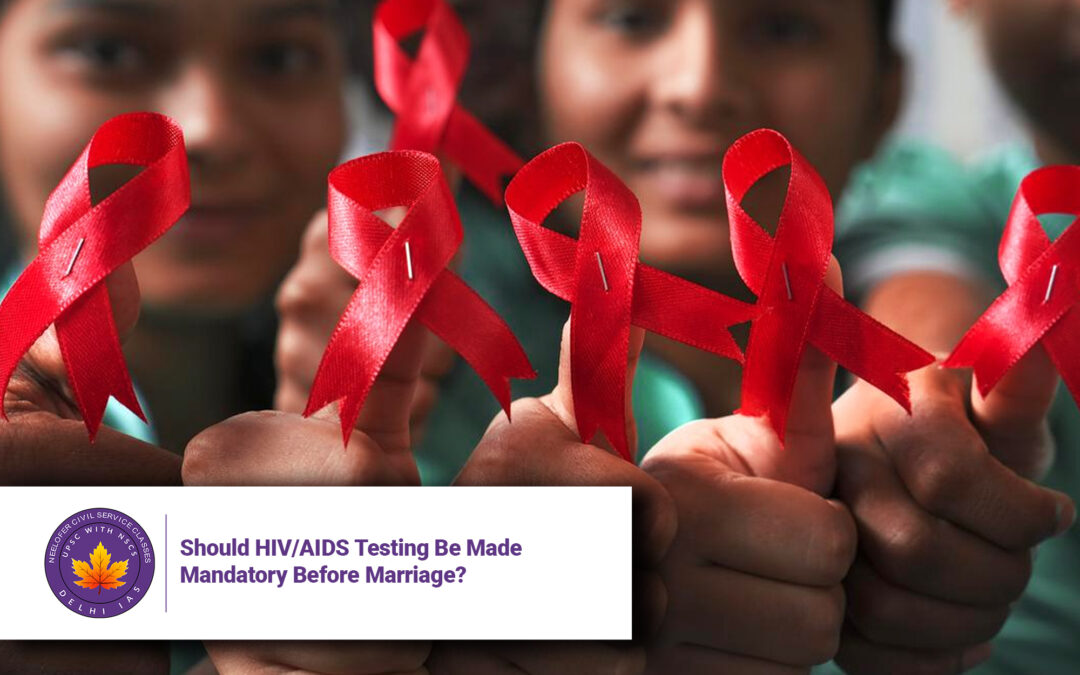
Should HIV/AIDS Testing Be Made Mandatory Before Marriage?
Why in News
In July, Meghalaya Health and Family Welfare Minister Mazel Ampareen Lyngdoh announced that the state may consider making HIV/AIDS tests mandatory for all before marriage. The proposal has sparked a national debate, as it involves not only medical and public health issues but also questions of human rights, stigma, social discrimination, and legality. This has reignited discussions on whether mandatory pre-marital HIV testing should be adopted in India and what consequences—positive or negative—it might bring.
Introduction
HIV/AIDS remains one of the most significant global health concerns, though treatment advancements have made the virus manageable and non-transmissible if treated effectively. India, with its large population and diverse cultural landscape, faces particular challenges in balancing public health measures with personal freedoms.
The discussion around mandatory HIV testing before marriage involves multiple dimensions:
-
Public health – preventing transmission of HIV within families and to future generations.
-
Human rights – ensuring no violation of an individual’s right to privacy, consent, and dignity.
-
Social stigma – avoiding further discrimination against people living with HIV (PLHIV).
-
Legal framework – respecting the HIV and AIDS (Prevention and Control) Act, 2017, which explicitly prohibits compulsory HIV testing.
While some argue that mandatory testing could prevent new infections and protect individuals from unknowingly marrying HIV-positive partners, others stress that such a step could fuel stigma, violate human rights, and discourage voluntary testing.
Key Issues and Background
1. Legal Restrictions
-
The HIV and AIDS (Prevention and Control) Act, 2017, clearly states that HIV testing can only be done with the informed consent of the person.
-
Mandatory testing, therefore, would conflict with existing law and could invite legal challenges.
-
Confidentiality is a cornerstone of HIV care; if violated, it could push people away from seeking medical support.
2. Scientific Understanding of HIV
-
With modern antiretroviral treatment (ART), a person with HIV can achieve undetectable viral load within months.
-
Scientific consensus: U = U (Undetectable = Untransmittable). A person with undetectable viral load cannot transmit HIV sexually.
-
This means that mandatory testing before marriage may not necessarily prevent HIV spread if the infected partner is on treatment.
3. Stigma and Social Discrimination
-
HIV in India has historically been associated with sex work, drug use, or “immorality,” which fuels stigma.
-
People living with HIV already face discrimination in workplaces, healthcare, and marriages. Mandatory testing could worsen this.
-
Many fear that instead of protecting individuals, compulsory tests could lead to social rejection, broken engagements, and lifelong discrimination.
4. Prevalence and Need for Awareness
-
According to UNAIDS, India has the third-largest HIV epidemic in the world.
-
States like Maharashtra, Andhra Pradesh, Karnataka, and Tamil Nadu report higher prevalence.
-
However, India has made significant progress in reducing new infections due to awareness and ART programmes.
-
Experts argue that rather than focusing on mandatory testing, emphasis should be placed on education, awareness, and voluntary counselling.
Specific Impacts or Effects
Positive Impacts (If Implemented)
-
Could help couples make informed marital decisions.
-
Might prevent HIV-positive individuals from unknowingly transmitting the virus.
-
Could improve awareness among communities where premarital health screening is uncommon.
Negative Impacts (Likely Outcomes)
-
Violation of Rights – Goes against the 2017 Act protecting consent and confidentiality.
-
Worsening Stigma – PLHIV could face rejection and isolation.
-
False Assurance – HIV tests are not foolproof; recent infections may not be detected (window period issue).
-
Gender Inequality – Women may face greater consequences, including blame, rejection, or abuse.
-
Decline in Voluntary Testing – People may avoid HIV counselling centres due to fear of being forced into testing.
Challenges and the Way Forward
-
Balancing Health with Rights – Any measure should respect privacy and autonomy. Mandatory testing is unlikely to be legally sustainable.
-
Improving Awareness – Public campaigns should highlight that HIV is manageable and non-transmissible with treatment.
-
Strengthening Voluntary Counselling – Pre-marital counselling services, where couples are encouraged (not forced) to get tested, could be more effective.
-
Reducing Stigma – Continuous efforts are needed to break the association between HIV and immorality. Just as diabetes or hypertension carry no stigma, HIV should be normalized as a medical condition.
-
Policy Alternatives – Instead of compulsion, governments can:
-
Provide free pre-marital health packages including HIV, hepatitis, and other tests.
-
Ensure counselling centres are available across rural and urban areas.
-
Promote community engagement to build trust and acceptance.
-
Conclusion
The debate on mandatory HIV/AIDS testing before marriage highlights a critical tension between public health safety and individual rights. While the idea seems protective on the surface, the legal, ethical, and social implications make it highly problematic. India’s HIV response must remain rooted in voluntarism, confidentiality, and education, not coercion.
The real solution lies not in compulsion, but in building a society where stigma is reduced, treatment is accessible, and people feel empowered to test voluntarily. As experts emphasize, HIV is no longer a death sentence—it is a chronic but manageable condition. The challenge is ensuring that our laws, policies, and attitudes reflect this reality.
5 Questions & Answers
Q1. Why is mandatory HIV testing before marriage controversial?
A1. Because it violates the HIV/AIDS (Prevention and Control) Act, 2017, which prohibits compulsory testing without consent. It also risks worsening stigma and discrimination.
Q2. Can HIV be fully prevented if someone tests negative before marriage?
A2. No. A negative test may not detect recent infections (window period), and HIV can still be acquired later in marriage through other means.
Q3. How can HIV transmission be prevented without mandatory testing?
A3. By encouraging voluntary testing, ensuring access to antiretroviral treatment, promoting awareness about “Undetectable = Untransmittable,” and reducing stigma.
Q4. Which states in India are considering or have considered mandatory testing?
A4. Meghalaya has recently discussed the proposal. Earlier, Goa and some southern states debated it but did not implement mandatory testing due to legal and ethical concerns.
Q5. What is the best way forward for India?
A5. Focus on voluntary pre-marital counselling, expand free testing services, fight stigma, and ensure people understand that HIV is manageable and not a moral failing.

