
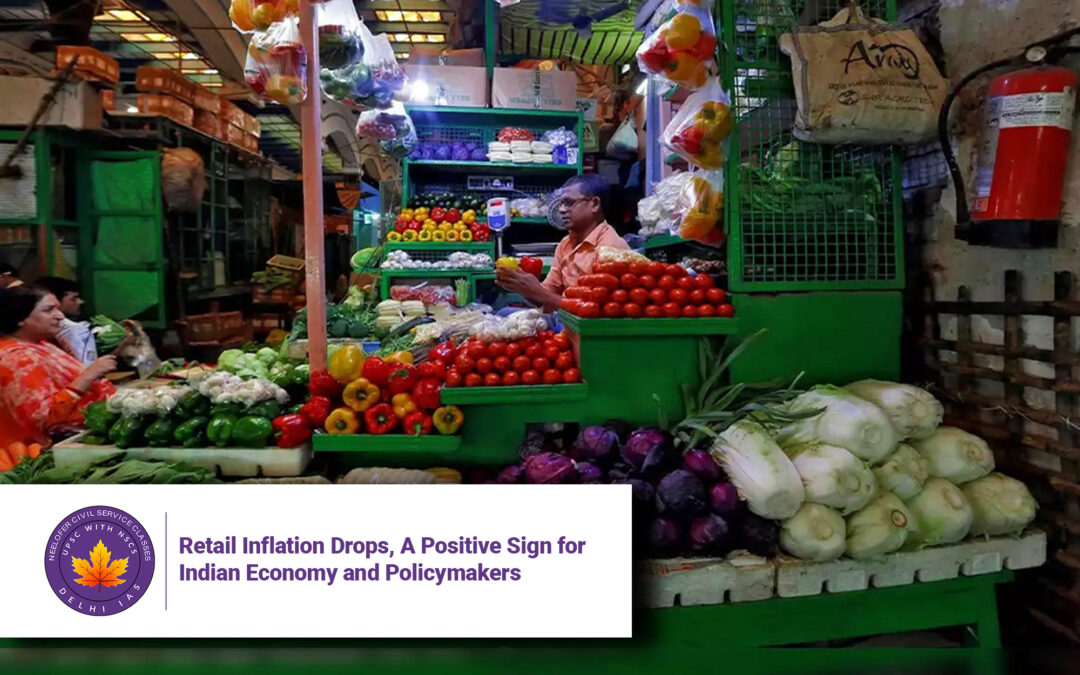
Retail Inflation Drops, A Positive Sign for Indian Economy and Policymakers
Why in News?
In April 2025, India recorded a 69-month low in retail inflation and a 13-month low in wholesale inflation, bringing much-needed relief to consumers and policymakers alike. This decline suggests a continued cooling of prices, offering hope after years of inflationary pressure. 
Introduction
The easing of retail and wholesale inflation in April is a welcome sign. For the general public, it brings relief in daily expenses. For policymakers, especially the Reserve Bank of India (RBI), it reinforces the confidence in their recent decisions to pause interest rate hikes.
Key Issues and Background
1. Decline Driven by Food Prices
-
The April inflation decline was largely due to a drop in vegetable prices (by 6.3%) and pulses (by 5.2%).
-
Vegetable inflation was in the 27%-30% range earlier (Feb-Apr 2023), showing a sharp contrast and indicating price stabilization.
2. Wholesale Inflation Also Falls
-
Wholesale price inflation (WPI) dropped by 1.28%, compared to nearly 12% in April 2023.
The Core of the Concern
1. Easing Due to Government Measures
-
Government measures to build buffer stocks, control essential food item prices, and improve market supplies appear to have worked.
-
These efforts, along with better rabi crop output and improved logistics, contributed to the price decline.
2. Liquidity Crunch as a Hidden Factor
-
A liquidity crunch in the market also played a role. With lower money in circulation, consumer spending decreased, reducing demand and helping lower inflation.
Key Observations
-
RBI’s cautious stance on interest rates seems justified given the current inflation trend.
-
While inflation has dropped, the path ahead depends on:
-
The monsoon season and its effect on food production.
-
Global commodity prices, including crude oil.
-
Ongoing tariff uncertainty and import duties.
-
Challenges and the Way Forward
Challenges
-
Volatility in food and energy prices can reverse the current decline.
-
Policy missteps—such as sharp rate hikes or inaction—could disrupt the inflation-control trend.
Steps Forward
-
RBI may continue with a pause in rate hikes, monitoring data from GDP growth, global prices, and commodity markets.
-
Policymakers must remain focused on supply-side interventions to keep food inflation in check.
-
A transparent and timely release of inflation data is crucial to maintain credibility and market confidence.
Conclusion
India’s record low inflation figures in April 2025 bring optimism, particularly for policymakers aiming for stable growth without economic overheating. However, this relief must be treated cautiously, as unpredictable factors like the monsoon, crude oil prices, and global supply chains may influence inflation trends in the coming months.
5 Questions and Answers
Q1. What caused the drop in retail inflation in April 2025?
A: The decline was mainly driven by lower prices of vegetables (down by 6.3%) and pulses (down by 5.2%), along with government efforts to stabilize essential commodities.
Q2. How did wholesale inflation perform in the same period?
A: Wholesale inflation dropped by 1.28% in April 2025, a sharp fall from nearly 12% in April 2023.
Q3. What external factors may influence future inflation?
A: Future inflation could be affected by the monsoon season, global crude oil prices, import duties, and overall global economic conditions.
Q4. How is RBI expected to respond to this inflation trend?
A: RBI is likely to pause interest rate hikes and take a wait-and-watch approach until more economic data (such as GDP growth) is released.
Q5. What is a key risk mentioned despite the falling inflation trend?
A: One key risk is the reliability of the inflation measurement, especially if prices in the fuel sector remain virtually unchanged due to policy decisions rather than actual market prices.

