
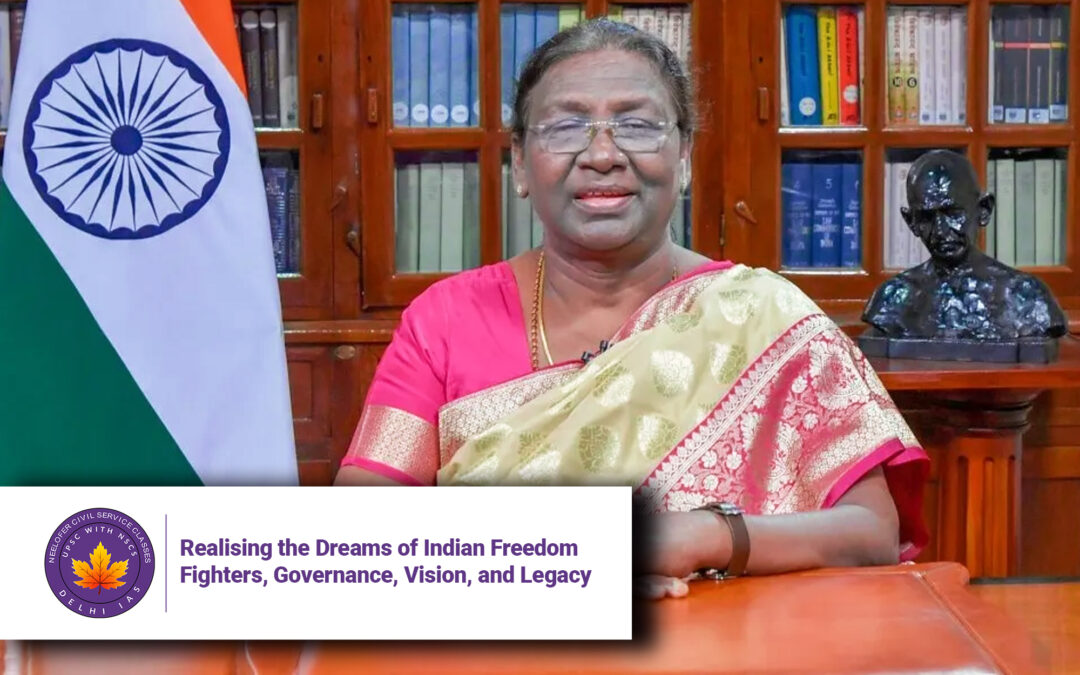
Realising the Dreams of Indian Freedom Fighters, Governance, Vision, and Legacy
Introduction
As India approaches yet another Independence Day celebration, the political narrative surrounding the country’s progress and identity is deeply tied to the vision of its freedom fighters. Prime Minister Narendra Modi, set to deliver his 12th consecutive Independence Day address from the Red Fort, stands as India’s second-longest-serving Prime Minister in consecutive terms, surpassing Indira Gandhi’s record.
Over the past 11 years, Modi’s government has sought to frame its policies and initiatives as aligned with the ideals of India’s independence movement — combining economic self-reliance, social inclusion, cultural pride, and strong national security. Whether through large-scale economic reforms, symbolic acts honouring historical leaders, or digital innovations, the Modi administration has repeatedly drawn parallels between its actions and the aspirations of figures like Subhas Chandra Bose, B.R. Ambedkar, Sardar Vallabhbhai Patel, and Mahatma Gandhi.
This article examines how the current government links its governance model to the dreams of freedom fighters, the historical background of these symbolic gestures, and the wider political implications.
I. Modi’s Independence Day Legacy and the “New India” Vision
When PM Modi addressed the 125th birth anniversary celebrations of Alluri Sitarama Raju in 2022, he declared:
“New India should be an India of the dreams of freedom fighters who gave up their lives for our freedom.”
This sentiment has been a recurring theme in his speeches — positioning today’s India as the direct inheritor of the freedom fighters’ vision. In Modi’s narrative, this includes a self-reliant economy, modern armed forces, and inclusive governance.
The Modi government’s communication strategy frequently draws explicit lines between policy measures and historical figures. For example:
-
Netaji Subhas Chandra Bose is evoked in discussions of military strength and bold operations like Operation Sindoor.
-
B.R. Ambedkar is linked to social justice policies and financial inclusion.
-
Sardar Patel is associated with national unity and legal reforms.
-
Mahatma Gandhi is referenced in anti-poverty initiatives and rural empowerment.
II. Governance Guided by the Principle of Antyodaya
A recurring governance philosophy cited by the Modi government is Antyodaya — the upliftment of the last person in the queue. This principle, rooted in Gandhian thought and later embraced by political leaders across party lines, focuses on inclusive development.
Under this framework, the government claims to have:
-
Lifted 25 crore people out of poverty.
-
Provided 94.3 crore Indians with a social security safety net.
-
Empowered 14.5 crore small farmers with financial support.
Such welfare measures are presented not as isolated policy choices but as a continuation of the freedom movement’s social justice agenda.
III. Historic Legislative and Symbolic Milestones
The Modi government’s political messaging often combines structural reforms with symbolic acts meant to reinforce a sense of cultural pride and continuity with the independence struggle.
Abolition of Article 370
The removal of Jammu & Kashmir’s special status in 2019 is framed as a step towards national integration, which Modi associates with Patel’s vision of a united India.
Bharatiya Nyaya Sanhita
Replacing colonial-era criminal laws with new codes is positioned as a symbolic “casting off” of colonial remnants — something leaders like Patel would have endorsed.
Sengol in Parliament
The installation of the Sengol in the new Parliament is linked to traditions of justice and righteous governance, with references to how leaders like C. Rajagopalachari would have appreciated its symbolic prominence.
IV. Revisiting the Legacy of Historical Leaders
The article from which this information is drawn highlights how different leaders have been honoured — sometimes after long delays.
Bose and Ambedkar in Parliament
While Netaji Bose and Ambedkar received the Bharat Ratna under Congress governments (1978 and 1990 respectively), their portraits were installed in Parliament’s Central Hall during non-Congress regimes. Modi’s narrative points to a historical pattern where non-Congress governments took symbolic steps to honour leaders beyond the Congress pantheon.
The Savarkar Controversy
The long-standing debate over Vinayak Damodar Savarkar’s role in the freedom struggle remains politically charged. The Modi government reinstalled the plaque commemorating his imprisonment in the Andaman Cellular Jail in 2016, after it had been removed in 2004 under the UPA. The Supreme Court has even warned against irresponsible remarks targeting freedom fighters like Savarkar.
V. Honouring Regional and Cultural Icons
PM Modi has expanded the roster of freedom-era icons beyond the usual national figures, integrating regional leaders and cultural personalities into the mainstream narrative.
Examples include:
-
Declaring Subramania Bharati’s birth anniversary as Indian Language Day.
-
Issuing a commemorative coin for Ahilyabai Holkar’s 300th birth anniversary.
-
Declaring Jan Jatiya Gaurav Diwas on 15 November, marking Birsa Munda’s birth anniversary, to recognise the role of tribal leaders in the freedom struggle.
This strategy not only broadens the historical narrative but also appeals to diverse voter bases by giving recognition to regional pride.
VI. Pilgrimage Circuits and Museums as Sites of National Memory
Beyond policy and symbolism, the Modi government has developed physical memorials and heritage circuits:
-
Bhim App & Ambedkar Pilgrimage Sites: Five key places from Ambedkar’s life, both in India and abroad, have been developed as centres of pilgrimage.
-
Statue of Unity (2018): The tallest statue in the world, dedicated to Patel.
-
Kranti Mandir (2021): Museum space inside the Red Fort dedicated to Netaji’s INA, the 1857 uprising, and Jallianwala Bagh.
These sites serve dual purposes — reinforcing national pride and attracting tourism.
VII. Political and Electoral Significance
The consistent invocation of freedom fighters’ dreams serves a clear electoral function:
-
Historical Legitimacy: By aligning with revered figures, the government taps into shared national pride.
-
Cross-Caste Appeal: Figures like Ambedkar, Birsa Munda, and Alluri Sitarama Raju appeal to specific communities, helping BJP expand its social base.
-
Contrast with Opponents: By highlighting moments where Congress governments allegedly failed to honour certain leaders, the BJP positions itself as the truer custodian of national heritage.
VIII. Criticisms and Counterpoints
While Modi’s government has been praised for increasing public awareness of lesser-known freedom fighters, critics argue that:
-
Many symbolic gestures lack follow-through in policy areas affecting the communities these leaders represented.
-
The historical reinterpretation sometimes sidelines uncomfortable aspects of leaders’ ideologies that don’t align neatly with present-day political narratives.
-
The framing of events often seeks to portray the BJP as the sole inheritor of the freedom struggle’s legacy, marginalising contributions from other political traditions.
IX. Looking Ahead: Viksit Bharat 2047
PM Modi has articulated Viksit Bharat 2047 as a national goal — envisioning India as a fully developed nation by the centenary of independence. The narrative is that the dreams of the freedom fighters will be fully realised when India achieves:
-
A high-income economy.
-
World-class infrastructure.
-
Universal access to social services.
-
Cultural and civilisational pride on the global stage.
Whether this vision is realised will depend on policy continuity, political stability, and India’s ability to navigate both domestic challenges and global uncertainties.
Conclusion
Over the last decade, the Modi government has worked to link its governance agenda with the ideals of India’s freedom fighters, blending policy reforms, symbolic acts, and cultural recognition. From installing the Sengol in Parliament to creating national days for tribal leaders, the approach is both historically conscious and politically strategic.
The challenge moving forward will be ensuring that these symbolic tributes are matched with substantive improvements in social equity, economic opportunity, and democratic health — the very values the freedom fighters fought for.
5 Exam-Oriented Q&A
Q1. What principle of governance, inspired by Gandhian thought, does the Modi government claim to follow in its welfare policies?
A: Antyodaya — the upliftment of the last person in the queue.
Q2. Name three historical figures explicitly linked to Modi government policies in the article.
A: Subhas Chandra Bose (military strength), B.R. Ambedkar (social justice), Sardar Patel (national unity).
Q3. What is the significance of Jan Jatiya Gaurav Diwas and when is it celebrated?
A: It is celebrated on 15 November to honour Birsa Munda and the contribution of tribal communities to India’s freedom struggle.
Q4. Which colonial-era law’s abrogation is associated with Sardar Patel’s vision?
A: Article 370’s removal, linked to Patel’s vision of a united India.
Q5. What is Viksit Bharat 2047?
A: A vision for India to become a fully developed nation by the 100th anniversary of independence in 2047.

