
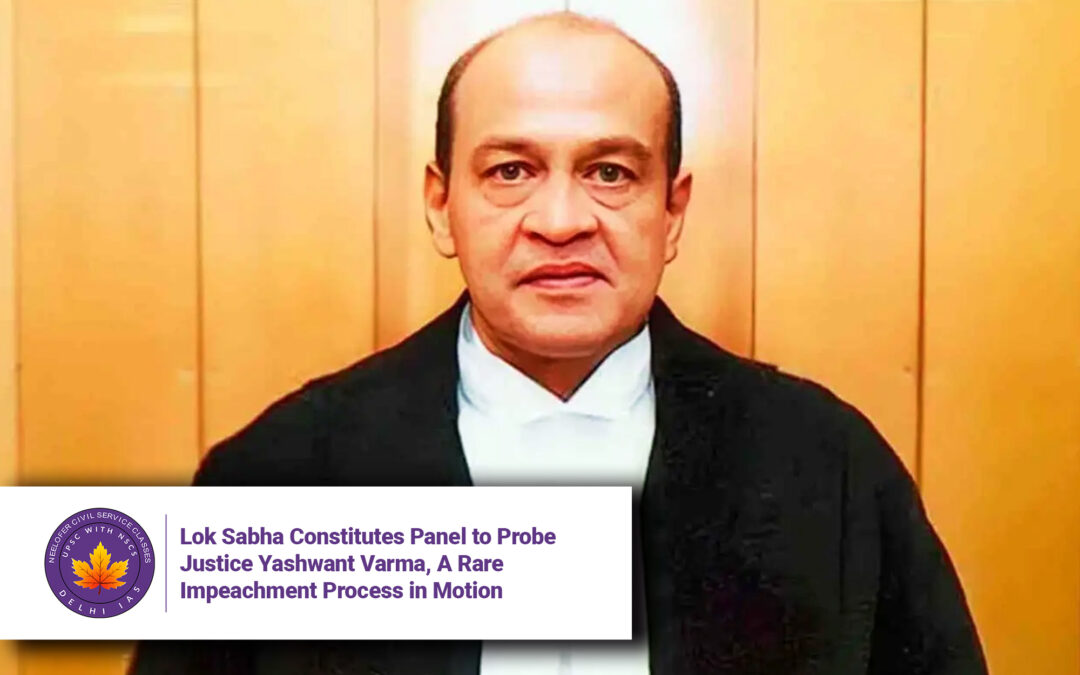
Lok Sabha Constitutes Panel to Probe Justice Yashwant Varma, A Rare Impeachment Process in Motion
In a move that could potentially become one of the rarest events in Indian judicial history, the Lok Sabha has formally constituted a committee to investigate allegations against Justice Yashwant Varma. This follows a court decision that removed procedural roadblocks and cleared the way for Parliament to act on an impeachment motion. The process, steeped in constitutional procedure and political significance, will determine whether Justice Varma joins the very small list of judges in India to face impeachment proceedings through to their conclusion.
Why This Matters: Judicial Accountability Meets Parliamentary Procedure
The impeachment of a sitting judge is not a routine matter in India. The judiciary enjoys a high degree of constitutional protection to ensure its independence from political influence. Judges of the High Courts and Supreme Court can only be removed through a rigorous process outlined in Article 124(4) and (5) of the Constitution, read with the Judges (Inquiry) Act, 1968.
In Justice Varma’s case, the Lok Sabha Speaker, Om Birla, accepted the impeachment motion, thereby triggering the next phase — the formation of an inquiry committee. The court’s decision played a pivotal role, rejecting Justice Varma’s procedural objections and effectively green-lighting parliamentary action.
The Court’s Observations
The court questioned Justice Varma’s conduct during the earlier stages of the inquiry. It noted:
-
Participation despite objections: Justice Varma had chosen to participate in the inquiry proceedings even though he claimed the process was unconstitutional.
-
Timing of objections: He raised his constitutional concerns only after the panel had already submitted its findings.
These observations undermined the credibility of Varma’s procedural challenge, strengthening the parliamentary motion’s legitimacy.
How the Impeachment Procedure Works in India
Under India’s constitutional framework, the impeachment process follows these key steps:
-
Notice of Motion: At least 100 Lok Sabha members or 50 Rajya Sabha members must sign a motion for removal, citing proven misbehaviour or incapacity.
-
Speaker’s Role: The presiding officer of the House — in this case, the Lok Sabha Speaker — decides whether to admit the motion.
-
Constitution of an Inquiry Committee: Upon admission, a three-member committee is formed, usually comprising:
-
A Supreme Court judge.
-
A Chief Justice of a High Court.
-
An eminent jurist.
-
-
Investigation: The committee investigates the allegations. If the findings support the charges, the motion proceeds.
-
Parliamentary Vote: Both Houses must pass the motion with a two-thirds majority of members present and voting.
-
Presidential Order: Upon approval by both Houses, the President issues an order removing the judge.
For Justice Varma, the Speaker has already moved to step three — constituting the committee.
Historical Context: Impeachments in Indian Judicial History
India has seen only a handful of impeachment proceedings against judges:
-
Justice V. Ramaswami (1993): The first case where impeachment was attempted. The motion failed in the Lok Sabha due to abstentions by the ruling party.
-
Justice Soumitra Sen (2011): The Rajya Sabha passed the motion, but the judge resigned before the Lok Sabha could act.
-
Justice P.D. Dinakaran (2011): Resigned before the conclusion of proceedings.
-
Justice J.B. Pardiwala (2015): Faced impeachment motion over controversial remarks but proceedings were dropped after an apology.
This shows that impeachment is rare and often inconclusive, either due to political complexities or the judge’s resignation.
The Allegations and the Stakes
While the article doesn’t detail the precise charges against Justice Varma, the stakes are enormous:
-
Judicial Credibility: Proven misbehaviour could damage public trust in the judiciary.
-
Parliamentary Responsibility: MPs must balance their constitutional duty to hold judges accountable against the need to protect judicial independence.
-
Precedent: A completed impeachment could influence future judicial conduct and parliamentary oversight.
If the committee upholds the allegations, both Houses will vote on the motion. This requires not only a majority of the total membership but also a two-thirds majority of those present and voting — a high bar designed to protect judges from frivolous or politically motivated actions.
Political and Legal Implications
The impeachment process is as much a political exercise as it is a legal one. For the motion to succeed:
-
Cross-party consensus is crucial. Without broad agreement across the political spectrum, achieving the two-thirds majority in both Houses will be difficult.
-
Judicial independence will be a flashpoint. Supporters of Varma may argue that the process is politically motivated, while critics will point to the need for accountability.
-
Public perception matters. The way this process unfolds will affect how the public views both Parliament and the judiciary.
Speaker Om Birla’s Role
Om Birla’s acceptance of the motion is a significant step, as many impeachment motions never proceed beyond the presiding officer’s desk. His decision signals that the allegations warranted serious consideration. By constituting the committee promptly, he has ensured the process moves forward without unnecessary delay.
What Happens Next
With the panel now formally in place, the coming weeks will be critical:
-
Committee Hearings: Witnesses may be called, documents examined, and evidence recorded.
-
Varma’s Defence: Justice Varma will have the opportunity to present his defence before the committee.
-
Report Submission: The panel will submit its findings to the Speaker.
-
Parliamentary Debate: If the report finds Varma guilty of the charges, the motion will be debated and voted upon in both Houses.
-
Final Decision: If passed in both Houses, the President will be advised to issue a removal order.
Possible Outcomes
-
Exoneration: The committee may find the charges unproven, ending the matter.
-
Resignation: Justice Varma may resign before proceedings conclude, as seen in previous cases.
-
Removal: A rare but possible outcome if both Houses pass the motion.
Public and Expert Reactions
While reactions remain mixed, constitutional experts stress the importance of following due process without political interference. Civil society groups are calling for transparency, urging that the committee’s proceedings and findings be made public to maintain trust in the system.
The Bigger Picture
This case is more than just about one judge — it is a test of India’s democratic and constitutional systems:
-
Can Parliament act decisively against alleged judicial misconduct without undermining judicial independence?
-
Will the high thresholds for removal act as safeguards or obstacles to justice?
-
Can the process be insulated from political gamesmanship?
The answers to these questions will shape not just Justice Varma’s fate but also the future balance between accountability and independence in India’s judiciary.
5 Key Q&A for Revision
Q1. What triggered the formation of the panel to investigate Justice Varma?
A court decision rejected Justice Varma’s procedural objections and cleared the way for the Lok Sabha Speaker to accept the impeachment motion, leading to the constitution of an inquiry committee.
Q2. What constitutional procedure is followed for removing a judge in India?
Under Article 124(4) and the Judges (Inquiry) Act, 1968, a motion must be signed by the requisite number of MPs, admitted by the Speaker/Chairman, investigated by a three-member committee, and passed by a two-thirds majority in both Houses before the President can order removal.
Q3. Why is impeachment of judges rare in India?
The high thresholds for removal, the need for cross-party consensus, and political reluctance to be seen as attacking judicial independence make it difficult. Most past proceedings ended in resignation before conclusion.
Q4. What are the potential outcomes of the current impeachment proceedings?
Justice Varma could be exonerated, resign before conclusion, or be removed if both Houses pass the motion by the required majority.
Q5. Why is the case of Justice Varma significant?
If completed, it could be one of the very few impeachments of a judge in India’s history, setting a precedent for judicial accountability and potentially reshaping the balance between Parliament and the judiciary.

