
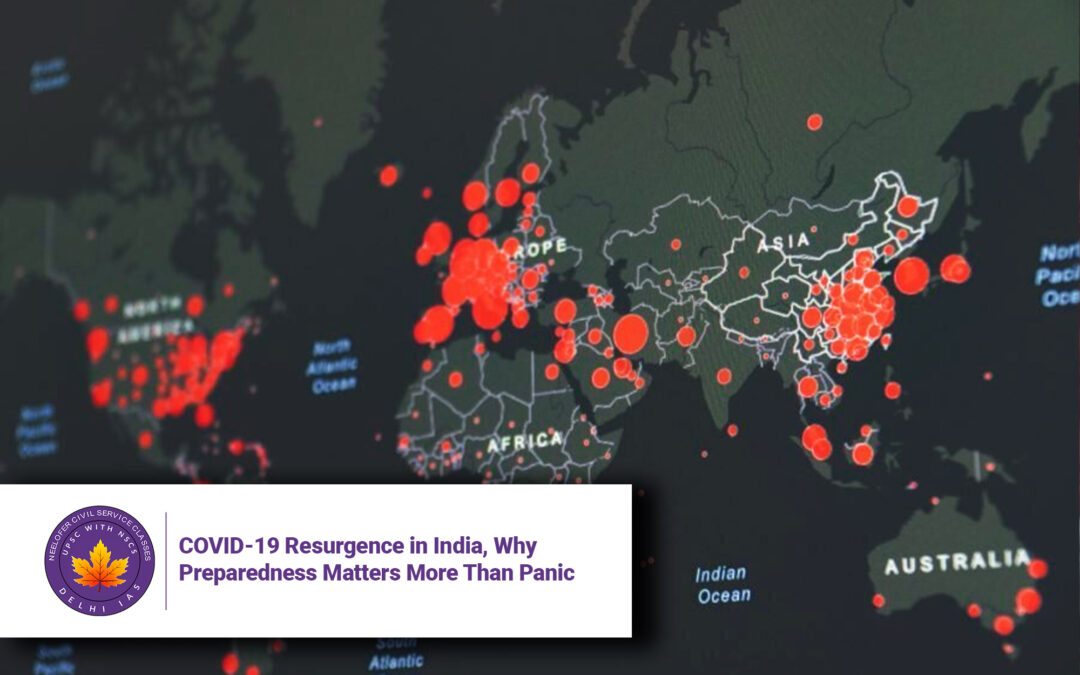
COVID-19 Resurgence in India, Why Preparedness Matters More Than Panic
Why in News?
India has recorded 3,961 COVID-19 cases and 32 deaths since January 2025, with recent weeks showing a minor uptick. While the numbers remain small (0.0002% of the population), experts emphasize targeted preparedness over alarm, citing lessons from past pandemic mismanagement. 
Key Insights
-
Current Situation:
-
Cases: Mostly Omicron subvariants (low severity, high recovery rate—2,188 discharged recently).
-
Hotspots: No state reports exponential growth; daily spikes remain in single/double digits.
-
-
Who’s at Risk?
-
Vulnerable groups: Elderly (60+), diabetics, hypertensive, and those with heart/kidney conditions.
-
Expert Advice: Masking in crowds, hand hygiene, and booster shots for high-risk groups (though vaccines are scarce in both urban/rural areas).
-
-
Systemic Gaps:
-
Vaccine Access: Despite WHO Pandemic Agreement, boosters remain unavailable nationally.
-
Infrastructure: Oxygen/bed stockpiles and healthcare worker readiness need reinforcement.
-
Data Transparency: Past obfuscation of deaths/infections must not recur.
-
5 Critical Questions Answered
Q1: Is this a new COVID wave?
A: No—it’s a seasonal uptick of mild Omicron subvariants, not a novel threat.
Q2: Should healthy adults worry?
A: Unlikely. Hybrid immunity (vaccines + prior infection) protects against severe illness.
Q3: What’s the biggest concern?
A: Systemic unpreparedness—vaccine shortages, oxygen/bed gaps, and data opacity.
Q4: How does this compare to 2020–21?
A: Cases are 1/1000th of peak levels; deaths are negligible (vs. 4,000+ daily in 2021).
Q5: What’s the way forward?
A: Precision preparedness: Boosters for vulnerable groups + real-time data sharing.
Conclusion
India’s COVID-19 challenge has shifted from emergency response to sustainable management. As Dr. Soumya Swaminathan notes, “Panic is debilitating; preparedness is enabling.” The government must prioritize:
-
Vaccine equity (especially boosters for high-risk groups).
-
Health infrastructure audits (oxygen, ICU beds).
-
Transparent reporting to maintain public trust.
For citizens: Stay informed, not fearful—and protect the vulnerable.
— With inputs from public health experts and WHO guidelines

