
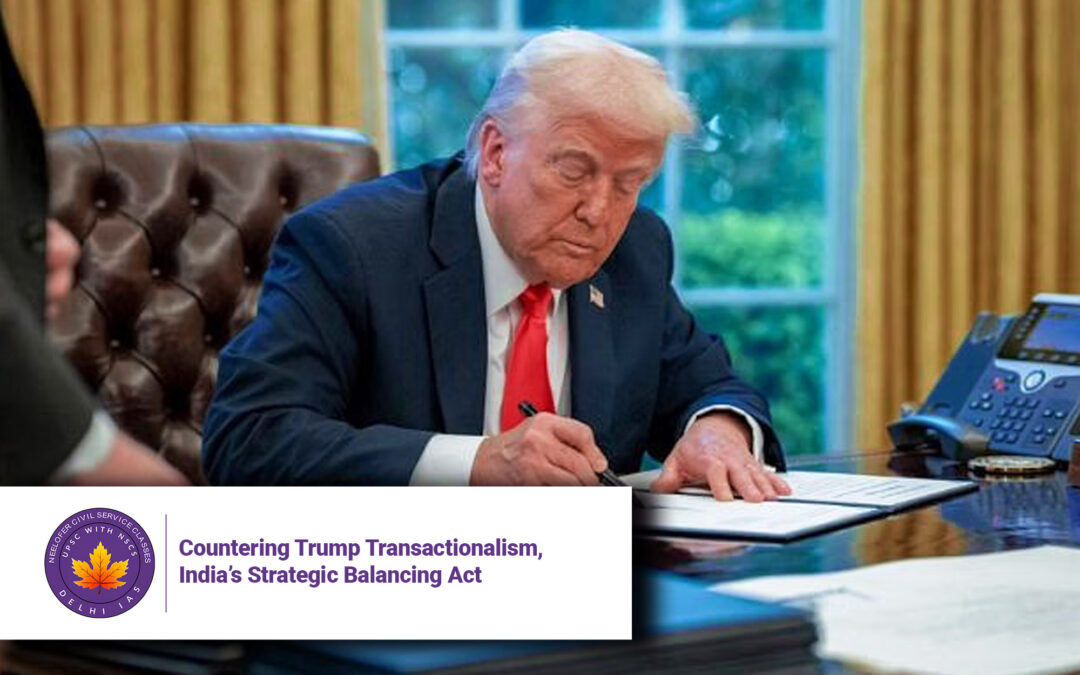
Countering Trump Transactionalism, India’s Strategic Balancing Act
Introduction
Over the past decade, India’s relationship with the United States has undergone several phases of warmth, tension, negotiation, and recalibration. While it is easy to portray the ups and downs in the bilateral relationship as a reflection of political personalities, the deeper reality lies in the shifting nature of American foreign and economic policy itself.
The presidency of Donald Trump, in particular, marked a distinct period of transactional diplomacy — a style rooted in direct bargaining, economic hardball, and a keen eye for personal gains in negotiation outcomes. Trump’s approach to India was no exception. He simultaneously praised India and Prime Minister Narendra Modi, while pressing hard on trade disputes, tariffs, and strategic concessions.
Understanding this dynamic is crucial for India, which must navigate not just the rhetoric but the structural forces shaping US policy. As Ram Madhav argues, America’s approach under Trump was less about ideology and more about extracting maximum advantage from bilateral engagements — a mindset deeply linked to a long-standing belief in American exceptionalism.
The Legacy of American Exceptionalism
The United States’ leadership role in the post-World War II world order was built on institutions like the International Monetary Fund (IMF) and the World Bank, both designed to stabilize and expand the global economy — but also to preserve US influence.
From its refusal to support a fully equitable international trade regime in the 1940s, to its selective engagement in multilateral forums, America shaped the rules of trade in ways that maintained its primacy. The failure of the Havana Charter, which would have created a more balanced International Trade Organization, was not accidental — US business leaders feared competition that could threaten their dominance.
Instead, the General Agreement on Tariffs and Trade (GATT) emerged, a weaker arrangement that tilted in favor of Western economies. Yet even under this less-than-ideal framework, countries like South Korea, Taiwan, Singapore, Japan, and Germany grew into formidable economic players.
By the 1990s, the World Trade Organization (WTO) replaced GATT. Developing economies, including India, pushed hard for fairer rules — resisting Western protectionism and advocating for a level playing field. But when nations like China and India began to grow rapidly, Western economies once again turned defensive.
India’s Emergence and the Western Pushback
India’s accession to the WTO in 2001 marked the start of its serious integration into the global trade system. Over the next two decades, India’s economy expanded significantly, and the country emerged as a major player in global markets.
This rise, however, triggered unease among Western powers. Accusations of WTO violations became a tool to pressure emerging economies, even as developed countries themselves flouted rules — blocking judicial appointments, ignoring tariff commitments, and delaying membership payments.
China bore the brunt of this pushback first. But once India began to close the gap with China in terms of economic momentum, it too became a target. Under Trump’s administration, the US Trade Representative Robert Lighthizer took a hard line against India, boasting in 2019 about removing India from the Generalized System of Preferences (GSP) — a move that ended tariff-free access for many Indian exports to the US.
Trump’s Transactional Style
Donald Trump’s worldview was never about maintaining the old globalist consensus. Instead, it was about direct, deal-oriented bargaining. For him, foreign relations were an extension of business negotiations — focused on maximizing perceived wins, reducing costs, and leveraging personal rapport.
This approach manifested in multiple ways with India:
-
Demanding greater access for US goods while reducing Indian exports’ advantages.
-
Pressuring India on its strategic autonomy, especially in relations with Russia and China.
-
Seeking visible diplomatic “victories” — such as mediation in conflicts — to bolster his domestic political narrative.
Trump’s ambitions went beyond economics. He openly aspired to win the Nobel Peace Prize, highlighting his claimed mediation successes in conflicts across the globe — from Israel-Iran ceasefires to peace deals in Southeast Asia and Africa. India, in Trump’s view, was an indispensable partner in furthering both his geopolitical and personal legacy goals.
India’s Strategic Autonomy and Resistance
Throughout Trump’s presidency, India maintained a clear position: it would not compromise on national interests. Whether in its refusal to alter its defense relationships with Russia, or its unwillingness to make sweeping concessions on trade, New Delhi signaled that partnership with the US could not come at the cost of sovereignty.
This insistence on autonomy occasionally irritated Washington. For example, Prime Minister Modi’s refusal to stop over in the US during a 2019 visit to the G7 — combined with New Delhi’s skepticism toward Trump’s offers to mediate in the Kashmir dispute — underscored India’s resistance to being drawn into political theatrics.
The Path Forward: Tact Over Aggression
Ram Madhav emphasizes that countering Trump’s transactionalism — or any similar approach from future US leaders — requires tact, not aggression. Europe has long mastered this balancing act: pushing back where necessary, while maintaining diplomatic calm.
For India, the key will be to recognize when American demands are part of a broader strategic pattern and when they are simply driven by personal political needs. Trump’s targeting of several countries was shaped by three key aims:
-
Resolving the Ukraine-Russia conflict in a way that positioned him as a peacemaker.
-
Winning the Nobel Peace Prize.
-
“Making America Great Again” by countering China’s rise.
India’s challenge — and opportunity — lies in leveraging these aims to its own benefit. If handled skillfully, such situations can turn transactional demands into mutually beneficial arrangements.
Conclusion
The India-US relationship will always oscillate between cooperation and contention, shaped by structural realities, domestic politics, and the personalities of leaders. Under Trump, these dynamics became more sharply defined due to his highly personalized, deal-driven approach.
India’s task is to engage with such leaders in a way that advances its long-term interests without alienating the US. That means understanding the blend of national strategy and personal ambition that drives US foreign policy — and using it to open doors rather than close them.
In the long run, the partnership between the world’s largest and most influential democracies is too valuable to be derailed by short-term disputes. Whether in the White House or South Block, the focus should remain on building a resilient, balanced relationship that can weather the storms of political change.
5 Key Q&A on the Trump-India Relationship
Q1: Why did Trump remove India from the Generalized System of Preferences (GSP)?
A: Trump’s administration argued that India was not providing the US with “equitable and reasonable access” to its markets. This was consistent with his broader trade policy of eliminating what he saw as unfair advantages for other countries. The removal of GSP benefits ended tariff-free access for over $5 billion worth of Indian exports annually, directly impacting sectors like textiles, leather goods, and engineering products.
Q2: How did Trump’s transactional approach differ from previous US administrations?
A: While previous administrations also pursued American economic and strategic interests, they tended to operate within a more multilateral and rules-based framework. Trump’s approach was more bilateral, personal, and immediate — often bypassing established diplomatic channels to secure quick, visible wins. His negotiations were often public, with a focus on optics and measurable concessions.
Q3: What role did India’s strategic autonomy play in the tensions with Trump’s US?
A: India’s insistence on maintaining independent positions in global affairs — such as continuing defense ties with Russia, refusing to alter its stance on China without due cause, and resisting US mediation in Kashmir — clashed with Trump’s desire for alignment on American terms. This autonomy was seen as both a source of friction and a marker of India’s growing global influence.
Q4: How did Trump’s personal ambitions influence his foreign policy towards India?
A: Trump’s interest in securing the Nobel Peace Prize and positioning himself as a global dealmaker shaped his engagement with India. He sought India’s cooperation in conflict mediation and strategic balancing, especially against China. These ambitions sometimes opened opportunities for India to negotiate favorable terms, but they also risked drawing New Delhi into politically charged initiatives.
Q5: What is the recommended strategy for India in dealing with future transactional US leaders?
A: The key is to avoid open confrontation while firmly protecting national interests. This means engaging in quiet, consistent diplomacy, understanding the domestic political drivers in the US, and identifying areas of mutual benefit. By offering cooperation in selective areas while drawing clear lines on sovereignty, India can maintain balance without sacrificing leverage.

