
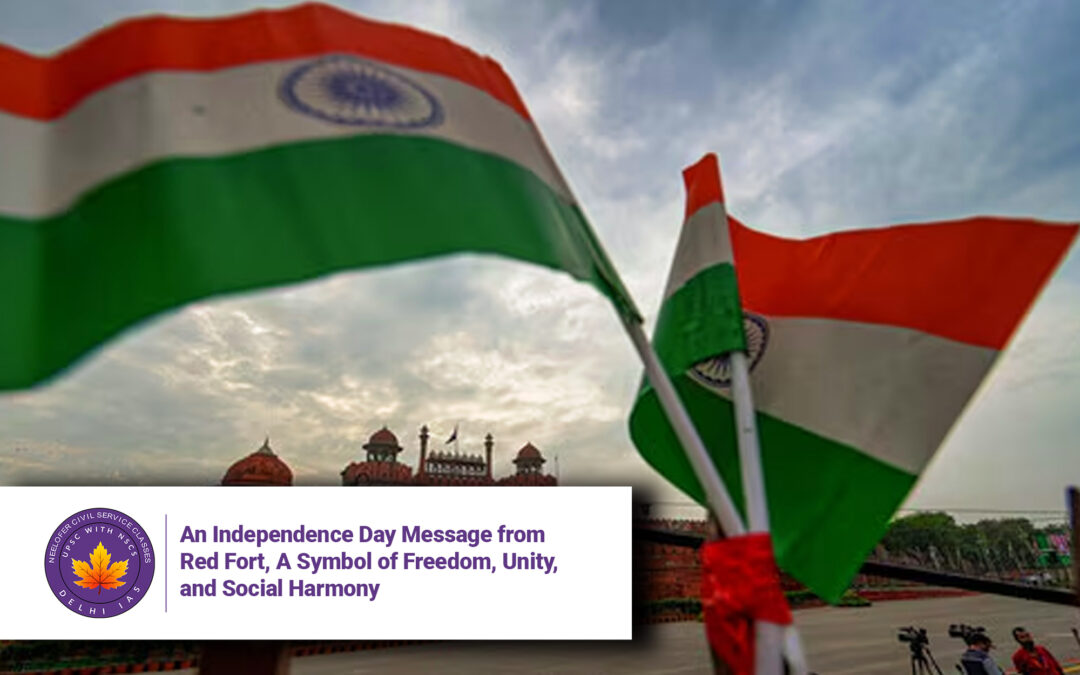
An Independence Day Message from Red Fort, A Symbol of Freedom, Unity, and Social Harmony
Why in News?
As India celebrates another Independence Day, the Red Fort once again becomes the central stage of national pride, history, and symbolism. The Prime Minister unfurls the national flag and addresses the nation from this historic site, carrying forward a tradition that began with Jawaharlal Nehru on August 15, 1947. This year’s reflections on Independence Day are deeply tied to the message the Red Fort has consistently given over centuries — a message about freedom, resilience, unity, and the ongoing struggle between social harmony and division.
Introduction
Independence Day is not only a national holiday but also a reminder of India’s long and difficult journey towards freedom, justice, and unity. From the Red Fort in Delhi, India’s Prime Minister addresses the nation every year, echoing a legacy that began the very day India gained independence from colonial rule.
But beyond being a ceremonial site, the Red Fort is a living monument. Its walls have witnessed not only celebrations of freedom but also episodes of pain, violence, resilience, and resistance. As history shows, the Red Fort has repeatedly been at the center of India’s political, social, and cultural shifts. Today, when social divisions and challenges to unity continue to surface, the Red Fort reminds the nation of its responsibility — to choose social cohesion over collapse, harmony over hate.
Historical Significance of Red Fort
The Red Fort, built by the Mughal Emperor Shah Jahan in 1639, was more than just a royal residence. It became a stage where India’s destiny was repeatedly shaped. On the walls of its Diwan-i-Khas, Shah Jahan inscribed a Persian phrase:
“Gar firdaus bar rū-e-zamīn ast, hamīn ast, hamīn ast, hamīn ast”
(If there be a paradise on Earth, it is here, it is here, it is here).
Originally, this phrase reflected the emperor’s vision of grandeur. But in the centuries that followed, the fort became less a paradise and more a battleground of ideologies, struggles, and the fate of the Indian people.
Red Fort as a Stage of Resistance
From Aurangzeb’s brutal displays of power — like parading his brother Dara Shukoh in chains through the streets before executing him — to the British Empire’s trials and executions of freedom fighters, Red Fort became a symbol of both oppression and resistance.
-
In 1857, during India’s first major war of independence against British rule, Bahadur Shah Zafar made the Red Fort the fulcrum of rebellion. Though short-lived, this event marked the beginning of a long chain of resistance against colonial domination.
-
Later, during India’s struggle for freedom, the Red Fort became synonymous with the courage of countless revolutionaries. Leaders like Shah Nawaz Khan, Gurbaksh Singh Dhillon, and Prem Kumar Sehgal — part of Subhas Chandra Bose’s Indian National Army — were tried by the British at the Red Fort. Their trials, far from suppressing resistance, ignited patriotic fervor across the nation. The slogan “Lal Qila se aayi awaaz, Dhillon, Sehgal, Shah Nawaz” became a rallying cry.
-
In 1948, after India’s independence, the Red Fort once again echoed with division during the Partition riots and the assassination of Mahatma Gandhi. Yet, despite its moments of tragedy, it emerged as a moral center reminding India of its responsibility to protect peace and unity.
Red Fort and the Birth of Independent India
On August 15, 1947, the Red Fort gained new life when Prime Minister Jawaharlal Nehru unfurled the Indian national flag from its ramparts. His speech marked the dawn of a new India — a sovereign, democratic nation committed to justice, liberty, equality, and fraternity.
Since then, every Independence Day has seen the Prime Minister unfurl the tricolor from the Red Fort, symbolizing continuity, freedom, and a reminder of the sacrifices that made independence possible.
Symbol of Social Cohesion
One of the deepest messages the Red Fort carries is the importance of social cohesion. The fort has seen India torn apart by communal divisions, sectarian violence, and political betrayals. Yet, it has also witnessed reconciliation, unity, and the strength of India’s pluralism.
The fort stands as a reminder that India’s freedom is not just political but also social and cultural. Independence can only be meaningful if it strengthens the bonds between communities rather than weakens them.
Red Fort in Modern Times: A Political and Moral Reminder
Today, as the Prime Minister addresses the nation from the Red Fort, the question arises: what lessons can we learn from this monument’s history?
The fort’s legacy warns against hatred, division, and intolerance. It reminds leaders and citizens alike that progress cannot be achieved if hatred rules the minds of the people. The socially vulnerable, the economically weak, and the politically marginalized must not be forgotten.
As India moves toward its centenary of independence in 2047, the Red Fort will continue to be a witness. Will it echo with unity, progress, and peace? Or will it become a silent observer of divisions and conflicts?
Key Issues and Institutional Concerns
-
Communal Harmony vs. Communal Division
-
Red Fort has been a stage where both unity and division were played out. The challenge for modern India is to ensure that communal divisions do not weaken the democratic fabric.
-
-
Violence and Peace
-
From Aurangzeb’s executions to terrorist attacks and sectarian violence, Red Fort has repeatedly witnessed bloodshed. The challenge lies in transforming it into a permanent symbol of peace and moral strength.
-
-
Political Symbolism
-
Every Independence Day speech from the Red Fort carries not just a ceremonial value but also a strong political message. It reflects the government’s vision for India’s future.
-
-
Global Image of India
-
As India grows in global stature, the Red Fort remains a reminder to the world of India’s unique journey — from colonial subjugation to a rising power that values freedom, democracy, and unity.
-
Challenges and the Way Forward
-
Rising Social Divisions
-
Religious polarization, caste tensions, and regionalism continue to threaten India’s social fabric. The Red Fort reminds us that division weakens the nation.
-
-
Economic Inequality
-
Independence is incomplete without economic justice. The Prime Minister’s speeches must continue to highlight inclusive growth, ensuring that progress benefits all.
-
-
Youth and Nationalism
-
India’s youth, much like the revolutionaries of the past, hold the key to shaping the country’s future. Their energy must be directed towards building rather than breaking.
-
-
Message of 2047
-
As India approaches 100 years of independence, the challenge is to ensure that the Red Fort continues to symbolize unity, prosperity, and peace rather than discord.
-
Conclusion
The Red Fort is not merely a historical monument. It is a living symbol of India’s struggles, sacrifices, victories, and aspirations. Its walls echo the voices of emperors, revolutionaries, freedom fighters, and leaders who shaped India’s destiny. On every Independence Day, as the Prime Minister raises the national flag from its ramparts, the fort reminds India of its responsibilities — to protect freedom, uphold unity, and strengthen harmony.
As we move towards 2047, the Red Fort’s message is clear: India must choose social cohesion over collapse, peace over violence, and love over hate. Only then can true freedom be realized.
Q&A Section
Q1. Why is the Red Fort significant on Independence Day?
The Red Fort is significant because it was from here that Jawaharlal Nehru unfurled the national flag on August 15, 1947. Since then, it has been the site where the Prime Minister addresses the nation every Independence Day, symbolizing freedom, unity, and continuity.
Q2. What historical events at the Red Fort highlight its role in resistance?
The Red Fort played a crucial role during the 1857 revolt, when Bahadur Shah Zafar made it the center of rebellion against British rule. Later, during the INA trials in 1945–46, leaders like Shah Nawaz Khan, Sehgal, and Dhillon were tried here, sparking nationalist movements across India.
Q3. How does the Red Fort symbolize both division and unity?
The fort has witnessed communal divisions, violence, and bloodshed, especially during the Partition. However, it has also been a place where unity and national spirit were reignited, making it a symbol of resilience and social cohesion.
Q4. What message does the Red Fort give to modern India?
The Red Fort warns against hatred and division while reminding the nation of the importance of unity, social justice, and inclusive progress. It emphasizes that true independence lies not only in political freedom but also in social harmony.
Q5. How does the Red Fort connect India’s past, present, and future?
Historically, it witnessed Mughal power, colonial oppression, and the freedom struggle. In the present, it hosts annual Independence Day celebrations. For the future, it symbolizes India’s aspirations to remain united, peaceful, and prosperous as it moves towards its 100th year of independence in 2047.

