
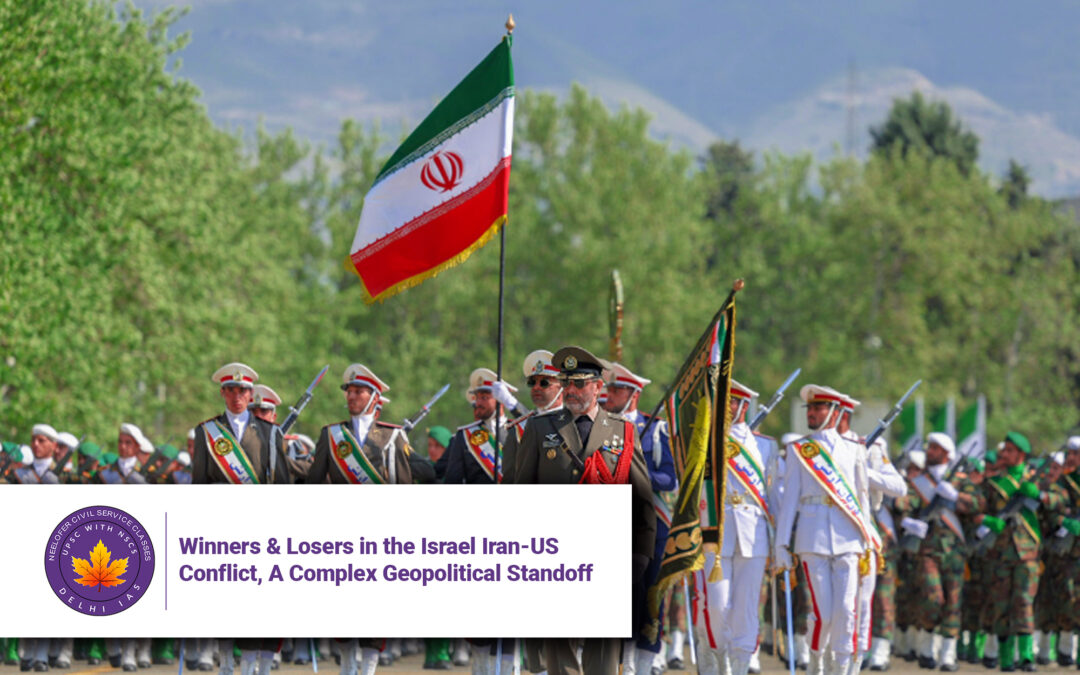
Winners & Losers in the Israel Iran-US Conflict, A Complex Geopolitical Standoff
Why in News?
The recent 12-day aerial conflict between Iran and Israel, followed by U.S. intervention, has left West Asia in a fragile state of calm. Tensions remain high due to provocative statements from leaders like U.S. President Donald Trump and Iran’s Supreme Leader Ayatollah Ali Khamenei, raising fears of renewed violence and nuclear escalation. 
Key Issues and Background
-
Escalating Rhetoric and Nuclear Threats
-
Trump warned of U.S. airstrikes if Iran continues its nuclear program, while Khamenei vowed “severe punishment” for any American attack.
-
Iran has accelerated its nuclear arms program, with reports suggesting it possesses 400kg of enriched uranium—enough for weapons-grade material within weeks.
-
-
Israel’s Role and Domestic Politics
-
Israel justified its strikes by labeling Iran a “permanent threat,” citing Tehran’s nuclear ambitions and alleged support for terrorism.
-
Analysts speculate that Prime Minister Benjamin Netanyahu orchestrated the conflict to divert attention from Gaza and boost his declining popularity ahead of elections.
-
-
U.S. Intervention: Motives and Consequences
-
The U.S. joined the conflict without clear strategic or moral justification, deploying stealth bombers like the B-2 and massive GBU-57 bombs.
-
Critics argue America’s actions mirror its discredited playbook from the Iraq War, where false claims of WMDs led to prolonged instability.
-
-
Regional and Global Fallout
-
Iran’s missile strikes on U.S. bases in Qatar and Iraq violated sovereign borders, prompting threats of retaliation from Gulf nations.
-
China and Russia quietly pushed for ceasefire talks, with Iran’s foreign minister meeting Vladimir Putin days before the pause in fighting.
-
Challenges and Unanswered Questions
-
Moral Ambiguity: The conflict lacked a clear moral basis, as the IAEA confirmed Iran had no nuclear weapons capability at the time of Israel’s strikes.
-
Proxy Warfare Risk: Further U.S. or Israeli attacks could drag Gulf states into a broader war, with Iranian missiles capable of targeting all U.S. bases in the region.
-
Nuclear Proliferation: Iran’s decision to quit the Non-Proliferation Treaty (NPT) signals a dangerous shift toward unchecked nuclear development.
Conclusion
The Israel-Iran-U.S. conflict underscores the volatile interplay of nationalism, misinformation, and geopolitical brinkmanship. With Iran defiant, Israel emboldened, and the U.S. entangled in another Middle Eastern crisis, the region faces prolonged instability. As global powers scramble to prevent escalation, the world watches whether diplomacy or destruction will define the next chapter.
5 Key Questions & Answers
-
What triggered the recent Israel-Iran conflict?
Israel preemptively struck Iran, citing an imminent nuclear threat, though the IAEA found no evidence of weaponization. -
Why did the U.S. intervene?
Motives remain unclear, but analysts suggest Trump aimed to assert dominance and back Netanyahu, despite lacking a legal or strategic rationale. -
How has Iran responded?
Tehran vowed to continue its nuclear program, quit the NPT, and launched missile strikes on U.S. bases in Iraq and Qatar. -
What role did Russia and China play?
Both nations privately brokered ceasefire talks, with Iran’s foreign minister meeting Putin days before the pause. -
Could the conflict reignite?
Yes—Khamenei and Trump’s threats, coupled with Iran’s uranium stockpiles and Israel’s elections, create a tinderbox for future clashes.
Shashi Shekhar
Editor-in-Chief, Hindustan

