
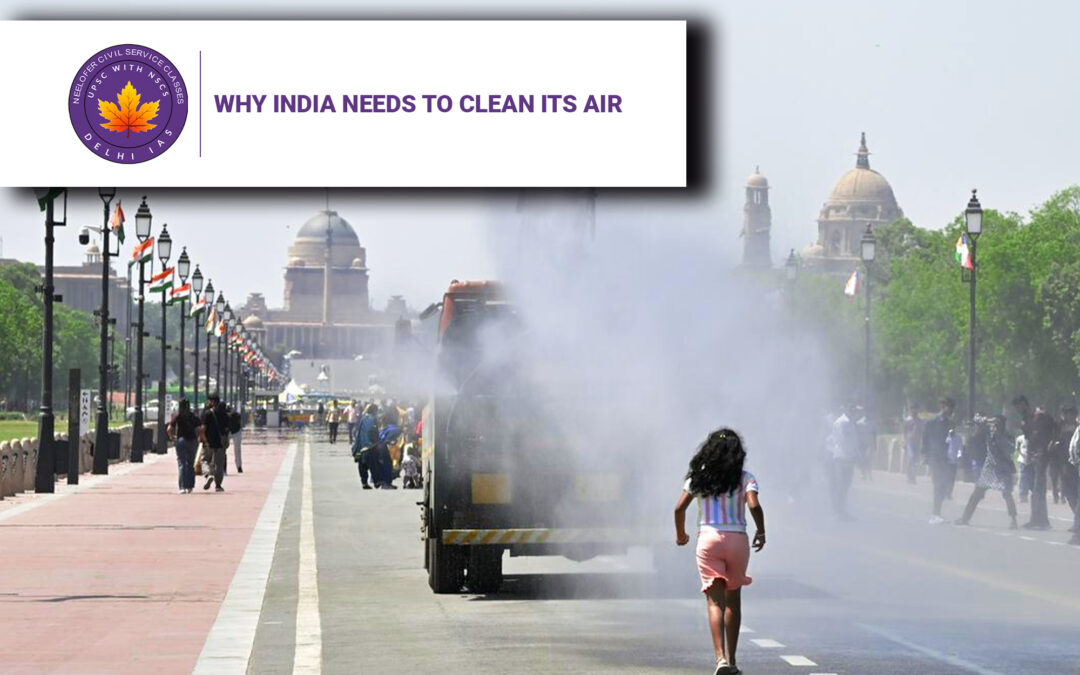
Why India Needs to Clean Its Air
Why in News?
Despite several national-level schemes, India continues to battle some of the worst air quality levels globally. The issue is back in focus following increased public scrutiny, rising health impacts, and the realization that progress remains fragmented and slow-moving. This highlights the urgent need for deeper, ground-level alignment in implementation.

Introduction
India’s air pollution crisis is not limited to winter smog or seasonal phenomena—it’s a chronic, systemic issue that impacts public health, environment, economy, and quality of life across the year. Respiratory cases surge, schools close, and productivity drops, all while India consistently ranks among the most polluted countries in the world.
Key Issues Highlighted
-
Fragmented Implementation of Air Policies
-
Major programs like NCAP (National Clean Air Programme), PMUY, and Bharat VI norms exist, but their impact remains limited without coordinated, local implementation.
-
Efforts such as phasing out coal in the NCR are important but lack speed and synchronization.
-
-
Ground-Level Disconnect
-
The root of the issue lies in how India views pollution—more as a technical concern than a behavioral, economic, and social problem.
-
On-ground municipal staff, engineers, planners, and officers work under tight budgets, outdated infrastructure, and misaligned mandates.
-
-
Transportation as a Key Contributor
-
India’s mobility sector needs clear actionable data—e.g., vehicle types, fuel usage, road design, and traffic volume—to address the issue properly.
-
Without local data, air quality targets risk falling short, such as reducing PM2.5 levels by 40% from 2017 levels by 2026.
-
-
Need for Shift in Metrics
-
Current metrics focus on emissions in isolation, often missing the full picture.
-
A shift to activity-based metrics and impact-centric data would better guide decision-making and drive stronger accountability.
-
-
Global Lessons and Missed Opportunities
-
While China implemented strict policies and made rapid progress, India’s response is more scattered.
-
Countries like London and Los Angeles have banned coal, adopted real-time tracking, and scaled clean fuel use.
-
Five Key Takeaways
-
Air pollution is a year-round systemic challenge in India, not just a winter issue.
-
While national programs exist, ground-level integration and coordination are missing.
-
Transport emissions, industrial activities, and urban development must be aligned with air quality goals.
-
India needs to shift from passive monitoring to proactive management using activity-based metrics.
-
Global best practices show that coherent policies, innovation, and local empowerment can produce significant results.
Challenges and the Way Forward
-
India must move beyond optics, like dashboards and smog towers, to deep structural reforms.
-
Policymakers should focus on scalable local models, supported by adequate funding and institutional capacity.
-
Solutions must reflect India’s federal and socio-economic diversity—one-size-fits-all won’t work.
-
A clean air future requires multi-stakeholder participation, including community leaders, planners, and researchers.
Conclusion
India’s clean air future cannot be painted with dashboards and slogans. It needs robust plumbing—policies, people, partnerships, and purpose. Air should not be a privilege but a right for all. As the world’s most populous democracy, India must lead by example with commitment, coordination, and courage.
Q&A Section
Q1. What is the major concern highlighted about India’s air quality approach?
India’s approach remains fragmented and slow, lacking coordination across national programs and local ground-level implementation.
Q2. What are some national schemes addressing air pollution in India?
Programs include the National Clean Air Programme (NCAP), Pradhan Mantri Ujjwala Yojana (PMUY), FAME India, and Bharat VI vehicle norms.
Q3. Why is transport a critical sector in the pollution debate?
Transportation contributes significantly to urban pollution, but lack of local data like vehicle types and traffic volume makes emission control ineffective.
Q4. What kind of shift is suggested in measuring air quality progress?
A shift from passive, emission-based metrics to activity-based, outcome-driven metrics is needed for more meaningful change.
Q5. How have other countries handled air pollution differently?
Countries like China and the UK have banned coal, promoted clean energy, and used real-time monitoring to manage pollution more effectively.
