
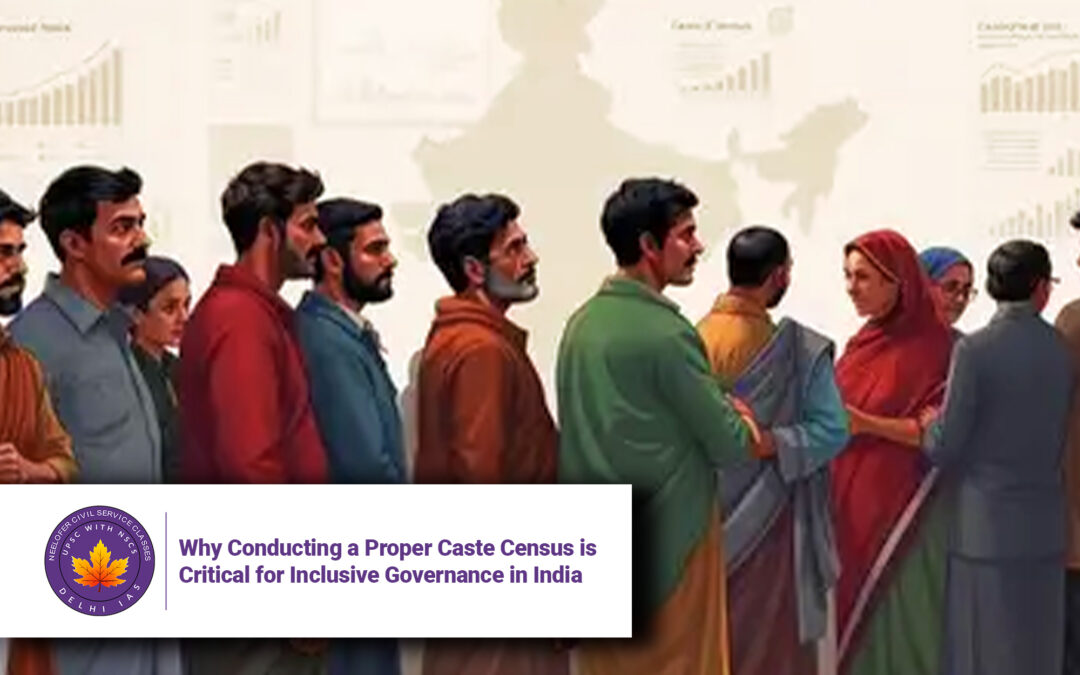
Why Conducting a Proper Caste Census is Critical for Inclusive Governance in India
Why in News?
With the Narendra Modi government’s decision to include caste enumeration in the next Census, the debate around the Caste Census has reignited. Experts highlight that while India has long avoided this data collection in the name of caste blindness, accurate caste data is essential for equitable policymaking, fair resource distribution, and meaningful social justice measures. 
Introduction
India has historically struggled with reconciling its desire to reduce caste-based divisions with the need for caste-based affirmative action. The lack of detailed caste data has hampered efforts to ensure justice in areas like education, employment, and welfare programs. The recent push for a legally empowered, administratively sound, and socially inclusive caste census offers a path to address long-standing inequalities.
Key Issues and Background
1. Post-Independence Policy Schizophrenia
After independence, India refused to collect caste-wise data while also using caste for affirmative action. This contradictory stance is called out as a form of policy schizophrenia. Without caste data, it is difficult to administer or evaluate reservations and benefits.
2. Legal and Administrative Imperative
India’s Constitution allows for the classification of Scheduled Castes (SCs) and Scheduled Tribes (STs), and reservations were later extended to Other Backward Classes (OBCs). But the current framework lacks reliable data on OBC sub-categories, leading to unequal benefits distribution.
3. Evidence of Inequality
The Justice Rohini Commission (2018) showed stark caste inequities:
-
Just 10 OBC castes received 25% of OBC benefits.
-
97% of the benefits went to a quarter of OBC castes.
-
38% of OBC castes got nothing at all.
Blueprint for a Successful Caste Census
-
Legal Backing:
Amend Census Act to allow caste enumeration, separating it from political pressures. -
Right Institution:
Hand over execution to the Office of the Registrar General & Census Commissioner for integrity and expertise. -
Standardised Questionnaire:
Use dropdowns and digital tools to ensure clear, accurate, and uniform caste categories. -
Separate SC/ST and OBC Enumeration:
Don’t lump all backward categories together. Recognize nuances within and between groups. -
Pilot Testing and Public Feedback:
Run pilot studies, engage community stakeholders, and refine formats before rollout. -
Enumerator Training:
Equip census workers with technology, clear instructions, and sensitivity training to avoid bias or error. -
Independent Audits and Monitoring:
Create oversight bodies to verify and ensure accuracy.
Conclusion
The absence of a caste census since 1931 has created serious blind spots in India’s data landscape. The recent SECC-2011 was plagued with flaws and never officially released. A well-planned caste census is not only constitutionally valid but necessary for justice, transparency, and targeted governance. The time to act is now—to correct past errors and empower future policymaking with accurate, inclusive data.
5 Questions and Answers
Q1. Why has India avoided conducting a caste census after 1931?
Answer: Due to a policy of caste blindness and fears of social division, India refrained from counting caste data after 1931, despite using caste for reservations.
Q2. What problems arise from not having updated caste data?
Answer: It leads to unequal distribution of benefits, policy inefficiency, and invisibility of many marginalized communities in official statistics.
Q3. What did the Justice Rohini Commission reveal about OBCs?
Answer: It showed that 97% of the benefits went to just a quarter of OBC castes, while 38% received nothing—indicating deep internal inequality.
Q4. How can a caste census be effectively conducted?
Answer: By ensuring legal sanction, digital data collection, expert-led design, public participation, training of enumerators, and independent audits.
Q5. Why is a caste census important for democracy?
Answer: It provides essential visibility to millions, ensures targeted policymaking, and strengthens India’s commitment to social justice and inclusive governance.

