
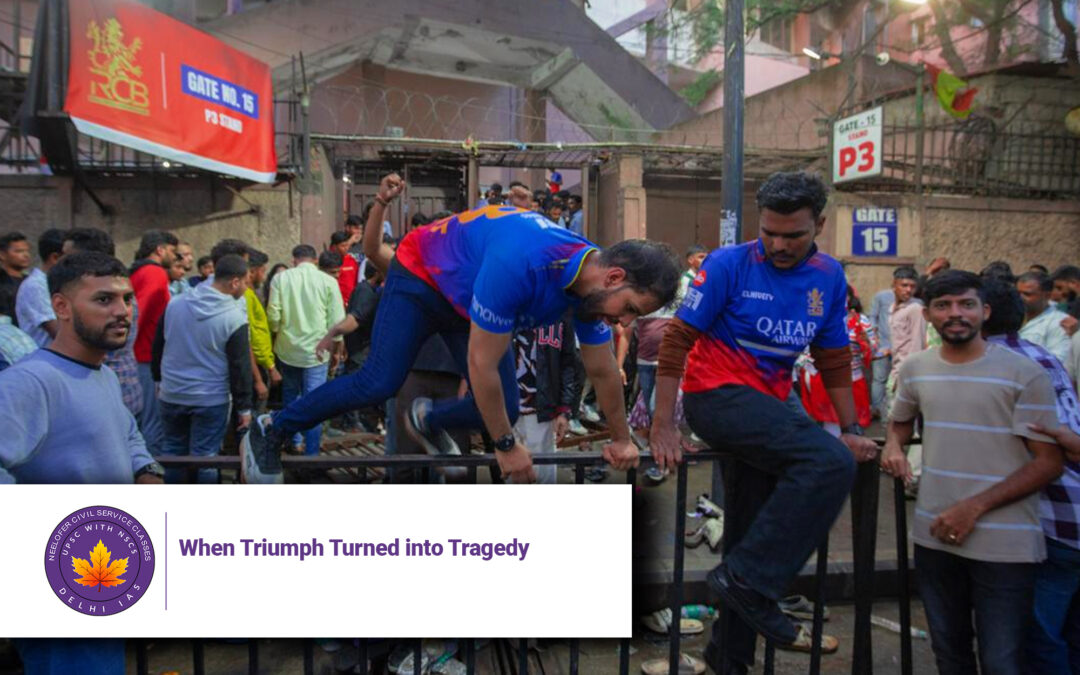
When Triumph Turned into Tragedy
Why in News?
On June 3, Royal Challengers Bengaluru (RCB) clinched its maiden Indian Premier League (IPL) title at the Narendra Modi Stadium in Ahmedabad.
However, what was expected to be a joyous celebration in Bengaluru the next day tragically turned into a chaotic and unsafe situation, exposing glaring failures in crowd management and administrative planning.
Introduction
When Virat Kohli announced that night celebrations would be held in Bengaluru, fans gathered with uncontrolled enthusiasm.
The mood turned euphoric with fireworks, chants, and an emotional display, marking RCB’s first-ever IPL win in 16 years.
Yet, this spontaneous joy soon spiraled into danger, driven by a lack of adequate planning and crowd control by the authorities.
Key Issues and Background
1. Poor Planning and Unheeded Warnings
-
A tremendous build-up led to a large crowd assembling in the city.
-
Top police officials, including Commissioner B. Dayananda, advised restraint and suggested that celebrations be delayed.
-
The government and higher officials ignored this advice and proceeded with hasty plans.
2. Mass Gathering at Stadium and Other Venues
-
Deputy CM D.K. Shivakumar personally went to the airport to receive the RCB team.
-
The team was invited to Vidhana Soudha and later a function was organised at Chinnaswamy Stadium.
-
More than 2 lakh people thronged the stadium — far exceeding the venue’s safe capacity.
-
Stampedes occurred at stadium gates, leading to severe crowding and exposing administrative failure.
3. Leadership and Responsibility
-
The Director General of Police (DGP) and other top officials failed to take decisive action despite early warnings.
-
Public safety was not prioritised over political optics and media spectacles.
Specific Impacts or Effects
1. Tragedy in the Making
-
Police clearly underestimated the scale of the crowd.
-
Medical facilities and emergency plans were inadequate.
-
The function nearly became a mass casualty event as fans were trapped and suffocated.
2. Institutional Breakdown
-
Multiple warnings from police hierarchy were ignored.
-
No clear division of responsibility between the police and political leadership was established.
-
The absence of rule of law at the event reflects a governance failure.
3. Political and Public Backlash
-
Widespread criticism followed on social media and in public forums.
-
The government and police commissioner are facing questions about their lack of accountability.
Challenges and the Way Forward
Challenges
-
Lack of clear event planning guidelines for mass public celebrations.
-
Political interference often undermines administrative autonomy.
-
Emergency preparedness for crowd situations remains weak.
Way Forward
-
Implement strict protocols for public events involving large crowds.
-
Empower police to make autonomous decisions in the interest of public safety.
-
Establish a disaster management framework that cannot be overridden for political gains.
-
Conduct a judicial inquiry into the June 3 incident to assign responsibility and issue corrective guidelines.
Conclusion
The tragic turn of RCB’s IPL celebration was not a result of fan exuberance but a failure of governance.
As public events grow larger and more spontaneous, institutional accountability and professional crowd management must become the norm.
Only then can celebrations remain safe and joyful, rather than descending into chaos and tragedy.
5 Questions & Answers
Q1: What event was being celebrated in Bengaluru on June 3?
A: RCB’s maiden IPL title win was being celebrated.
Q2: What went wrong during the celebrations?
A: Poor planning, ignored police warnings, and overcrowding at Chinnaswamy Stadium led to stampede-like situations and chaos.
Q3: Who advised against holding the public celebrations?
A: B. Dayananda, the Bengaluru Police Commissioner, advised caution and delay.
Q4: What was the scale of the crowd at the stadium?
A: Over 2 lakh people gathered at the stadium, far beyond its safe capacity.
Q5: What steps are needed to prevent such incidents in future?
A: Implement strict crowd management protocols, empower police autonomy, conduct judicial inquiries, and insulate public safety decisions from political interference.

