
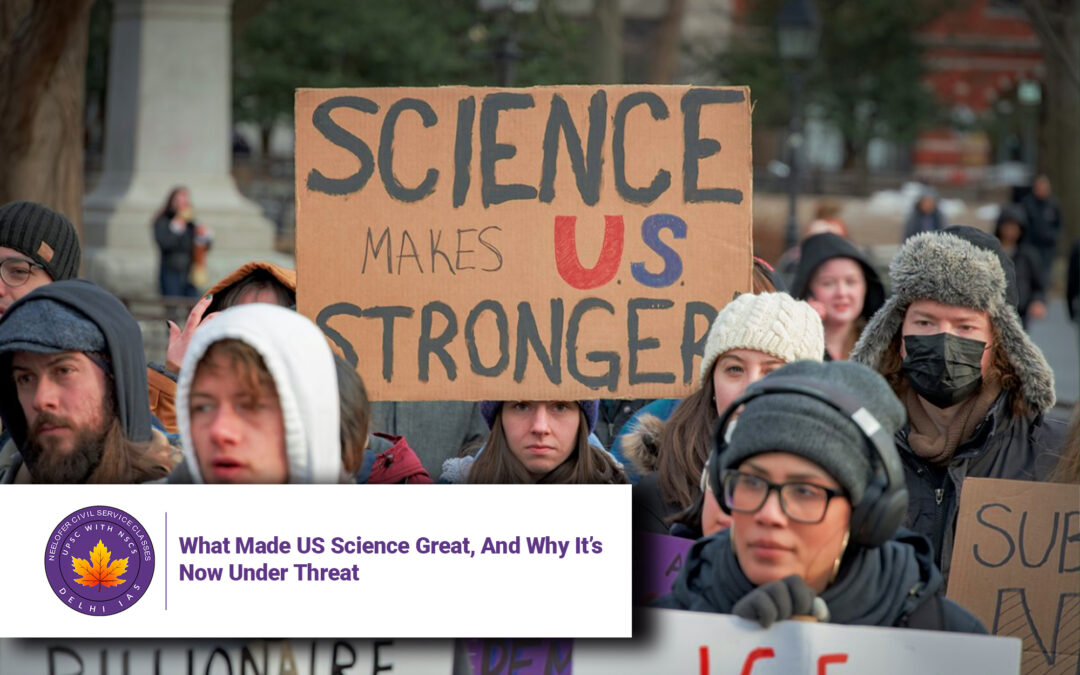
What Made US Science Great, And Why It’s Now Under Threat
Why in News?
The world is reflecting on the ecosystem that helped the United States become a scientific superpower — and how that same model is now under severe threat. An article by Hemant Kanakia and Sonalde Desai highlights the foundational structure of American science and its vulnerability due to rising political interference and anti-science narratives. 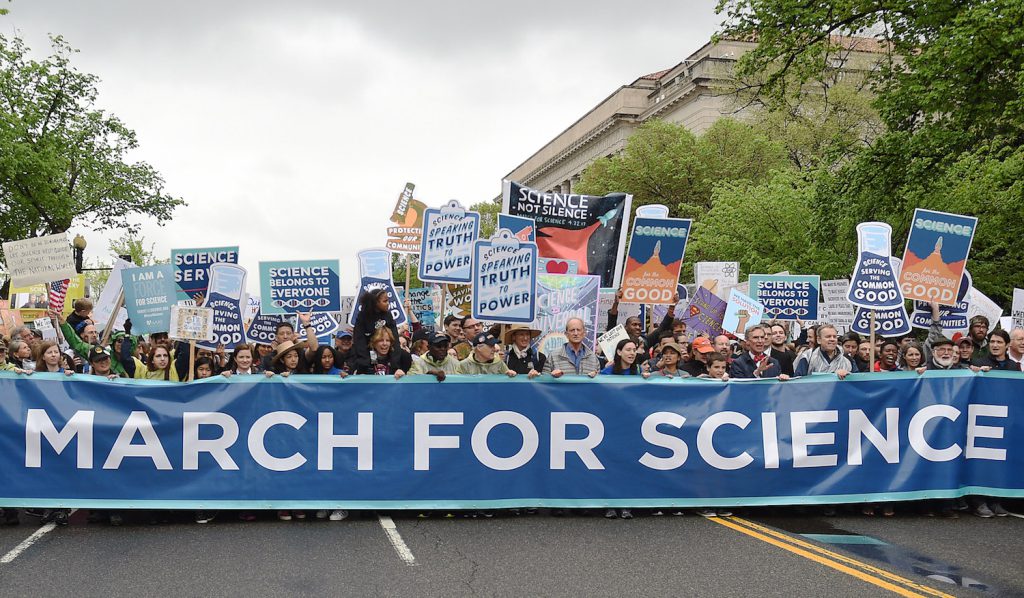
Introduction
From the internet to gene-editing tools like CRISPR, the United States has long been a cradle of global scientific innovation. But the key to its success has been a unique ecosystem — a triad of stable government funding, independent research environments, and open marketplaces of ideas — now facing major threats.
Key Issues
1. Assault on Universities and Anti-Science Sentiment
-
Universities, once the bedrock of U.S. innovation, are facing reduced support and growing political hostility.
-
Anti-intellectual rhetoric and funding cuts are weakening America’s capacity for research and innovation.
2. Disruption of the Innovation Ecosystem
-
The U.S. scientific model relied on stable government grants and a clear division between research institutions and politics.
-
Today, increasing oversight, political interference, and misinformation threaten this delicate balance.
3. Decline in Global Scientific Leadership
-
Nations like Germany and China are attracting global talent, while U.S. universities lose appeal due to rising intolerance and uncertainty.
-
Between 2011 and 2022, American scientists’ share of Nobel Prizes decreased, a sign of declining influence.
Alternative Approaches and Global Lessons
-
Countries looking to build strong scientific ecosystems can learn from the U.S. model: fund basic science, protect institutions from politics, and encourage open global collaboration.
-
Nations like India and China could use this moment to invest more heavily in research infrastructure and talent attraction.
Challenges and the Way Forward
-
America must restore its commitment to scientific independence, rebuild trust in universities, and separate politics from research funding.
-
Reversing anti-science rhetoric, promoting diversity in science, and recommitting to global cooperation are essential for reclaiming leadership.
Conclusion
The scientific success of the U.S. was no accident — it was the result of intentional design, consistent support, and trust in its institutions. As this model weakens, other countries have an opportunity to step up. The future of science depends not just on funding, but on freedom, openness, and political maturity.
5 Q&A Based on the Article
Q1. What key factors made US science globally successful?
A: A combination of stable government funding, independence of research institutions, and access to open global marketplaces of ideas.
Q2. What is currently threatening the US science ecosystem?
A: Political interference, funding cuts, anti-university rhetoric, and tighter controls on scientific discourse are weakening the foundation.
Q3. How has global scientific leadership shifted recently?
A: Countries like Germany and China are attracting top scientists, while the US has seen a decline in Nobel Prizes and scientific influence.
Q4. What role does political independence play in scientific innovation?
A: Political independence ensures researchers can explore ideas freely, take risks, and pursue innovation without censorship or bias.
Q5. What lessons can other countries learn from the US model?
A: Support basic research, fund institutions long-term, avoid political interference, and ensure science remains open, accountable, and globally collaborative.

