
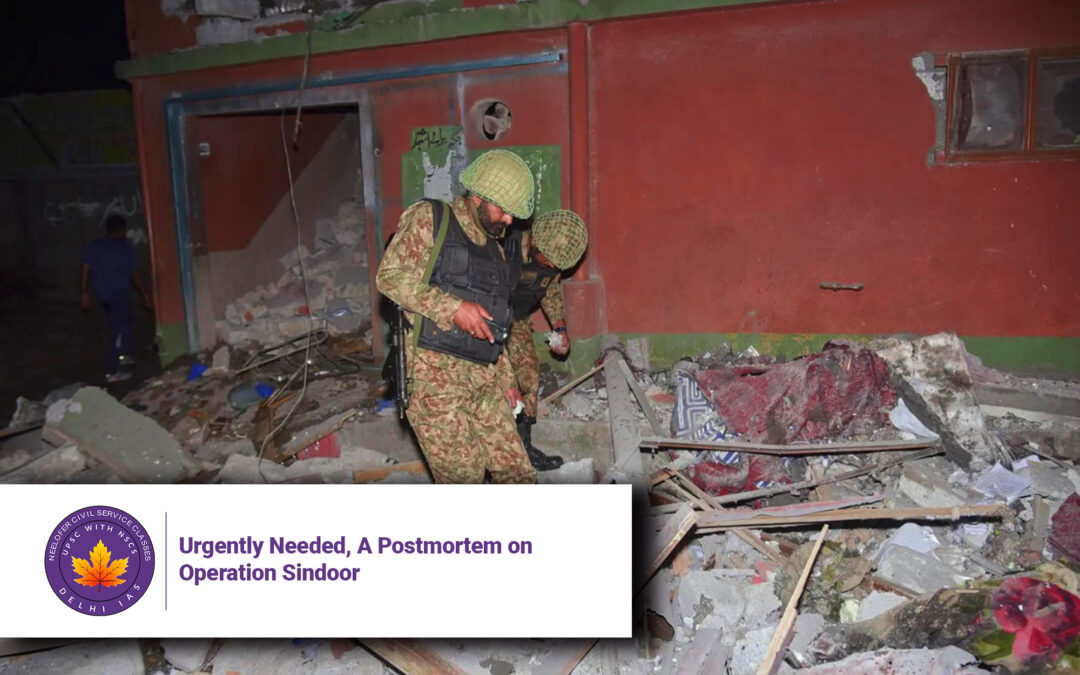
Urgently Needed, A Postmortem on Operation Sindoor
Why in News?
The Indian military’s successful execution of Operation Sindoor—a counter-terror operation in Pakistan—has ignited political, social, and strategic debates across borders. A key trigger was a viral photograph showing senior Pakistani military officers at the funeral of a slain jihadist, which raised serious questions about Pakistan’s alleged state support for terrorism. 
Introduction
Operation Sindoor wasn’t just a military strike; it was a symbolic message. The operation targeted terror camps and leaders of Lashkar-e-Taiba and Jaish-e-Mohammed in Muridke and Bahawalpur, respectively. More than the destruction caused, the real impact was in revealing the hypocrisy and duplicity of Pakistan’s claims of not harboring or supporting terrorism.
The Image That Spoke Volumes
The widely circulated photograph of Pakistani military officers at the funeral of a known jihadist sent shockwaves through both nations. It exposed the state’s double standards, where the military mourns terrorists while denying state involvement in terrorism. This image, as Tavleen Singh notes, served as a “defining image” of the operation and highlighted the need for a moral and political postmortem in Pakistan.
Pakistan’s Narrative Crumbles
Despite international scrutiny, Pakistan continued with its denial narrative, using English-speaking diplomats and celebrities to divert attention from the real issue. Even leaders like Bilawal Bhutto and Shehbaz Sharif could not convincingly distance themselves from the accusations. When asked about support for terrorism, they dodged questions rather than offering direct answers.
India’s Strategic Clarity
The purpose of Operation Sindoor, as inferred from official messaging, was to send a strong message that India will no longer tolerate terrorism as a “cross-border hobby” of Pakistan. This operation, in many ways, filled the void left by years of “no response” policies and delivered justice to the martyrs of Pulwama and countless other terror attacks.
Media Responsibility and Hypocrisy
Indian media, with some exceptions, played a role in twisting or hyping up the narrative rather than offering sober analysis. However, the operation was covered extensively and demonstrated that India has learned to fight both militarily and psychologically in the information war.
Conclusion
Operation Sindoor may be a tactical victory, but its greatest success lies in exposing the truth: Pakistan’s military continues to be complicit in cross-border terrorism. The narrative of “innocent Pakistan” has been effectively dismantled. What remains is for India to ensure that truth, not just bombs, continues to be its sharpest weapon.
5 Questions and Answers
Q1: What was the key event that triggered public reaction after Operation Sindoor?
A: A photograph showing Pakistani military officers at the funeral of a slain jihadist, exposing their ties to terrorism, went viral.
Q2: What terror outfits were targeted during Operation Sindoor?
A: The operation specifically targeted Lashkar-e-Taiba in Muridke and Jaish-e-Mohammed in Bahawalpur.
Q3: What was the main purpose of Operation Sindoor?
A: To send a strong signal that India will not tolerate jihadist terrorism and to expose Pakistan’s duplicity in supporting terror groups.
Q4: How did Pakistani leadership respond to allegations of state-sponsored terrorism?
A: Leaders like Bilawal Bhutto and Shehbaz Sharif dodged direct questions, failing to convincingly deny the state’s involvement in terrorism.
Q5: How did Tavleen Singh describe the broader significance of the operation?
A: She highlighted the need for a “postmortem” of Pakistan’s narrative, showing that Operation Sindoor revealed deeper truths about state-backed terrorism.

