
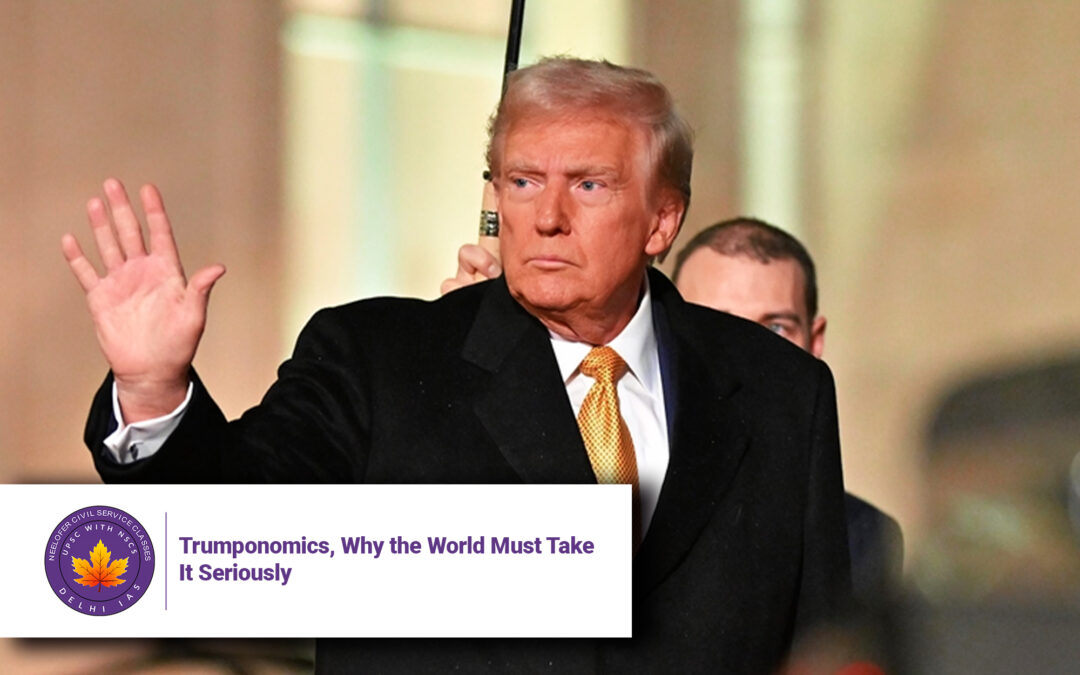
Trumponomics, Why the World Must Take It Seriously
Why in News?
Donald Trump’s economic policies, popularly dubbed “Trumponomics,” have re-entered discussions globally due to their significant implications on global trade, domestic manufacturing, and international economic dynamics. With Trump launching tariff-based trade reforms, this economic approach is reshaping U.S. economic priorities and forcing the world to adapt. 
Introduction
Trumponomics is more than a political slogan—it’s a strategic economic doctrine aimed at reviving American manufacturing, addressing trade deficits, and strengthening national security. Trump’s aggressive use of tariffs and trade restrictions marks a major departure from decades of globalization, warranting global attention.
Key Issues and Background
1. The Core Propositions of Trumponomics
-
Reshoring U.S. Manufacturing: Focuses on bringing back industries outsourced to China and other countries.
-
Correcting Trade Deficits: Emphasizes reducing America’s large trade imbalances.
-
Protecting National Security: Argues that domestic manufacturing is essential for defense and resilience in times of crisis.
The Core of the Concern
1. Why Manufacturing Must Return
-
The U.S. lost 5 million manufacturing jobs between 2000 and 2009.
-
Job losses were concentrated in specific areas, leading to social issues like drug abuse, crime, and homelessness.
-
Manufacturing is seen as crucial not just for jobs, but for national strength.
2. The Currency Debate and Trade
-
The U.S. dollar is overvalued due to high global demand and investment safety.
-
An overvalued dollar makes U.S. exports costlier and imports cheaper, worsening the trade deficit.
-
Tariffs are used as a corrective tool to rebalance this dynamic.
3. Tariffs as a Weapon
-
Trump uses tariffs to:
-
Encourage domestic production.
-
Penalize foreign competitors.
-
Create negotiating leverage in trade deals.
-
-
Tariffs, however, may also raise prices for American consumers, depending on global currency shifts.
Key Observations
1. The ‘Other Trump Cards’
Besides tariffs, Trump’s economic playbook includes:
-
Tax cuts to boost corporate profitability.
-
Deregulation to reduce business costs.
-
Subsidies to key industries.
-
Reduced government spending to curb national debt.
2. Global Economic Shift
-
Trump’s policies challenge the free trade orthodoxy.
-
Countries dependent on U.S. markets must now adjust.
-
America’s economy, with reformed trade and industry, will push foreign competitors to rethink their models.
Conclusion
Trumponomics reflects a strategic shift in U.S. economic thinking—focusing on national self-reliance, trade leverage, and industrial revival. Though controversial, it is compelling enough to demand attention, not only for its immediate impact but for its potential to redefine global economic order.
Q&A Section
Q1. What is the main goal of Trumponomics?
Ans: To reshape the U.S. economy by bringing back manufacturing, correcting trade deficits, and enhancing national security through economic self-reliance.
Q2. Why are tariffs central to Trump’s strategy?
Ans: Tariffs help reduce imports, encourage domestic manufacturing, and create leverage in trade negotiations.
Q3. What is the link between the overvalued dollar and trade deficits?
Ans: An overvalued dollar makes U.S. exports expensive and imports cheaper, leading to larger trade deficits.
Q4. What risks come with imposing tariffs?
Ans: Tariffs can increase costs for American consumers and may hurt international relationships if retaliatory tariffs follow.
Q5. What other tools does Trump use apart from tariffs?
Ans: Tax cuts, deregulation, subsidies, and reduced government spending form the other pillars of Trumponomics.
