
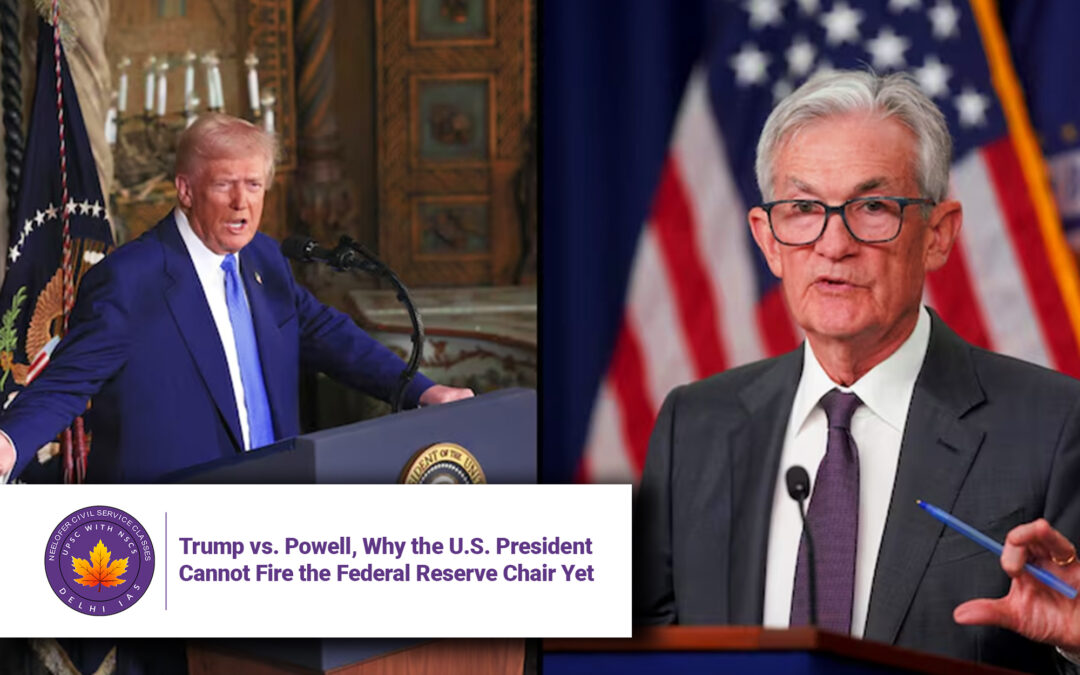
Trump vs. Powell, Why the U.S. President Cannot Fire the Federal Reserve Chair Yet
Why in News?
Former U.S. President Donald Trump recently lashed out at Federal Reserve Chairman Jerome Powell, criticizing the central bank’s interest rate policies. However, despite his frustrations, Trump cannot easily remove Powell from office due to a landmark 1935 Supreme Court ruling that limits presidential power over independent federal agencies. 
Introduction
The independence of the Federal Reserve (the U.S. central bank) is a cornerstone of economic stability in the United States. With growing tensions between politicians and the Fed, particularly during election years, this issue has resurfaced. Trump’s comments have reignited the debate over executive power vs. institutional autonomy in monetary policy.
Key Issues and Background
What is the Fed and Who is Jerome Powell?
The Federal Reserve sets key interest rates and regulates the U.S. monetary system. Jerome Powell, appointed by Trump himself, is the current chair. Though originally backed by Trump, Powell later fell out of favor due to his decisions on interest rates.
Trump’s Frustration
Trump’s public criticism stems from the belief that Powell’s monetary policy is too tight and could hinder economic growth ahead of elections. Trump previously sought to fire Powell, claiming he had the power to do so.
The Core of the Concern
Can a President Fire the Fed Chair?
No — and here’s why:
1935 Supreme Court Ruling
The case Humphrey’s Executor v. United States established that members of independent agencies (like the Fed) cannot be fired by the President without just cause, such as misconduct or neglect of duty. This limits presidential power and protects institutional independence.
Trump v. Wilcox
In a similar case, the Supreme Court reaffirmed that even if a President disagrees with economic policy, he cannot fire Fed officials at will.
Key Observations
Fed’s Independence Is Crucial
-
The Federal Reserve is designed to be immune to political pressure.
-
Allowing the President to fire Fed officials at will could undermine investor confidence and disrupt economic stability.
Congressional Role
-
Congress has expanded the scope and power of independent agencies.
-
The ruling is backed by decades of legal precedence and judicial reaffirmation.
Conclusion
Despite Trump’s criticism of Powell, legal protections ensure the independence of the Federal Reserve. The U.S. Supreme Court’s 1935 ruling stands as a safeguard against executive overreach, ensuring that economic decisions are made based on facts, not political motives. As elections near, this issue may resurface — but for now, Powell’s job remains secure.
Q&A Section
Q1. Why is Donald Trump unhappy with Jerome Powell?
Ans: Trump believes Powell’s monetary policies, particularly interest rate hikes, could slow economic growth and negatively impact his political goals.
Q2. Can a U.S. President fire the Federal Reserve Chair at will?
Ans: No. According to the 1935 Supreme Court ruling in Humphrey’s Executor v. United States, the President cannot fire independent agency heads without cause.
Q3. What is the significance of the 1935 ruling?
Ans: It established a legal precedent that protects the independence of federal agencies, preventing Presidents from firing officials for political disagreements.
Q4. What role does the Fed play in the U.S. economy?
Ans: The Federal Reserve controls interest rates, regulates banks, and ensures overall economic stability.
Q5. What could happen if the President gained power to fire the Fed Chair?
Ans: It could destabilize markets, reduce trust in U.S. institutions, and compromise the Fed’s ability to make independent economic decisions.
