
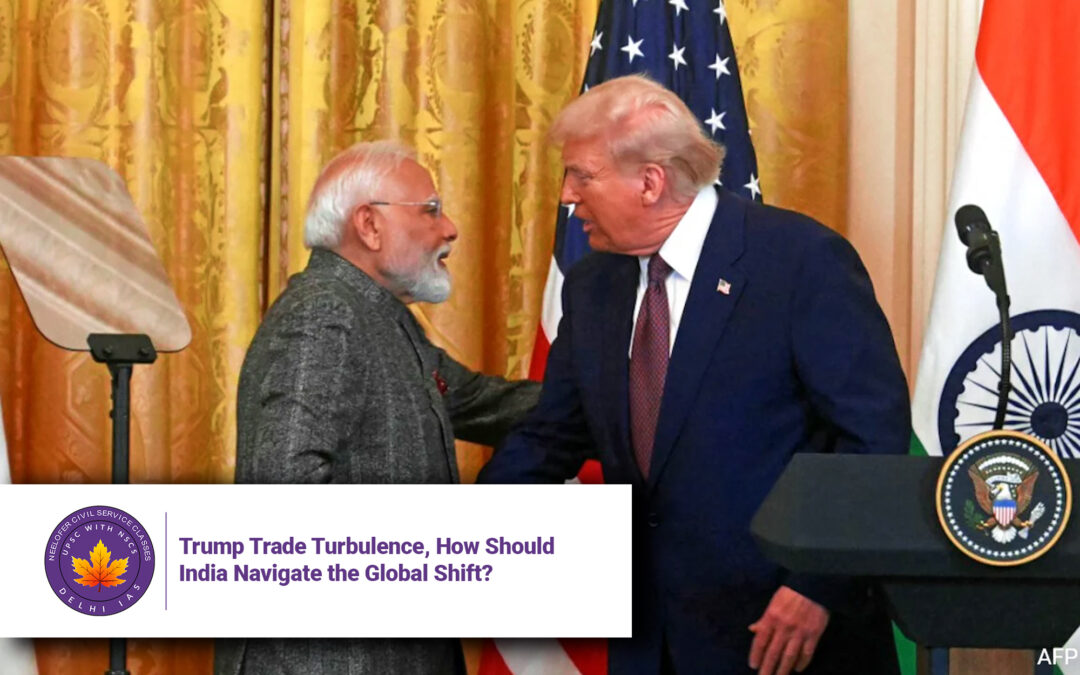
Trump Trade Turbulence, How Should India Navigate the Global Shift?
Why in News?
With U.S. President Donald Trump launching a trade war on multiple fronts — including allies like Canada and adversaries alike — nations are grappling with how to respond. India must now decide its stance: should it retaliate, negotiate, or cooperate with others to bypass U.S. hostility? 
Introduction
President Trump’s recent trade policies have shaken the foundation of global commerce. Imposing tariffs under the guise of national interest, he’s targeted countries indiscriminately, from Canada and Mexico to China and India. This aggressive approach, combined with the erosion of global trade norms, demands strategic thinking — especially from large economies like India.
Key Issues/Background
-
Unilateralism Replaces Multilateralism
Trump has rejected the World Trade Organization (WTO) principles of non-discrimination and Most Favoured Nation (MFN) treatment, instead favoring bilateral deals with tariffs and threats. -
Economic Retaliation and Uncertainty
Countries are unclear how to respond. Should they retaliate with tariffs? Ignore the U.S. provocations? Or create alliances that render the U.S. position irrelevant? -
India’s Dilemma
India must assess if it should:-
Remain passive and wait it out.
-
Retaliate proportionately.
-
Push for a Free Trade Agreement (FTA).
-
Deepen ties with regional allies and global trade partners.
-
-
Global Coordination vs. Solo Action
The author suggests the best response is global coordination — not unilateral retaliation — by forming coalitions with countries like the EU, Japan, Canada, Singapore, and others to uphold fair trade standards. -
Impact on Innovation and Trust
Trump’s approach threatens the innovation ecosystem and the rules-based trade framework that has long supported economic progress, particularly for developing nations.
Five Key Takeaways
-
India must not act in isolation. Coordinated global action is more impactful in countering unfair trade practices.
-
Retaliatory tariffs should be limited and strategic, not emotional or hasty. Retaliation must align with WTO norms and broader trade goals.
-
Deepening regional partnerships through FTAs with Asia-Pacific and South Asian countries can create economic resilience.
-
The current crisis presents an opportunity to reinforce international institutions and multilateral trade norms.
-
India’s response will shape its global leadership identity, not just its trade policy. Diplomacy and cooperation must guide its strategy.
Challenges and the Way Forward
-
Challenges:
-
Navigating a trade war without disrupting economic growth.
-
Balancing between defending national interests and upholding global norms.
-
Facing pressure from domestic lobbies for immediate retaliation.
-
-
Way Forward:
-
Strengthen alliances with countries advocating open trade.
-
Push for reform and relevance of multilateral institutions like the WTO.
-
Negotiate new FTAs to secure market access and build trade redundancy.
-
Avoid getting dragged into bilateral conflicts with the U.S. on Trump’s terms.
-
Use forums like ASEAN, EU, and RCEP for economic diplomacy.
-
Conclusion
President Trump’s aggressive trade policies may be disruptive, but they also offer a critical moment for India and others to reaffirm their commitment to fair, rules-based trade. By working with like-minded countries, India can not only protect its economic interests but also help shape the future of global trade — one based on collaboration, not coercion.
Q&A Section
1. Why is President Trump’s trade policy seen as a threat to global commerce?
Because it abandons multilateral principles and imposes tariffs arbitrarily, even on allies, eroding the trust in global trade systems.
2. How should India ideally respond to Trump’s trade war tactics?
By not acting alone; instead, India should coordinate with global partners to resist unfair trade policies and uphold WTO norms.
3. What is the risk of retaliating with tariffs directly against the U.S.?
It could escalate tensions and harm India’s own exports, without resolving the underlying issues or changing U.S. behavior.
4. What long-term strategy does the author recommend for India?
To deepen existing trade relationships, explore FTAs, and actively promote international standards and institutions.
5. Why is the multilateral trade system so crucial now?
Because it ensures fairness, predictability, and collective strength in global trade — all of which are endangered by rising unilateralism.
