
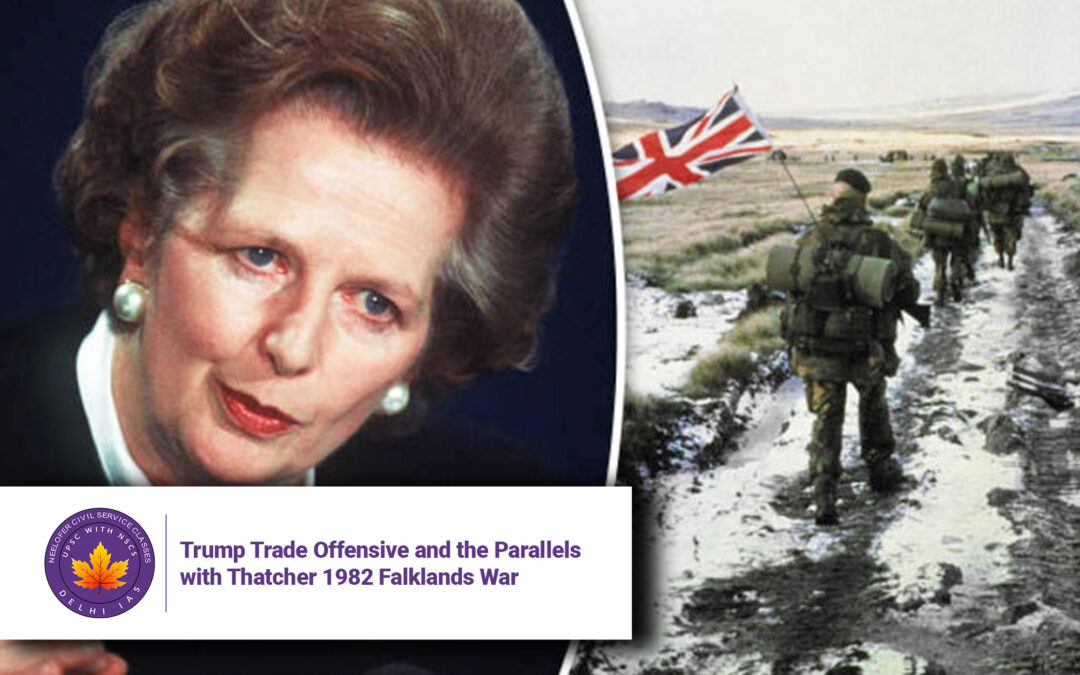
Trump Trade Offensive and the Parallels with Thatcher 1982 Falklands War
Introduction
Trade wars and military conflicts may appear to be separated by categories of power — one economic, the other military — yet both reflect the ways states project strength and test the resilience of adversaries. In his second presidency, Donald Trump has returned to an aggressive trade policy that bears striking resemblance to former UK Prime Minister Margaret Thatcher’s war with Argentina over the Falkland Islands in 1982. Thatcher, facing domestic discontent, used the war as a demonstration of British resolve, while Trump, beset by political challenges at home, has adopted tariffs and unilateral trade actions as a means of asserting U.S. power abroad.
The essence of the comparison lies in the disproportionate show of force against weaker opponents, the reliance on symbolic victories to sustain domestic credibility, and the willingness to incur costs for the sake of projecting toughness. Yet the implications of Trump’s trade war go far beyond symbolism: they test the global trading order, expose the European Union’s vulnerabilities, and complicate the delicate balance of U.S. relations with China, Latin America, and allies in Europe.
Trump’s Trade Offensive: The “Liberation Day” Tariffs
Trump’s latest move was to impose tariffs under what he called “Liberation Day” — a strikingly triumphalist label that echoes wartime rhetoric. The measures included:
-
A 15% baseline tariff on a broad range of imports, with exceptions for aircraft parts, certain minerals, and a select group of goods.
-
Additional U.S. duties on steel, copper, and aluminium, at levels as high as 50%.
-
Specific targeting of 57 countries and territories, although only three — Brazil, Canada, and China — are considered capable of credible retaliation.
This offensive resembled Thatcher’s campaign against Argentina: a show of overwhelming power designed not merely to secure specific economic gains, but to signal toughness and resolve. Just as Thatcher mobilised naval fleets and air power to reclaim distant islands, Trump mobilised tariffs to demonstrate U.S. dominance in the global economy.
Why the Comparison to the Falklands War Matters
The Falklands conflict was, in purely strategic terms, a small war over a distant and sparsely populated archipelago. Yet politically, it carried immense weight. Thatcher’s decisive victory bolstered her standing at home, silenced critics, and gave her government the strength to pursue reforms and win reelection.
Similarly, Trump’s trade offensive is not merely about market access or trade balances. It is about demonstrating resolve, rallying his political base, and asserting U.S. primacy in a global order where many allies and rivals had grown accustomed to American retrenchment.
The Falklands War also highlighted the ability of a state to pursue forceful action even at great cost. Britain suffered casualties and significant financial expenditures, but Thatcher’s government considered these acceptable in the service of demonstrating national power. Trump’s tariffs likewise impose costs — higher import prices for consumers, inefficiencies in domestic industries, and retaliation risks — but for Trump, the symbolic value of appearing tough outweighs the material downsides.
The European Union’s Weak Response
One of the most striking aspects of Trump’s offensive has been the muted response of America’s traditional allies, particularly the European Union.
-
The European Commission accepted the 15% baseline tariff with only minimal resistance.
-
In exchange for continued access for some European exporters, Brussels agreed not to impose higher tariffs in response.
-
EU Commission President Ursula von der Leyen pledged additional U.S. energy imports worth $100 billion annually, further sweetening the deal for Washington.
This outcome reveals the EU’s structural weakness in confronting unilateral U.S. action. Unlike China, which can credibly retaliate by cutting off rare earth exports essential to U.S. industries, Europe lacks equivalent leverage. The EU’s dependence on U.S. security guarantees, particularly in the context of Ukraine, further constrains its ability to respond forcefully.
The result is a capitulation that mirrors Argentina’s retreat after its ill-fated Falklands adventure. Where Thatcher forced a weaker adversary into submission, Trump has managed to extract concessions from Europe without incurring much retaliation.
The Rationality of Tariffs: Strategy or Psychosis?
A critical question arises: are Trump’s trade policies rational, or are they the product of ideology and personal satisfaction? The article suggests they are driven not by coherent economic strategy, but by Trump’s irrational faith in tariffs — which he has described as “the most beautiful word in the dictionary.”
For Trump, tariffs serve multiple functions:
-
They punish adversaries and even allies.
-
They provide symbolic satisfaction to his political base.
-
They reinforce his narrative of defending American workers against exploitation.
From an economic perspective, however, tariffs are self-defeating. They:
-
Increase costs for domestic producers reliant on imported inputs.
-
Fuel inflation by raising consumer prices.
-
Encourage inefficiency by sheltering domestic industries from global competition.
Just as Thatcher’s use of military force in the Falklands carried immense risks of escalation and loss, Trump’s use of tariffs risks triggering broader trade wars that leave all parties worse off.
The “Madman” Problem of Retaliation
In international politics, deterrence depends on the credibility of retaliation. A rational adversary can be deterred by the threat of costs. But with Trump, negotiators worry that retaliation only provokes further retaliation, creating a spiral of escalation.
This dynamic mirrors the Cold War concept of the “madman theory” — the idea that appearing unpredictable and willing to escalate can deter opponents. Yet it also creates instability. Just as launching a conventional war can invite counterattacks that inflict heavy costs, retaliating against Trump risks unleashing further waves of tariffs.
Thus, Europe and other U.S. partners often refrain from strong countermeasures, preferring to absorb the damage rather than risk uncontrollable escalation.
Global Dimensions: China, Latin America, and Beyond
Beyond Europe, Trump’s trade policies reshape global dynamics in several ways:
-
China:
China retains significant leverage because of its control over rare earth minerals vital to U.S. high-tech industries. Beijing can retaliate in ways Europe cannot. Yet Trump’s tariffs also force China to seek alternative markets, strengthening its ties with Asia, Africa, and Latin America. -
Latin America:
Trump’s tariffs could push Europe to accelerate trade deals with Latin America’s Mercosur bloc. By diversifying its partners, the EU reduces dependence on the U.S. -
Global South:
Many smaller economies, especially those in Africa and Southeast Asia, find themselves caught between U.S. and Chinese influence. Trump’s tariffs risk fragmenting global trade, forcing countries to choose sides.
Domestic Politics: Distraction and Symbolism
The most striking similarity to Thatcher’s Falklands War lies in the domestic political function of Trump’s trade offensive.
-
For Thatcher, the Falklands victory distracted from domestic economic turmoil and unemployment.
-
For Trump, tariffs distract from scandals, controversies, and criticisms of his administration.
The show of toughness abroad reassures domestic supporters, even if the economic consequences are negative. The tariffs provide a symbolic narrative of “fighting for American workers,” much as Thatcher framed the Falklands as a defense of British sovereignty.
The Limits of Trump’s Strategy
While effective in the short term, Trump’s trade strategy risks undermining U.S. power in the long run.
-
Allies Alienated: Repeated targeting of allies like the EU and Canada undermines trust in U.S. leadership.
-
Global Trade Order Weakened: The World Trade Organization (WTO) and multilateral trade norms are sidelined.
-
Domestic Costs: Rising inflation, inefficiency, and consumer dissatisfaction could erode support over time.
Like Thatcher’s Falklands gamble, the trade offensive provides immediate political dividends, but its sustainability remains in question.
Conclusion
Donald Trump’s trade offensive illustrates how economic tools can be weaponised in ways reminiscent of military power. Like Margaret Thatcher’s Falklands War, it is less about the material stakes than about projecting strength, rallying domestic support, and deterring adversaries. The costs are real — economic inefficiencies, inflation, and global instability — but the symbolic gains may prove politically decisive.
The EU’s weak response highlights the asymmetry of power, while China and other global actors recalibrate their strategies. Ultimately, Trump’s tariffs risk being self-defeating, much as critics argued that Thatcher’s reliance on military power masked deeper domestic problems.
Seventy-eight years after the creation of the multilateral trading system, the world confronts a stark reality: global trade is once again an arena of political conflict, where power and symbolism matter as much as efficiency and cooperation.
5 Exam-Oriented Q&A
Q1: In what way is Trump’s trade offensive compared to Margaret Thatcher’s Falklands War?
A1: Both represent disproportionate shows of force aimed at weaker opponents, designed more for symbolic domestic political gain than material necessity. Thatcher’s war boosted her standing, while Trump’s tariffs reinforce his image of toughness.
Q2: Why did the European Union’s response to Trump’s tariffs appear weak?
A2: The EU accepted a 15% baseline tariff with minimal resistance, agreed to additional U.S. energy imports, and refrained from retaliation due to lack of leverage and reliance on U.S. security guarantees.
Q3: What are the economic consequences of Trump’s tariffs?
A3: Tariffs increase consumer prices, raise input costs for domestic industries, encourage inefficiency, and risk triggering retaliatory trade wars, ultimately hurting both the U.S. and its partners.
Q4: How does China’s position differ from Europe’s in responding to Trump’s trade policies?
A4: Unlike Europe, China can credibly retaliate by cutting off rare earth exports vital to U.S. high-tech industries, giving it more leverage in trade disputes.
Q5: What political purpose do Trump’s tariffs serve domestically?
A5: They act as a distraction from domestic controversies and scandals, reinforcing his narrative of defending American workers, much like Thatcher used the Falklands War to distract from domestic economic turmoil.

