
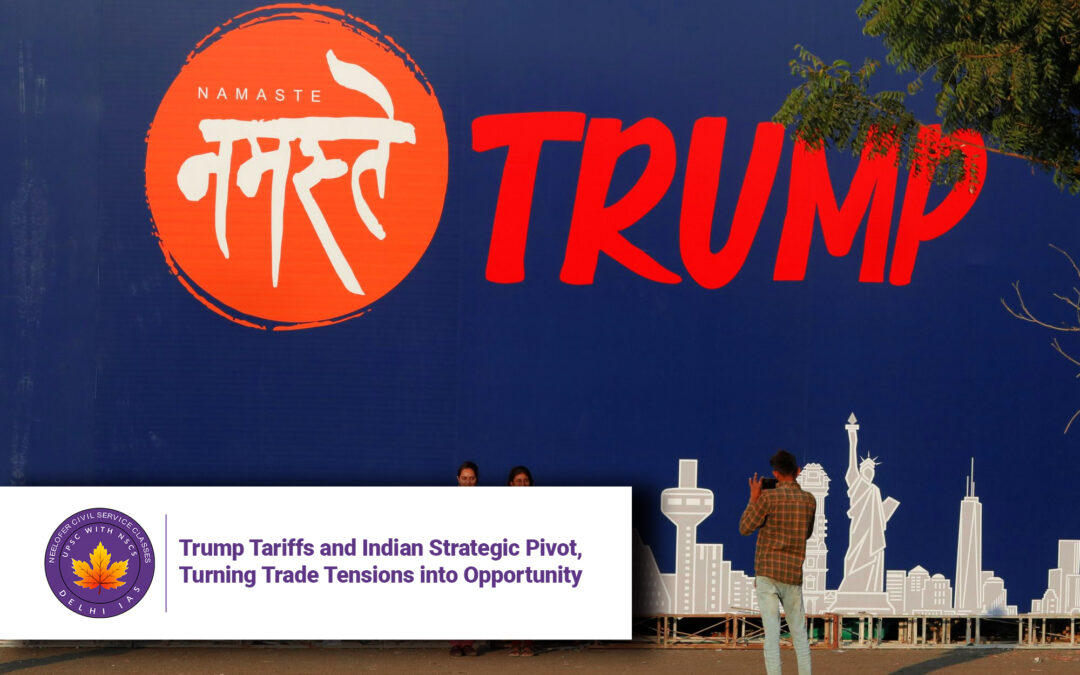
Trump Tariffs and Indian Strategic Pivot, Turning Trade Tensions into Opportunity
Introduction
The recent 25% tariff imposition by the U.S. on select Indian exports, coupled with vague geopolitical penalties linked to India’s Russia ties, marks a critical inflection point in Indo-U.S. relations. While the Trump administration frames this as a move to “correct trade imbalances,” the underlying message is clear: Washington expects India to align with its strategic priorities or face economic consequences.
However, as policy expert Rakesh K Chitkara argues, this moment is not a crisis but an opportunity—a chance for India to reduce over-dependence on any single market, recalibrate defense procurement, and assert its economic sovereignty. This article examines:
-
The real motives behind Trump’s tariffs
-
India’s vulnerabilities (trade, defense, tech)
-
A 5-point strategy to turn tariffs into leverage
-
Why this could accelerate India’s rise as a global economic counterweight
Why in News?
-
U.S. imposes 25% tariffs on Indian exports (textiles, electronics, auto parts).
-
Linked to India’s Russia ties: Penalties hinted for buying Russian oil/arms.
-
Trump’s rhetoric: Called India a “dead economy” (later walked back).
-
India’s response: No panic—focus on diversification, self-reliance.
Key Issues and Analysis
1. Decoding Trump’s Tariffs: Trade or Geopolitics?
A. The “Trade Deficit” Myth
-
U.S. trade deficit ($1.1T) stems from low savings, not foreign policy (Jeffrey Sachs).
-
Tariffs are a tax on Americans:
-
80% of costs borne by U.S. importers (Tax Foundation).
-
India’s exports to U.S. = $118B (2024); tariffs may cut GDP by 0.2-0.3%.
-
B. The Real Target: India’s Russia Ties
-
U.S. wants India to ditch Russian oil/arms (India saves $5B/year on discounted crude).
-
Defense coercion: Threat to withhold GE fighter jet tech, Predator drones.
Historical Parallel:
-
2018 U.S.-China trade war: Failed to reduce deficit; supply chains shifted to Vietnam.
2. India’s Strategic Vulnerabilities
| Sector | Dependence | Risk |
|---|---|---|
| Trade | 18% exports to U.S. | Tariffs hurt textiles, pharma. |
| Defense | $20B pending U.S. arms deals | Tech sanctions could stall S-400, TEJAS. |
| Tech | Google/Amazon dominate digital ads | Data colonialism; little local R&D. |
Case Study: Defense Dilemma
-
U.S. vs. Russia:
-
U.S.: Ties arms sales to policy compliance (CAATSA threats).
-
Russia: No strings attached (e.g., Akula submarines, Brahmos JV).
-
3. The 5-Point Pivot: Turning Crisis into Opportunity
1. Trade Diversification
-
Fast-track EU, UK FTAs (offset U.S. losses).
-
Rupee trade with Russia/Iran (bypass dollar sanctions).
2. Defense Self-Reliance
-
Boost DRDO, private sector (e.g., Tata-Airbus chopper deal).
-
Diversify suppliers (France, Israel, Japan).
3. Tech Sovereignty
-
Data localisation laws (limit Big Tech monopolies).
-
PLI 2.0: Incentivize semiconductor, AI hardware.
4. Energy Security
-
Double down on Russian oil (cheaper, reliable).
-
Invest in renewables (solar, hydrogen).
5. Global South Leadership
-
Leverage BRICS, SCO for non-Western trade blocs.
-
Push Global South agenda in WTO, UN.
Case Study: How China Responded to Trump’s Tariffs
-
2018: U.S. imposed 25% tariffs on $250B Chinese goods.
-
China’s countermeasures:
-
Domestic subsidies for tech (Huawei, SMIC).
-
Rare earth export controls.
-
Belt & Road Initiative (BRI) to reduce U.S. dependence.
-
-
Result: Trade deficit remained, but China grew its global influence.
Lesson for India: Strategic patience + self-reliance = long-term resilience.
The Road Ahead: India’s Moment of Reckoning
Short-Term (0-12 Months)
-
Lobby U.S. Congress (business groups oppose tariffs).
-
Secure EU FTA to compensate export losses.
Medium-Term (1-3 Years)
-
Achieve 70% defense indigenization (vs. 50% now).
-
Launch digital rupee for trade settlements.
Long-Term (5+ Years)
-
Become AI/hardware hub (compete with China).
-
Lead Global South in reshaping trade rules.
Conclusion: From Tariffs to Transformation
Trump’s tariffs are less about economics and more about geopolitical arm-twisting. But as Chitkara notes, India’s response will define its future:
✔ Resist panic, embrace strategic recalibration.
✔ Reduce dependencies, amplify multi-alignment.
✔ Lead the Global South in a post-Western economic order.
The road won’t be easy, but as history shows, disruption breeds opportunity. India’s choice is clear: Bow to unilateralism or rise as a sovereign power.
5 Key Questions & Answers
Q1: Will tariffs hurt India’s economy badly?
A1: Short-term pain (0.3% GDP dip), but long-term gain if India diversifies.
Q2: Why is the U.S. targeting India’s Russia ties?
A2: To weaken Moscow and test India’s loyalty to the Western bloc.
Q3: How can India reduce defense dependence on the U.S.?
A3: Boost DRDO, partner with France/Israel, fast-track TEJAS Mk2.
Q4: What’s the #1 lesson from China’s tariff response?
A4: Self-reliance (tech, supply chains) beats short-term compromises.
Q5: Can India lead the Global South economically?
A5: Yes—via BRICS, rupee trade, and South-South supply chains.

