
Trump Doctrine: A New Foreign Policy Taking Shape
Why in News?
US President Donald Trump, in his address to the US Congress on March 4, highlighted a new and distinct foreign policy direction, marking a clear shift from previous administrations. This evolving approach is being described as the “Trump Doctrine.”
Introduction
President Donald Trump, in one of the earliest sessions of his second term, laid out the core principles of his administration’s domestic and foreign policies. His speech underscored a new tone in American policy, both internally and externally, through bold reforms and assertive international posturing. Analysts are observing what they call the emergence of a “manifest destiny” narrative within Trump’s administration. 
Key Features
-
Domestic Reforms and Governance Changes
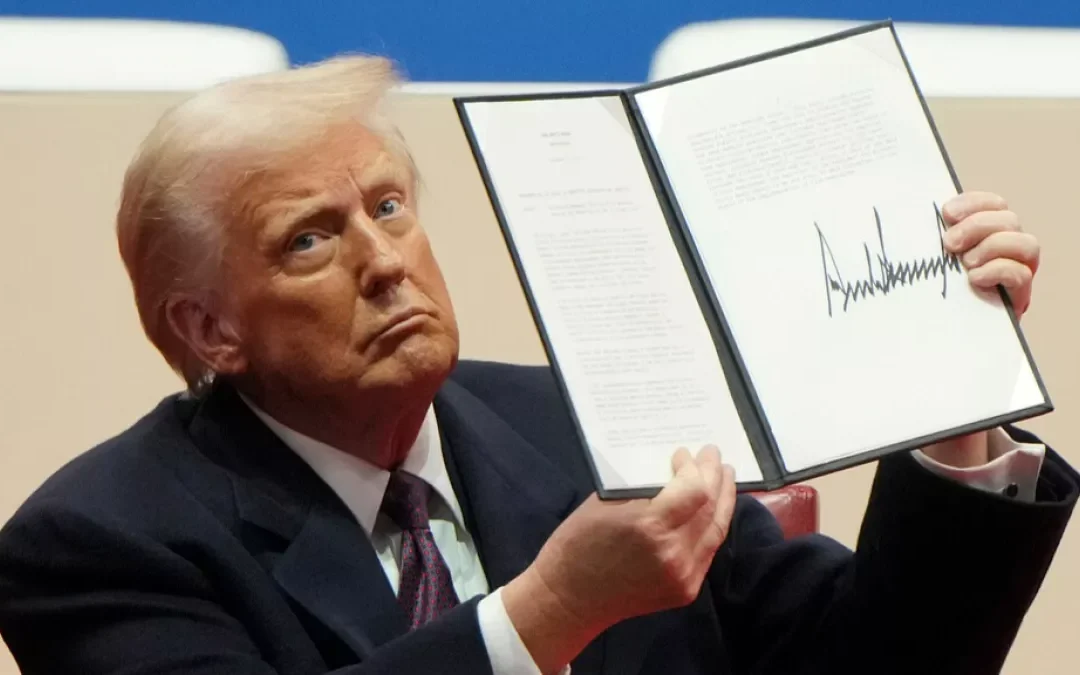
Trump signed over 100 executive orders and 400 executive actions aimed at transforming governance by cutting bureaucracy, downsizing the government, and reducing regulations.
He has focused on reducing illegal immigration, cutting taxes, and lowering unemployment rates. His approach has been labeled a “draining the swamp” strategy, aimed at reshaping governance with an America-first policy. -
Energy Policy Shifts
Trump reversed Obama-era restrictions on fossil fuel production, signed executive orders to restart offshore drilling, and expanded the US energy sector.
He declared the US a net energy exporter and revoked mandates on electric vehicles. -
Government Downsizing and Deregulation
Trump’s administration has sought to reduce federal spending and limit the size of government agencies.
The Department of Government Efficiency (DOGE) was placed at the forefront to address widespread inefficiencies. -
Foreign Policy Realignment
Trump’s foreign policy is marked by unilateralism and nationalism, emphasizing America’s global dominance.
Key actions include imposing a 25% tariff on Canadian and Mexican goods and renaming US landmarks to reflect his “America First” agenda.
Trump also threatened to pull the US out of global organizations such as the World Health Organization and the United Nations Human Rights Council.
Specific Impacts or Effects
-
Trade and Economic Policies
Trump’s policies have reshaped trade dynamics with allies and adversaries alike.
His pressure tactics are aimed at renegotiating agreements to favor US economic interests, including trade disputes with Canada, Mexico, and China. -
Geopolitical Maneuvering
Trump’s administration has shown increased interest in expanding US territorial and strategic influence.
He has backed moves such as the renaming of Mount McKinley to Denali and proposals to merge Canada into the US’s 51st state narrative. -
Military and Strategic Influence
Trump has emphasized military strength and economic power as tools for ensuring US dominance.
His administration’s policies have focused on reducing US involvement in global alliances while pushing allies to increase their defense spending.
Challenges and the Way Forward
Challenges
- Trump’s aggressive unilateralism risks alienating traditional US allies in Europe and Asia.
- His economic policies could trigger trade wars that may harm global economic stability.
- Internal divisions within the US remain a concern, particularly as Trump consolidates support ahead of future elections.
Steps Forward
- Diplomacy and engagement should be prioritized to balance unilateral actions.
- Careful management of economic policies is needed to avoid global instability.
- Bridging internal political divides will be critical for sustaining long-term policy success.
Conclusion
The Trump Doctrine represents a major departure from traditional US foreign policy, reflecting a blend of nationalism, economic protectionism, and assertive international posturing. While many analysts view this as typical Trumpian bluster, it may well be a deliberate strategy aimed at reshaping America’s global role. The coming months will reveal whether this doctrine will leave a lasting legacy or remain a controversial experiment in US leadership.
Questions and Answers
-
What is the Trump Doctrine?
A distinct shift in US foreign and domestic policy focusing on nationalism, unilateralism, and America First principles. -
What did Trump emphasize in his Congress address on March 4?
Transformative domestic reforms and a strong foreign policy shift towards American dominance. -
How many executive orders and actions has Trump signed?
Over 100 executive orders and 400 executive actions. -
What is Trump’s approach to energy policy?
Reversing previous restrictions, restarting offshore drilling, and promoting the US as a net energy exporter. -
What is DOGE’s role in Trump’s administration?
The Department of Government Efficiency (DOGE) is focused on addressing inefficiencies and streamlining government operations. -
What trade policies has Trump enacted?
Imposed tariffs on Canadian and Mexican goods and renegotiated trade agreements. -
How is Trump reshaping US foreign relations?
By adopting a unilateral approach, pressuring allies, and emphasizing economic dominance. -
What are Trump’s goals for the US economy?
Boost domestic manufacturing, reduce government spending, and increase US energy exports. -
What are the risks of Trump’s doctrine?
Alienating allies, potential trade wars, and internal political divisions. -
What legacy does Trump aim to leave?
A redefined US global role marked by economic and military strength, and a more assertive foreign policy stance.

