
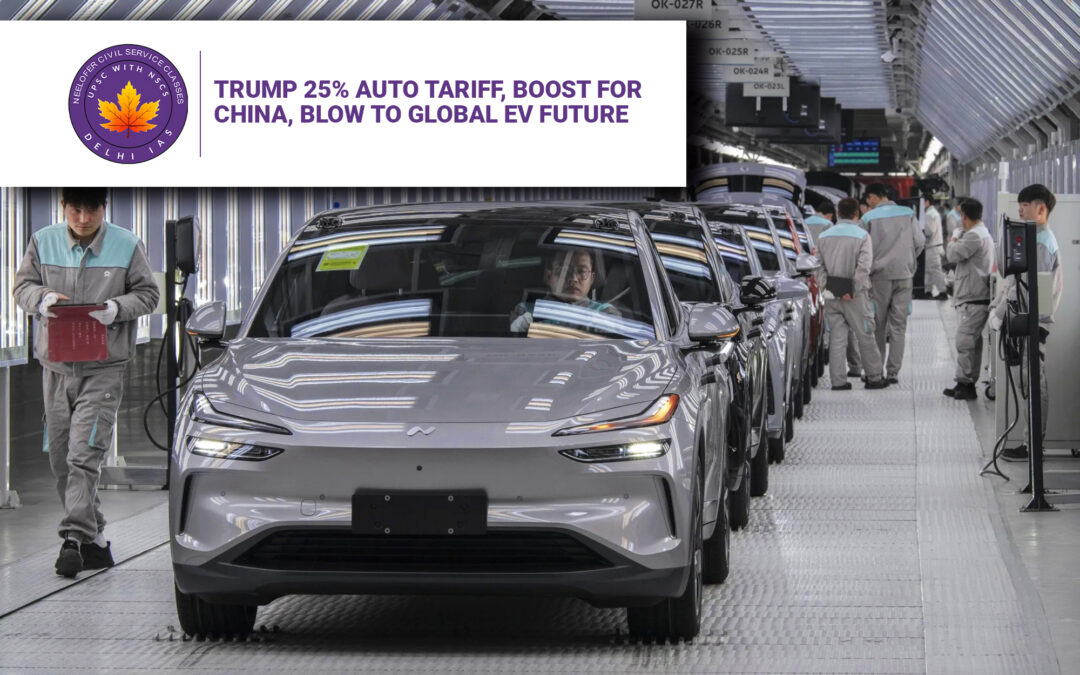
Trump 25% Auto Tariff, Boost for China, Blow to Global EV Future
Why in News?
Former U.S. President Donald Trump has announced a 25% tariff on all auto imports, a move that threatens to disrupt the global electric vehicle (EV) supply chain and unintentionally hand over the reins of the global auto industry to China.
Introduction
As the world races toward a future powered by electric vehicles, global supply chains for EVs are more interconnected than ever. Countries like Japan and South Korea have emerged as crucial players, especially in battery manufacturing. Trump’s new tariff could derail this collaboration, further strengthening China’s dominance in the EV sector. 
Key Issues
1. Japan and South Korea Hit Hardest
The new levies will severely impact Japan and South Korea, which together account for one-third of all U.S. car imports—more than twice the volume of imports from Canada and Mexico. While Mexico and Canada might be partially exempt, Japan and Korea will face the full force of these tariffs.
2. EV Battery Supply Chain at Risk
South Korean and Japanese firms produced over 25% of the world’s EV batteries last year, positioning them as China’s primary rivals. U.S. automakers like Ford, GM, and Stellantis rely heavily on these companies for battery supply, along with Tesla, which works with Japan’s Panasonic.
Trump’s tariffs risk severing these crucial links, undermining the EV supply chain that the U.S. desperately needs to maintain a competitive electric auto industry.
3. Economic Consequences
These new tariffs will:
-
Raise costs for American manufacturers.
-
Hurt Hyundai and Kia, who sell more cars in the U.S. than in their home market.
-
Disrupt Korean and Japanese companies that rely on exports to maintain profitability.
Many of these companies already operate on thin profit margins, often in the single digits, and are already competing with Chinese firms like CATL and BYD.
Alternative Approaches (Previously Taken)
The Biden administration’s approach focused on de-risking from China while building clean energy alliances with South Korea and Japan. Korean companies invested billions into U.S. battery plants, with LG, Samsung SDI, and SK On pledging $54 billion for 15 battery facilities.
The Reshoring Initiative credited these investments for bringing half of all new jobs back to the U.S. since 2021. Trump’s tariff now threatens these efforts.
Challenges and the Way Forward
Short-Term Gains, Long-Term Risks
In the short run, Wall Street investors and Detroit-based automakers may welcome the protectionist move, as it boosts short-term profits by reducing R&D and capital costs.
But the long-term consequences could be dire:
-
Weakening America’s EV transition
-
Disrupting non-China supply chain alliances
-
Allowing China to tighten its grip on the global car industry
Policy Reversals
Trump’s first term already saw the rollback of clean energy incentives, EV charging infrastructure, and fuel economy standards. The new tariffs are another step back from climate goals and technological modernization.
Conclusion
Trump’s 25% tariff might sound like a move to protect American jobs and industries, but in reality, it undermines the very structure needed to compete in the EV revolution. With China already dominating the battery and EV markets, severing ties with trusted Asian allies only accelerates the shift in power—from Detroit to Beijing.
Q&A Section
Q1. Who are the biggest losers from Trump’s 25% auto tariff?
Japan and South Korea, which together export a third of all cars to the U.S., are the most affected. Their companies are also central to EV battery production.
Q2. How will this tariff affect the U.S. electric vehicle industry?
It risks dismantling vital supply chains. U.S. automakers depend on South Korean and Japanese companies for battery technology and assembly, which are essential for EV production.
Q3. What was Biden’s approach to building a non-China supply chain?
Biden pushed for clean energy partnerships with Asian allies. Companies from South Korea pledged over $54 billion to build 15 battery plants across the U.S., revitalizing domestic manufacturing.
Q4. Why might investors initially welcome this move?
The tariff reduces pressure on automakers to invest in costly R&D and electrification, boosting short-term profits. But it’s a short-sighted gain with long-term costs.
Q5. How does this benefit China?
By disrupting the U.S.’s partnership with its non-Chinese allies, the move cements China’s dominance in the EV industry, especially as firms like CATL and BYD continue to lead in global battery tech.

