
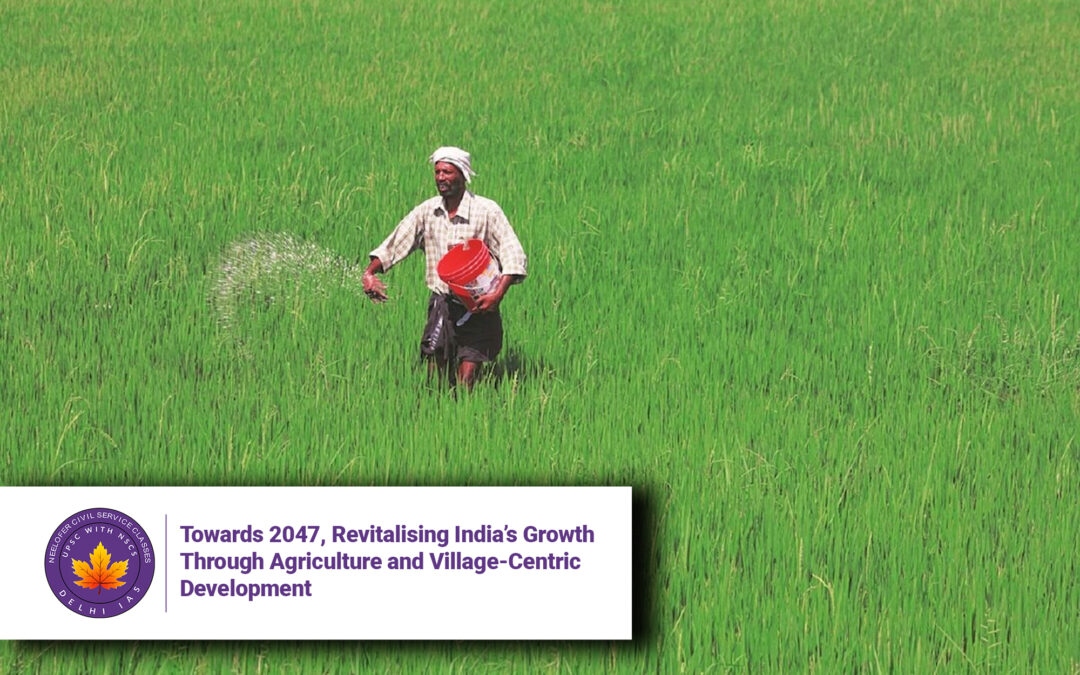
Towards 2047, Revitalising India’s Growth Through Agriculture and Village-Centric Development
India’s ambition to become a Viksit Bharat — a developed, US$30 trillion economy by 2047 — is grounded in its current growth trajectory. With the economy expanding at over 10% in certain quarters, India stands as one of the fastest-growing major economies globally. However, sustaining this momentum over the next two decades will require a shift in strategy, especially given that growth rates have fluctuated between 6% and 7% in recent years.
The Government’s primary focus has been on energising manufacturing through initiatives such as Make in India (2014), Production Linked Incentive (PLI) schemes (2020), and the Design Linked Incentive (DLI) programme (2021). These policies aimed to create 10 crore new jobs in the manufacturing sector and raise the sector’s contribution to GDP from 15% to 25% in a decade.
Yet, despite these ambitious targets, the manufacturing share of GDP has hovered between 16% and 17%, with little real increase in employment. NSSO sample surveys show manufacturing employment declining from 12.6% of total employment in 2011–12 to just 11.4% in 2022–23. Even with significant budget allocations — like the Rs. 2.96 lakh crore for PLI — the expected boom has not materialised.
A Closer Look at the Manufacturing Challenge
While PLI schemes were intended to boost local assembly and production, particularly in electronics and smartphones, they have often been reduced to re-assembly of imported components, resulting in negligible domestic value addition. This is not entirely the fault of industry; persistent structural issues within India’s policy environment have slowed progress.
Despite heavy investment in infrastructure, tax reforms, decriminalisation of compliance burdens, and liberalised FDI norms, private sector investment in manufacturing has lagged. Commerce Minister Piyush Goyal has been vocal about India’s capacity to innovate, noting in April 2025 that Indian start-ups excel in areas like food delivery, digital payments, robotics, and AI. However, scaling up manufacturing to match these digital successes remains a hurdle.
The corporate tax cuts of 2019 — from 30% to 22% for existing companies and 15% for new manufacturing firms — were expected to spur investment. While these moves saved companies substantial sums, much of the money was channelled into debt servicing, dividends, and share buybacks, rather than capital expenditure.
The Government has announced new initiatives under the “Manufacturing Mission” to rejuvenate the sector, but the challenge remains steep. Import substitution policies, especially targeting Chinese goods, have been attempted before but delivered mixed results. India’s dependence on China for upstream goods like electronics components remains high.
Agriculture: The Quiet Powerhouse
While manufacturing struggles, agriculture has quietly outpaced other sectors. Between 2018–19 and 2022–23, agriculture’s share of the workforce increased from 42.5% to 45.8%. More importantly, Gross Value Addition (GVA) growth in agriculture averaged 4.7%, higher than manufacturing’s 4.2%. Even during COVID-19, when most sectors suffered, agriculture recorded impressive resilience.
This resilience suggests that India’s growth strategy for the next two decades should not be limited to urban-centric manufacturing hubs. Instead, a Gandhian agriculture and village-based model — focusing on decentralisation, small-scale industries, and rural infrastructure — could yield sustainable results.
Why the Village-Centric Approach Matters
India’s urban-centric growth has often left rural areas lagging behind. Many villages still lack basic healthcare, education, and economic opportunities. Roads are poorly maintained, internal trade is limited, and unemployment is rampant.
Past attempts to modernise urban infrastructure, like the Smart Cities Mission launched in 2015, have delivered mixed outcomes. Despite investments aimed at world-class infrastructure, many smaller towns and villages remain untouched by progress.
If India is to achieve a Viksit Bharat by 2047, rural areas must become engines of growth rather than reservoirs of surplus labour for cities. This means investing in roads, schools, water systems, housing, healthcare, and most importantly, agriculture-linked industries.
The Case for Agricultural Innovation
The agriculture sector is not without its challenges — from soil degradation to the spread of invasive weeds like lantana and water hyacinth. But with the right investment in perennial crop cultivation, soil health, irrigation, and processing industries, agriculture could become a growth driver.
Key steps could include:
-
Building cold storage facilities to reduce post-harvest losses.
-
Expanding agro-processing industries in rural areas.
-
Encouraging organic and sustainable farming to meet both domestic and export demand.
-
Providing credit support and insurance to farmers to reduce income volatility.
Such measures could not only increase rural incomes but also reduce migration pressures on cities.
Economic Decentralisation: A Strategic Imperative
Decentralisation offers two key benefits:
-
Economic resilience — Smaller cities and rural hubs can sustain growth even if urban centres face downturns.
-
Social stability — Local employment reduces migration, easing housing, transport, and infrastructure pressures in cities.
By promoting cluster-based industries in smaller towns — such as textiles in one district, food processing in another — India could create strong local economies. This was the essence of Mahatma Gandhi’s vision, where villages were self-reliant units of production.
The Road Ahead
Achieving Viksit Bharat status by 2047 will require balancing manufacturing-led growth with agriculture and village-based development. The current model, heavily skewed towards urban IT, finance, and manufacturing hubs, leaves too many areas vulnerable to economic shocks.
An integrated approach would involve:
-
Boosting manufacturing with targeted incentives, R&D investment, and infrastructure support.
-
Revitalising agriculture through innovation, credit, and market access.
-
Empowering villages with decentralised industries and infrastructure.
-
Fostering education and skill development tailored to rural economies.
-
Building resilience into the economy by diversifying growth drivers.
The vision for 2047 cannot be achieved through urban expansion alone; it must rest on a strong rural foundation.
5 Key Questions & Answers
Q1: Why has manufacturing employment stagnated despite major government initiatives?
A: While initiatives like Make in India and PLI were designed to boost domestic production, they often resulted in assembly rather than full-scale manufacturing. A lack of domestic supply chains, continued dependence on imports (especially from China), and limited private sector investment in capacity expansion have all contributed to slow employment growth.
Q2: How did agriculture perform during the COVID-19 pandemic compared to other sectors?
A: Agriculture was the only major sector to record positive growth during the pandemic. While industries like manufacturing, tourism, and IT faced disruptions, agriculture’s GVA continued to expand, highlighting its resilience and role as an economic stabiliser.
Q3: What are the benefits of a village-centric economic model?
A: A decentralised model reduces migration pressures on cities, creates local jobs, strengthens food security, and ensures that infrastructure and opportunities are more evenly distributed across the country. It also aligns with Gandhi’s vision of self-reliant rural communities.
Q4: What steps can be taken to make agriculture a long-term growth driver?
A: Key measures include investing in cold storage, promoting agro-processing industries, encouraging sustainable farming practices, improving irrigation systems, and expanding access to credit and insurance for farmers.
Q5: Why is decentralisation considered a strategic economic move for India’s future?
A: By creating strong local economies in smaller towns and rural areas, India can build resilience against global economic shocks, reduce urban congestion, and ensure balanced regional development. Decentralisation also strengthens social cohesion by reducing inequality between rural and urban regions.

