
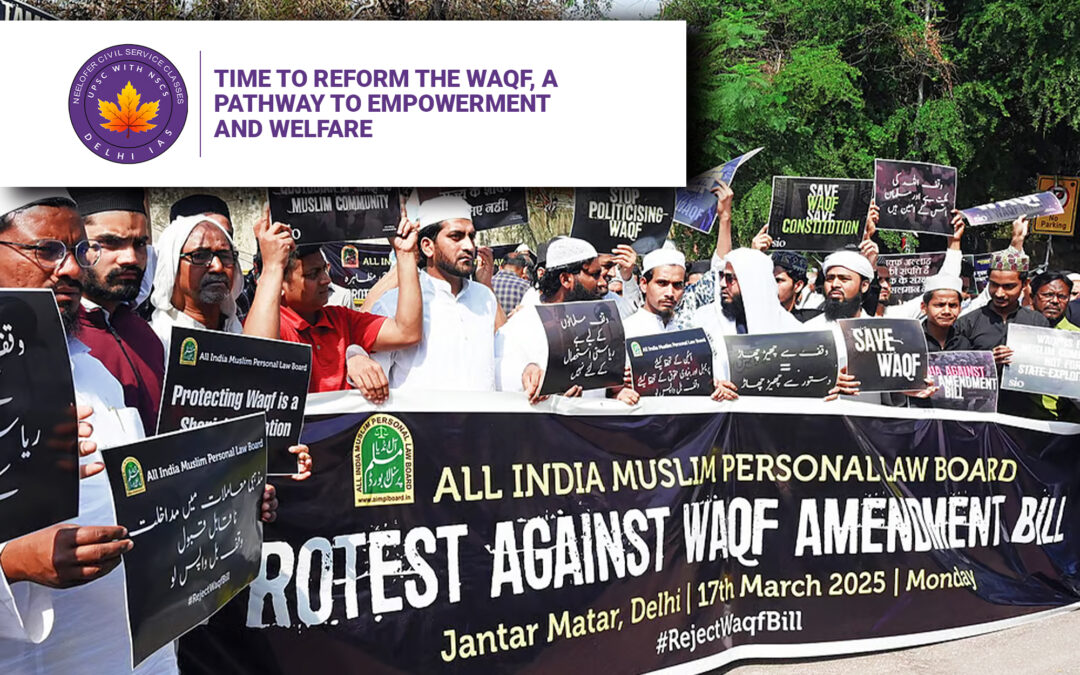
Time to Reform the Waqf, A Pathway to Empowerment and Welfare
Why in News?
The Government of India is set to introduce the Waqf (Amendment) Bill, 2024, which aims to reform one of India’s most underutilised and mismanaged religious and socio-economic institutions—the Waqf. The bill focuses on accountability, efficiency, and transparent management of Waqf properties. 
Introduction
Waqf is a centuries-old Islamic institution meant to serve the public good, especially the Muslim community, through contributions to education, healthcare, religious and social welfare. Ironically, despite being India’s third-largest landowning entity, the Waqf system suffers from inefficiency, mismanagement, low returns, and a lack of transparency. This situation has led to a critical need for reforms to revive its potential.
Key Issues Highlighted
-
Underutilization and Mismanagement of Waqf Properties
Though Waqf owns substantial land and property across India, the rental values are outdated (some fixed in the 1950s), and rent is either meagre or not collected. For example, some central properties in Jaipur fetch only ₹2000 annually, whereas they could generate over ₹20,000 crore a year. -
Corruption and Lack of Accountability
Several mutawallis (custodians) of Waqf properties function with zero accountability, leading to squandering and illegal sales of assets, often in collusion with local boards. This system has nurtured inefficiency and corruption for decades. -
Failure to Serve the Community
Waqf was created for socio-religious upliftment—supporting schools, libraries, mosques, hospitals, and welfare initiatives. However, funds from Waqf assets rarely benefit the community due to poor governance. -
State of the Waqf Board
The current structure is fragmented, outdated, and riddled with legal and procedural hurdles. The board lacks the capacity to manage or even account for all its assets. In many cases, Waqf land is encroached upon or neglected. -
Proposed Waqf (Amendment) Bill, 2024
The bill, also called the Unified Waqf Management, Empowerment, Efficiency, and Development (UMEED) Bill, promises to restructure Waqf governance, ensure transparency, and enhance community-centric development.
Key Takeaways
-
Waqf is a massive yet mismanaged asset base, especially for Indian Muslims.
-
Lack of transparency, outdated rents, and misappropriation hinder its welfare objectives.
-
The UMEED Bill seeks to bring accountability and reform to the Waqf Board and properties.
-
Reforming Waqf could unlock ₹20,000+ crore annually, potentially revolutionising Muslim social welfare.
-
Welfare must mean self-sustaining, inclusive institutions—not merely survival of decaying setups.
Challenges and the Way Forward
-
Update Rental Structures: Waqf rents should reflect market value to ensure financial viability.
-
Professional Governance: Boards must have financial and legal experts, not just religious administrators.
-
Transparent Systems: Use digital tracking and audits to manage properties and revenue flows.
-
Inclusive Development: Invest in education, healthcare, and social upliftment, using Waqf profits.
-
Public Participation: Ensure Muslim civil society and institutions play a role in guiding Waqf reform.
Conclusion
The Waqf is too important to be misused or ignored. With sincere reform, it can play a transformative role in not just uplifting the Muslim community, but also in enhancing national welfare. The time to overhaul the Waqf system is now—towards a future of transparency, efficiency, and inclusive growth.
Q&A Section
Q1. What is the primary purpose of the Waqf system?
The Waqf system was originally meant for public welfare, particularly for the Muslim community, through services like education, health, and religious institutions.
Q2. What are the major issues facing the Waqf today?
The Waqf suffers from inefficiencies, outdated rent policies, corruption, and poor management, leading to underutilisation of its vast property base.
Q3. What is the UMEED Bill, 2024?
The Unified Waqf Management, Empowerment, Efficiency, and Development (UMEED) Bill aims to reform and streamline Waqf governance to ensure better accountability and use of Waqf assets.
Q4. How much revenue could the Waqf system potentially generate annually?
Revised estimates suggest that Waqf properties could generate ₹20,000 crore per year, compared to the current yield of only ₹2,000 crore.
Q5. Why is reforming the Waqf essential for Indian society at large?
Reforming Waqf will not only uplift the Muslim community but also promote inclusive welfare and sustainable development, benefiting broader society through improved institutions and public services.

