
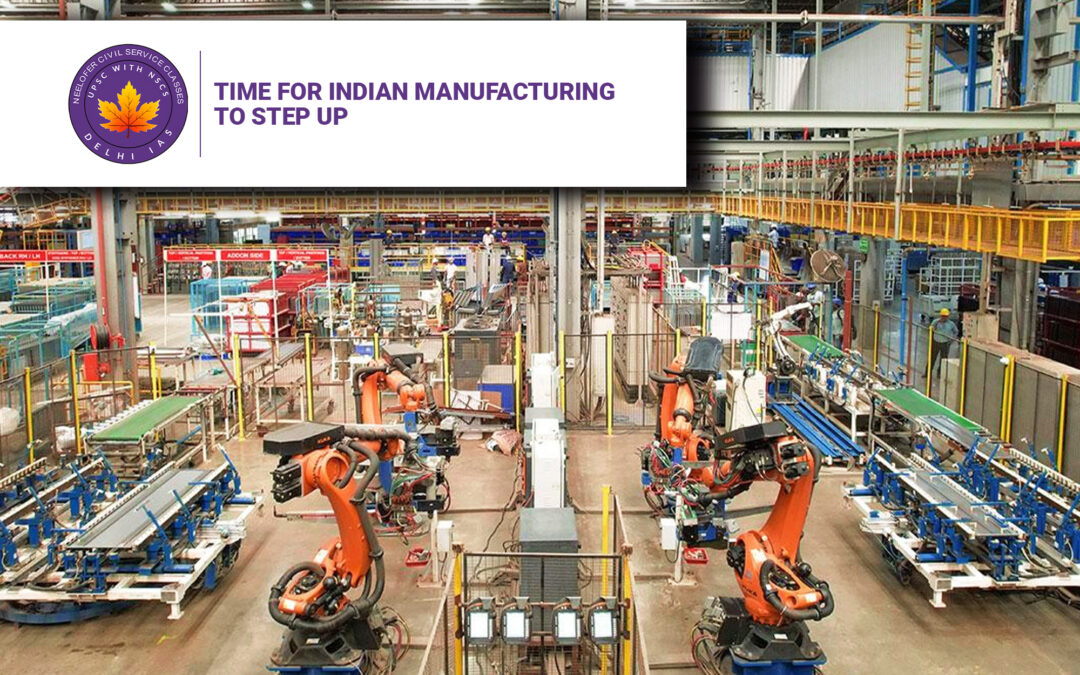
Time for Indian Manufacturing to Step Up
Why in News?
With former US President Donald Trump’s tariff policies (like the so-called “Liberation Day” tariffs) and the global trend of de-risking supply chains, there is renewed urgency for India to strengthen its manufacturing base. This move is seen not only as a shield against external shocks but also as a long-overdue push toward economic self-reliance. 
Introduction
Tariff wars and global economic uncertainties have exposed the vulnerabilities of countries that heavily depend on imports or limited trading partners. India, which has long struggled to build a competitive manufacturing sector, is once again at a crossroads. While some nations retaliated against US tariffs, India has opted for a more conciliatory approach—choosing negotiation and internal reforms over confrontation.
Key Issues Highlighted
-
India’s Manufacturing Underperformance
-
Manufacturing makes up just 13–14% of India’s GDP and 2% of exports, much below the target of 25%.
-
Despite programs like Make in India and Atmanirbhar Bharat, India hasn’t become a global manufacturing powerhouse.
-
-
Global Context and Competitive Pressure
-
Countries like China, with better infrastructure, lower costs, and proactive policies, dominate global manufacturing.
-
India, by contrast, faces high land and power costs, red tape, labour issues, and a lack of scale.
-
-
Policy Framework and Institutional Support
-
The National Manufacturing Policy (NMP) and PLIs (Performance Linked Incentives) are well-intentioned, but poorly implemented.
-
There is also no clear focus on specific sectors like electronics, pharma, or auto where India could lead globally.
-
-
Structural Bottlenecks
-
Problems include land acquisition delays, poor logistics, labour rigidity, and tax disputes.
-
These issues make manufacturing unviable for both domestic and foreign investors.
-
-
Need for Unified State-Centre Coordination
-
Despite announcements and slogans, the lack of coordination between the Union and states has weakened implementation.
-
Without joint action, India’s economic transformation will remain incomplete.
-
Five Key Observations
-
India’s manufacturing share in GDP is stagnant at 13–14%, far from the 25% target.
-
Despite large youth demographics, India hasn’t capitalized on labour-intensive global supply chains.
-
Repeated policy attempts have failed to deliver a globally competitive manufacturing ecosystem.
-
Major hurdles include infrastructure, regulation, and lack of clear sectoral focus.
-
A true manufacturing revolution needs coordination between central and state governments.
Challenges and the Way Forward
-
Administrative Reform: States must simplify procedures for land, power, logistics, and legal compliance.
-
Sectoral Focus: India should choose a few strategic sectors and concentrate resources and policy support there.
-
Innovation and Scale: Private firms must scale up with innovation and global branding, not just rely on government subsidies.
-
Labour and Tax Reform: Urgent changes needed to make labour flexible and taxation investor-friendly.
-
Skill Building: A skilled and semi-skilled workforce aligned with industry needs must be a top priority.
Conclusion
India has the potential to become a major global manufacturing hub, but time is running out. Without targeted reforms, genuine Centre-State cooperation, and bold industrial policy, India risks missing yet another opportunity. The goal should not be to merely respond to external threats like US tariffs, but to build internal resilience and become an export powerhouse.
Q&A Section
Q1. Why is Indian manufacturing lagging behind?
Due to poor infrastructure, regulatory hurdles, lack of scale, and inconsistent policies despite numerous initiatives like Make in India.
Q2. How do global tariff threats impact India?
Tariffs by major economies (e.g., US) push countries to seek alternative trading partners. If India strengthens manufacturing, it can benefit from diverted trade.
Q3. What percentage of India’s GDP comes from manufacturing?
Currently, only 13–14%, which is far below the target of 25% set by the government.
Q4. What are PLIs and are they effective?
Performance Linked Incentives (PLIs) are government schemes offering incentives based on output. While promising, their effectiveness depends on execution.
Q5. What is the biggest obstacle to manufacturing in India?
Apart from infrastructure and regulatory issues, the lack of coordination between Centre and States is seen as a major bottleneck.
