
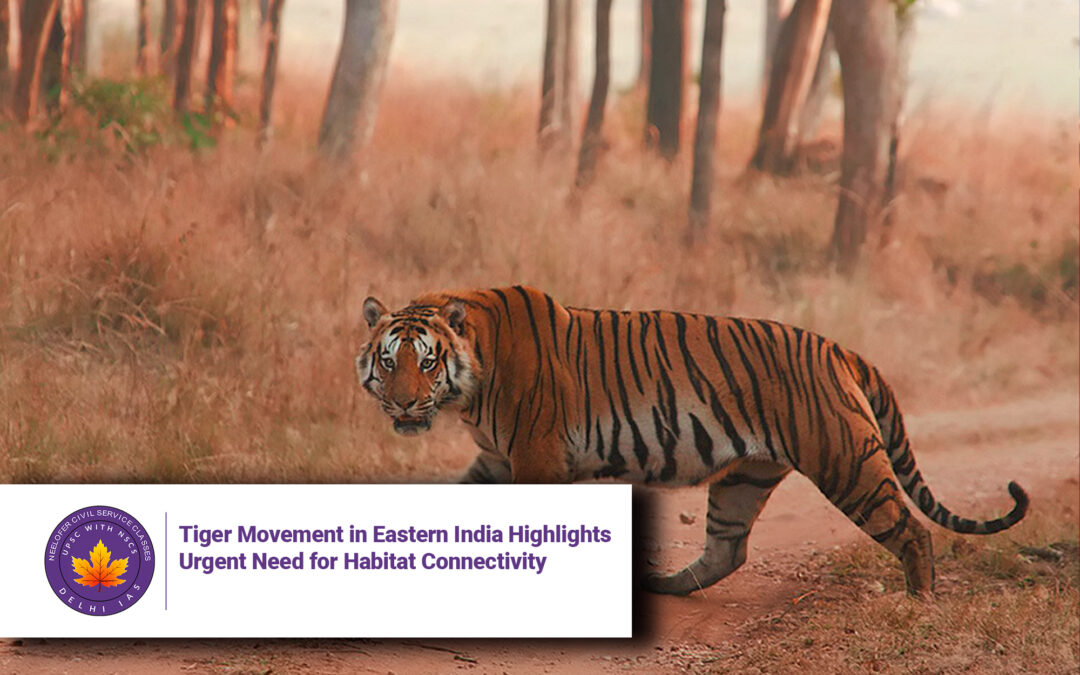
Tiger Movement in Eastern India Highlights Urgent Need for Habitat Connectivity
Why in News?
A male tiger was recently rescued from a house in Silli, Jharkhand, near the West Bengal border, and relocated to Palamu Tiger Reserve. This event highlights growing tiger movement across eastern India as young males search for territory and mates due to habitat gaps. 
Introduction
Tiger dispersal and long-range movement have increased significantly in eastern India over the past few years. This includes movements from Madhya Pradesh and Chhattisgarh into Jharkhand, Odisha, and West Bengal. The observed patterns raise important concerns about habitat fragmentation and the absence of resident tigresses in these landscapes.
Key Observations
-
The rescued tiger had entered Jharkhand via Chhattisgarh and had been photographed in Palamu and Dalma earlier.
-
Multiple tigers have been reported walking long distances—often hundreds of kilometers—in search of prey and partners.
-
Wildlife corridors such as the Tadoba-Kanha corridor and others are critical transit routes but remain poorly connected.
-
At least six tiger dispersals and one return movement were recorded in Palamu since 2021.
-
Many of these lone males are termed “floaters,” as they do not settle and continue roaming.
Challenges
-
Lack of resident tigresses: The absence of breeding females leads to continuous male dispersal and conflict with humans.
-
Fragmented corridors: Movement is hindered by agriculture, human settlements, and infrastructure development.
-
Rising conflict: As tigers enter human-dominated areas, cases of livestock killing and human-wildlife encounters increase.
From Source to Sink: The Ecological Cycle
In conservation terms, a source site is a breeding ground while a sink site is a region where tigers migrate to, often without successful reproduction. Palamu and Simlipal serve more as sink areas due to poor connectivity and inadequate female presence.
Way Forward
-
Habitat restoration: Improve and reconnect corridors like Bandhavgarh-Palamu and Tadoba-Kanha.
-
Female tiger presence: Introduce and retain tigresses to stabilize local tiger populations.
-
Conflict mitigation: Early detection and community awareness must be strengthened to reduce encounters.
Conclusion
The tiger’s long walk across eastern India underlines the urgent need for better landscape connectivity and habitat management. Without adequate planning, these dispersal movements will continue to cause ecological imbalance and human-animal conflict.
5 Q&A
Q1. Why was a tiger rescued from Silli, Jharkhand recently?
A: It had wandered from Palamu Tiger Reserve in search of territory and was found near a human settlement.
Q2. What is a ‘floater’ tiger?
A: A floater is a male tiger that moves continuously without settling, often due to lack of mates or prey.
Q3. What are tiger movement corridors?
A: These are forested pathways that allow safe movement between tiger reserves, such as Tadoba-Kanha or Simlipal-Palamu.
Q4. Why is there an imbalance in tiger populations in eastern India?
A: The absence of resident females, fragmented habitats, and human encroachments lead to high male dispersal and low breeding success.
Q5. What is the suggested solution to this ecological challenge?
A: Enhancing landscape connectivity, introducing resident tigresses, and minimizing human conflict through early warning systems and community engagement.

