
The Terror Trio of Pakistan, Hizb-ul-Mujahideen, LeT, and JeM Under Global Scrutiny
Why in News?
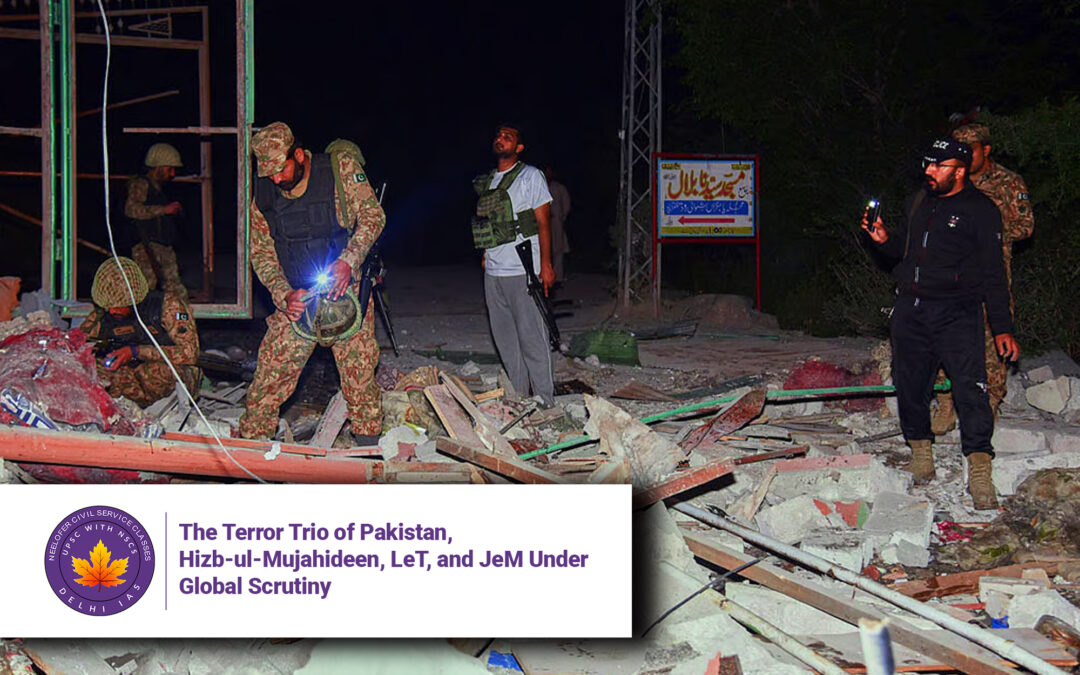
India recently launched Operation Sindoor following a terrorist ambush in Poonch on April 22 that killed several soldiers. Intelligence reports confirmed that the attack was coordinated by Pakistan-based terror groups — Hizb-ul-Mujahideen, Lashkar-e-Taiba (LeT), and Jaish-e-Mohammed (JeM) — all of which have long-standing links with Pakistan’s military-security establishment. 
Introduction
For over three decades, three major Islamist terrorist groups—Hizb-ul-Mujahideen, LeT, and JeM—have orchestrated deadly attacks inside India, especially in Jammu and Kashmir. These groups are not only driven by anti-India ideology but also receive backing and shelter from Pakistani military intelligence (ISI) and political forces. Despite mounting international pressure, Pakistan continues to harbor and support these organizations.
Key Groups and Background
1. Hizb-ul-Mujahideen (HM)
-
Founded in 1989 as the armed wing of Jamaat-e-Islami, Hizb-ul-Mujahideen aimed to merge Jammu and Kashmir with Pakistan.
-
Led by Syed Salahuddin, the group once dominated militancy in Kashmir Valley.
-
It recruits locally and externally from Pakistani-administered areas, operating training camps and receiving weapons via Pakistani intelligence channels.
-
Salahuddin became a UN-designated global terrorist in 2017.
-
Although its strength has weakened in recent years, it maintains influence via underground networks in Kashmir.
2. Lashkar-e-Taiba (LeT)
-
LeT, or “Army of the Pure,” was founded in the 1990s and is linked to the Markaz-ud-Dawa-Wal-Irshad.
-
Led by Hafiz Saeed, the group is accused of the 2008 Mumbai attacks, killing 166 people.
-
LeT operates from Muridke, near Lahore, and is supported through charities, schools, and madrasas.
-
Hafiz Saeed has been designated a global terrorist by the UN and the U.S., though Pakistan continues to shelter and protect him.
-
LeT has been involved in infiltration, grenade attacks, and cross-border firing in Jammu and Kashmir.
3. Jaish-e-Mohammed (JeM)
-
Founded by Masood Azhar in 2000 after his release from an Indian jail during the IC-814 hijacking crisis.
-
JeM has carried out major attacks like the 2001 Parliament attack, 2016 Pathankot attack, and 2019 Pulwama suicide bombing.
-
Azhar operates freely in Bahawalpur, Pakistan, under ISI protection despite being designated a global terrorist.
-
JeM is known for high-profile suicide missions, especially targeting Indian security forces.
Key Observations
-
These groups have deep links with Pakistan’s Army and ISI, often enjoying state-level protection.
-
Despite repeated international condemnation and Financial Action Task Force (FATF) scrutiny, Pakistan has failed to dismantle their operational networks.
-
They often exploit humanitarian organizations as fronts for terror recruitment and logistics.
-
India continues to face security challenges due to these outfits, prompting targeted counter-terror operations in sensitive regions.
Conclusion
The persistent activities of Hizb-ul-Mujahideen, Lashkar-e-Taiba, and Jaish-e-Mohammed reinforce concerns about Pakistan’s state-sponsored terrorism. These groups remain central to cross-border militancy and destabilization efforts in Kashmir. India’s counter-terror strategies must evolve to confront both the ideological and institutional backing these organizations continue to receive.
5 Questions and Answers
Q1. What is the main objective of Hizb-ul-Mujahideen?
Answer: To merge Jammu and Kashmir with Pakistan through armed insurgency.
Q2. Who leads Lashkar-e-Taiba and what is it infamous for?
Answer: Hafiz Saeed leads LeT, which is infamous for orchestrating the 2008 Mumbai terror attacks.
Q3. What major attack is Jaish-e-Mohammed responsible for in recent times?
Answer: JeM carried out the 2019 Pulwama suicide bombing which killed 40 CRPF personnel.
Q4. What common trait links all three terror groups?
Answer: All three are Islamist militant groups operating from Pakistan with support from Pakistan’s military-security establishment.
Q5. How has the international community responded to these groups?
Answer: The UN and countries like the U.S. have designated their leaders as global terrorists, and the FATF has pressured Pakistan to curb their activities, though enforcement remains weak.

