
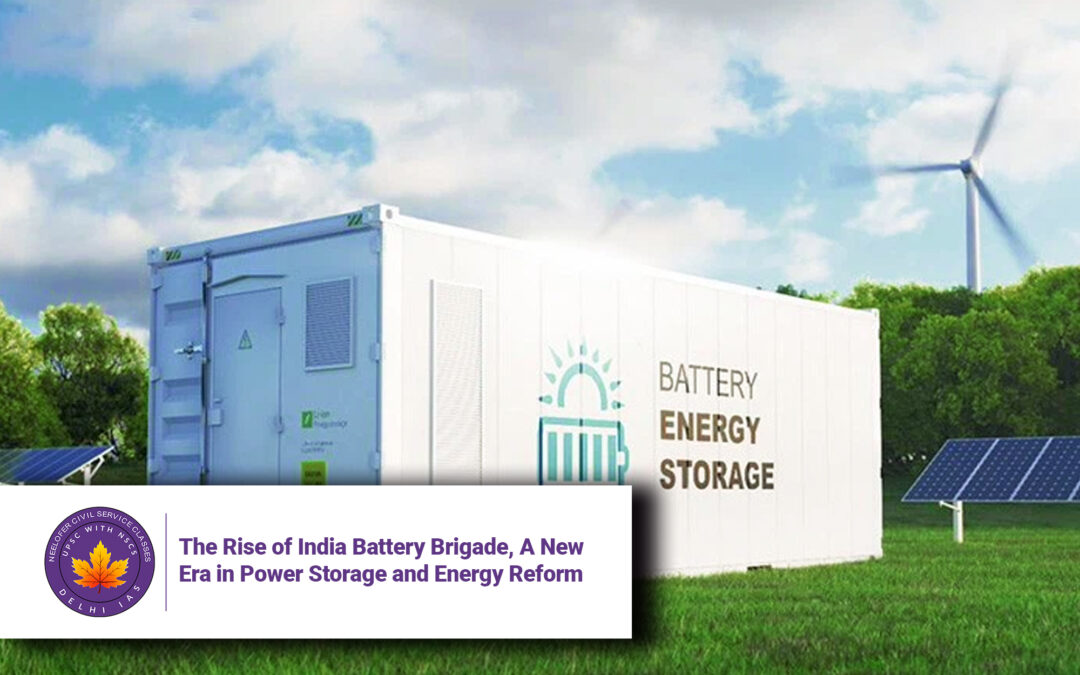
The Rise of India Battery Brigade, A New Era in Power Storage and Energy Reform
Why in News?
Electricity regulators in Maharashtra and Gujarat recently approved large-scale battery storage projects to be set up by their respective state-owned utilities. Delhi has already taken the lead by operationalizing one such unit a few months ago. With declining battery prices and increasing focus on renewable energy (RE), these developments mark a significant step toward stabilizing India’s clean energy supply and promoting utility reforms. Batteries are now poised to revolutionize the Indian energy landscape by improving reliability, lowering tariffs, and empowering consumers.
Introduction
India is witnessing a pivotal transformation in its energy infrastructure, driven by the growing integration of battery storage systems. Traditionally reliant on inconsistent renewable sources and struggling with tariff distortions, India’s electricity sector has long faced challenges in both generation and supply stability. However, with the adoption of new battery technologies and falling global prices, the country stands at the threshold of a power storage revolution.
Electricity regulators in states like Maharashtra, Gujarat, and Delhi are taking bold steps to incorporate battery storage into mainstream energy systems. These units are designed not to generate electricity, but to store it, particularly excess energy generated by solar farms during the day, for use when the sun isn’t shining—like during the evening peak hours. This initiative is expected to play a crucial role in maintaining grid stability and improving access to clean, reliable, and affordable energy.
Key Issues and Institutional Concerns
1. Storage vs. Generation
Battery systems do not produce electricity. Their main function is to store energy when production is high and demand is low and release it when demand spikes or when RE generation falters. This means utilities need to balance production, storage, and distribution to meet consumer demand effectively.
2. Dependency on Weather and Climate Patterns
Even though India has increased its capacity for renewable energy, RE supply is still subject to climatic fluctuations—such as sunlight variability due to clouds, rain, or seasonal shifts. Batteries provide an essential buffer, but their effectiveness depends on proper sizing and strategic usage. For example, India’s summer peak demand was lower this year due to an early monsoon and reduced heat spells. Such variations require utilities to constantly analyze demand and adapt battery deployment accordingly.
3. Limited Duration of Battery Discharge
Current battery technologies usually act as stop-gaps for about 1–2 hours. Their charge often doesn’t last through the evening peak or overnight demand. Therefore, they must be used judiciously and complemented with other energy sources. Long-term reliability is also a function of how quickly newer, more durable technologies (e.g., non-lithium-based batteries) can be adopted at scale.
4. Tariff and Utility Reform
India’s electricity tariffs are heavily distorted. State-run utilities often subsidize households and farms by charging higher tariffs to commercial users. This imbalance discourages competitiveness and drives commercial consumers to set up their own solar systems. Batteries, by offering load-balancing and backup solutions, can help loosen the grip of utilities and encourage tariff restructuring based on actual costs.
5. Technology and Infrastructure Gaps
Only 10% of India’s billing meters are digitized. This lack of data severely limits dynamic pricing mechanisms that could help optimize power usage. Smart meters and digitized billing could allow consumers to shift power-intensive activities (like EV charging or laundry) to off-peak hours, lowering their bills and easing grid stress.
Challenges and the Way Forward
-
Scaling Battery Storage Nationwide
While Maharashtra, Gujarat, and Delhi are leading the charge, other states need to follow suit. The Centre’s support in terms of viability gap funding is crucial, but coordination between central and state-level stakeholders must improve for uniform implementation. -
Ramping Up Domestic Manufacturing
To reduce dependency on imports and ensure price stability, India needs to encourage domestic battery manufacturing. This would also align with the broader “Make in India” initiative and provide employment opportunities. -
Technology Diversification
The future lies not just in lithium-ion batteries but also in alternative chemistries like sodium-ion or flow batteries, which offer superior safety, longer duration, and lower costs. Investing in R&D and pilot projects is necessary to assess and scale these technologies. -
Policy and Regulatory Push
India needs a modernized regulatory framework that accommodates the dynamic nature of battery storage. This includes tariff reforms, time-of-use pricing, and incentives for decentralized storage adoption. -
Smart Meter Penetration
Deeper penetration of smart meters is essential for real-time data, dynamic pricing, and efficient load management. This requires both technological investment and consumer awareness.
Conclusion
The battery revolution in India is more than a technological shift—it is a systemic transformation that can change how power is produced, stored, and consumed. By enabling a cleaner, more reliable, and fairer energy market, storage batteries have the potential to democratize power access, stimulate private investment, and drive tariff reforms.
As battery prices continue to decline and technology matures, India must seize this opportunity to create a resilient energy ecosystem. A forward-thinking policy environment, combined with innovation and consumer empowerment, can truly unleash the power of India’s battery brigade.
Q&A Section
Q1: Why are battery storage systems being promoted in India now?
A: Battery storage systems are gaining popularity in India due to a combination of falling global battery prices, the growing share of renewable energy, and the need for grid stability. These systems allow utilities to store excess electricity generated by solar farms during the day and release it during peak demand periods, such as in the evening or during overcast conditions.
Q2: What are the benefits of integrating batteries into the Indian power sector?
A: Batteries offer multiple benefits:
-
Stabilizing renewable energy supply
-
Filling in during grid failures (like transformer outages)
-
Reducing reliance on fossil fuels
-
Supporting tariff reform by making power pricing more reflective of actual usage patterns
-
Empowering consumers through better load management and potential bill reduction
Q3: What are the key challenges in adopting battery storage widely across India?
A: Major challenges include:
-
Limited discharge duration (1–2 hours for current batteries)
-
High upfront costs
-
Inadequate digitization (only 10% of meters are smart)
-
Limited local manufacturing capacity
-
Need for tariff and policy reform to incentivize adoption
Q4: How does battery adoption help in tariff restructuring?
A: Batteries can allow consumers to store energy when tariffs are low and use it when they are high. This reduces dependence on state-run utilities and creates pressure to reflect real-time costs in tariffs. With dynamic pricing, consumers could lower their bills and industries could regain competitiveness, ultimately driving utility reform.
Q5: What is the role of new battery technologies like sodium-ion in India’s energy future?
A: Non-lithium chemistries like sodium-ion promise lower cost, superior safety, and better performance, especially for long-duration applications. Their successful integration could make battery storage more economically viable and scalable across different sectors in India, from households to large industries.

