
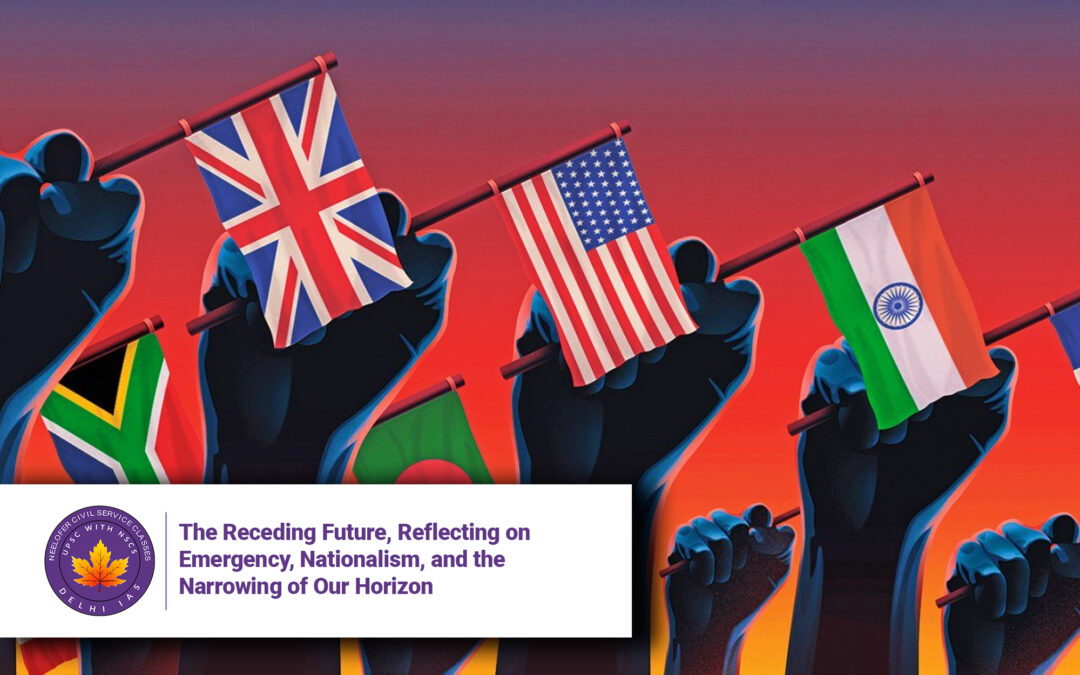
The Receding Future, Reflecting on Emergency, Nationalism, and the Narrowing of Our Horizon
Why in News?
Amidst India’s 50th anniversary of the Emergency, public discourse has reignited debates around nationalism and historical memory. Prominent political thinkers like Pratap Bhanu Mehta argue that while remembering the past is important, excessive focus on it may limit our imagination and readiness to shape the future. 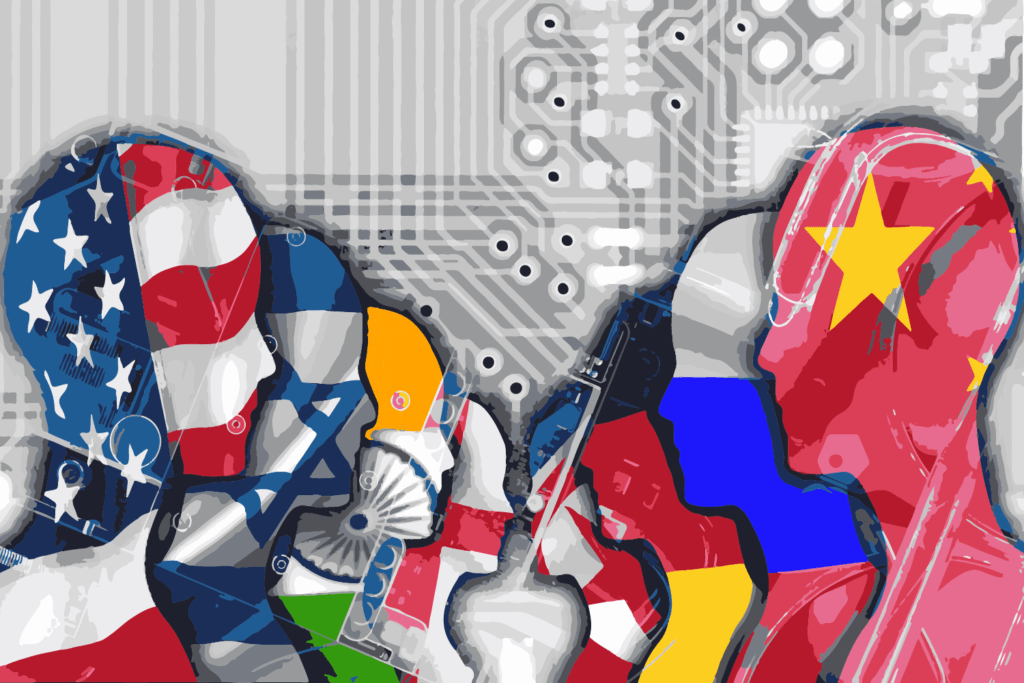
Introduction
Referencing the reflections of Haruki Murakami and the political churn in India, Pratap Bhanu Mehta’s commentary draws attention to the tendency to be consumed by history — particularly, the Emergency era and questions of nationalism. This obsession, he warns, risks obscuring present-day democratic challenges and distracts from preparing for future transformations.
Key Issues and Institutional Concerns
1. Over-reliance on Historical Framing
Debates around “good” vs. “bad” nationalism often begin and end with historical figures like Nehru, Indira Gandhi, and Ambedkar. Such reflections, while valuable, can trap us in moralistic binaries, limiting new ways of thinking.
2. Evading Contemporary Governance Challenges
The article stresses that present-day democratic and constitutional issues such as free speech, civic participation, legal autonomy, and economic justice are not being addressed substantively because debates remain fixated on legacy politics.
3. Performance Politics over Policy Substance
Many current public figures and intellectuals engage in rhetorical nationalism, offering symbolic gestures and blame rather than concrete solutions. This leads to performative politics where the form overshadows function.
4. Narrowing of Political Imagination
The nostalgia-fueled focus on “who was right or wrong in the past” has led to a shrinking of the imagination, where new frameworks to define freedom, equality, and inclusion are rarely discussed or proposed.
5. Urgency of Moral and Institutional Clarity
With global democratic backsliding, India’s challenge is to chart a path that balances historical understanding with moral and institutional renewal, especially in the face of social, environmental, and economic crises.
Conclusion
As India reflects on its past and marks milestones like the Emergency’s anniversary, the greater test lies not in how accurately we remember the past but in how boldly we imagine the future. Debates around nationalism must not become tools to shut down dialogue or fuel authoritarian trends. Instead, they should inspire renewed commitment to liberty, pluralism, and justice.
Q&A Section
1. Q: What is the main concern raised in the article by Pratap Bhanu Mehta?
A: That India’s political discourse is overly focused on historical events like the Emergency, limiting its ability to address present and future democratic challenges.
2. Q: Why is the obsession with past nationalism problematic?
A: It leads to moral binaries and performative politics, preventing meaningful engagement with current issues like free speech, equality, and policy innovation.
3. Q: What does Mehta propose as the real issue at stake?
A: The erosion of moral and political imagination, and the need to clarify what values — like justice, equality, and freedom — should guide our institutions today.
4. Q: How does the article view the current state of political debate?
A: It criticizes the debate for being more about historical score-settling and identity posturing than constructive, forward-thinking problem solving.
5. Q: What is suggested as the way forward?
A: To focus less on who was “right or wrong” in history, and more on building a future-oriented politics rooted in inclusive values and institutional strength.

