
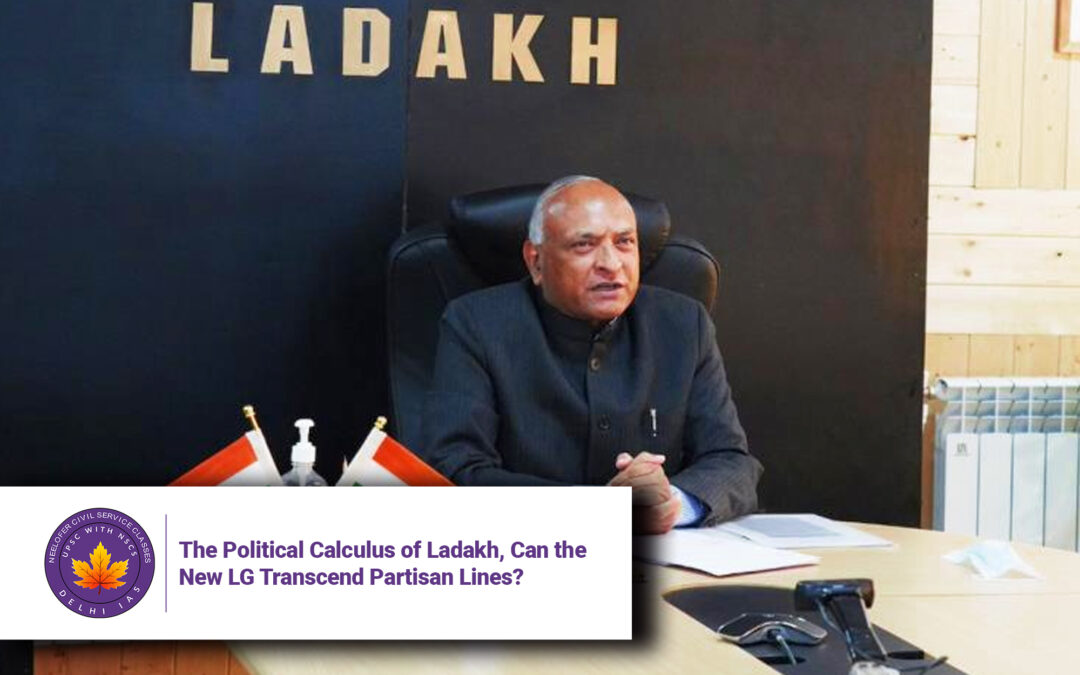
The Political Calculus of Ladakh, Can the New LG Transcend Partisan Lines?
Introduction
The Union Territory (UT) of Ladakh, carved out from Jammu and Kashmir in 2019, continues to occupy a critical yet complex space in India’s political landscape. The region, often referred to as India’s strategic crown due to its geographical positioning, has been at the crossroads of democratic aspirations, cultural identity, and national security imperatives. With the recent appointment of Kavinder Gupta—a senior BJP leader from Jammu and former Deputy Chief Minister of Jammu and Kashmir—as the new Lieutenant Governor (LG) of Ladakh, the political temperature in the UT has once again risen.
In a context where LG appointments are often deeply political and reflective of broader party strategies, questions are now being raised: Will Mr. Gupta rise above partisan interests to address the legitimate concerns of Ladakh’s people? Or is his appointment another strategic move by the Centre to consolidate political control and maintain the BJP’s dominance in the region?
This article explores the nuances behind Gupta’s appointment, the political realities in Ladakh, the Centre’s evolving strategies in UT governance, and the implications for democratic federalism in India.
The Context of LG Appointments: A Political Tool?
India’s Constitution provides for the appointment of Governors and Lieutenant Governors as representatives of the President in states and Union Territories. Although expected to be apolitical, these appointments have long been instruments of political strategy by successive central governments—cutting across party lines.
However, what was once subtle has now become blatant. The LGs are often party loyalists or sidelined leaders being accommodated with gubernatorial roles. This trend has accelerated under the current regime, where the Raj Bhawan (Governor House) is frequently transformed into an outpost of the ruling party’s political agenda rather than a neutral constitutional office.
Kavinder Gupta’s appointment fits squarely into this pattern. A seasoned BJP leader from Jammu, with deep ties to the party’s ideological fountainhead—the Rashtriya Swayamsevak Sangh (RSS)—Gupta has no administrative experience in Ladakh and lacks the stature of previous governors who could act independently of political pressures.
Ladakh’s Political Climate: A Brewing Storm
Since its separation from Jammu and Kashmir and elevation to Union Territory status, Ladakh has witnessed growing unrest over a range of issues: lack of elected representation, delayed implementation of Sixth Schedule protections, environmental degradation, and the dilution of domicile rights.
The two districts—Leh and Kargil—although culturally distinct, have united on key issues like democratic empowerment, job reservations, and land rights. The people have consistently demanded a legislative assembly, constitutional safeguards, and greater autonomy. The Centre’s failure to fulfill pre-UT promises has led to the emergence of powerful civil society coalitions, such as the Leh Apex Body and Kargil Democratic Alliance, demanding a more accountable governance structure.
The resignation of two prominent Ladakhi leaders—Thupstan Chhewang, a former MP with RSS ties, and Nawang Rigzin Jora, a senior Congress figure—has intensified the demand for leadership that genuinely represents Ladakh’s interests. Their departure signifies the people’s disillusionment with both national parties and their inability to address regional aspirations.
The Gupta Factor: Strategically Placed or Tactically Flawed?
Appointing Mr. Gupta as LG is not merely administrative; it’s symbolic and strategic. He is the first politician to be appointed as LG of Ladakh—signaling a shift from bureaucratic neutrality to political control. His roots in Jammu’s Mahajan community, a core BJP vote bank, and his status as a middle-rung leader make him a manageable ally for the central leadership. This allows the Centre to retain firm control while appearing responsive.
However, Mr. Gupta’s appointment also reflects the growing political insecurities of the BJP in the region. In Jammu, the party faces anti-incumbency and unfulfilled promises. In Ladakh, its electoral base is shrinking. By sending a loyalist from Jammu, the BJP may be attempting to reconsolidate its base and use Ladakh as a launchpad to influence political sentiments back in Jammu.
But this strategy is not without risks. Ladakhis are increasingly politically aware, and Gupta’s appointment may be seen as an imposition rather than a gesture of goodwill. His lack of political clout and administrative record in dealing with Ladakh-specific issues could weaken his ability to mediate disputes or lead with legitimacy.
Will the LG Act as a Bridge or a Barrier?
Ladakh is a UT without an elected Legislative Assembly, which gives the LG sweeping executive powers. With no opposition leader or elected government to challenge him, the LG assumes an outsized role in decision-making. This makes Gupta’s role critical, not just symbolically but functionally.
The question is: Will he use this authority to empower local voices or suppress them in favor of Delhi’s agenda?
A genuine LG would:
-
Strengthen local governance mechanisms
-
Engage civil society groups and religious leaders
-
Champion Sixth Schedule protections
-
Push for a Legislative Assembly in Ladakh
-
Mediate between the people and the Centre on the promises made during UT formation
Will Gupta be able to do any of this?
Given his background, the concern is that he might instead act as a conduit for BJP’s electoral ambitions, maintaining the Hindutva narrative, managing dissent, and controlling political mobilization in a way that serves party interests—not Ladakh’s aspirations.
The RSS Connection: A Double-Edged Sword
Gupta’s long-standing relationship with the RSS adds another layer to his appointment. While RSS influence has helped create a strong cadre-based party system in regions like Jammu, its cultural and political ethos is viewed with suspicion in Ladakh, especially in the Buddhist-majority Leh and the Shia-dominated Kargil.
The RSS ideology of cultural homogenization runs contrary to Ladakh’s distinct ethnic, religious, and ecological identity. If Gupta attempts to implement policies that resonate with RSS or BJP ideologies without local consultation, it could fuel resistance and further alienate Ladakhis.
At the same time, his RSS background might enable him to muster bureaucratic discipline and connect with the broader Sangh Parivar network to expedite development works—if used prudently and not dogmatically.
Centre’s Dilemma: Control vs Credibility
The Union government today faces a tough balancing act:
-
It wants to control Ladakh strategically, due to its border with China and Pakistan, which makes the region geopolitically invaluable.
-
It wants to maintain a democratic facade, especially on the international stage, as it promotes itself as the world’s largest democracy.
-
It cannot afford a civil uprising in Ladakh, as it would dent the success narrative around the abrogation of Article 370 and 35A.
Appointing someone like Gupta allows the government to exercise influence without visible suppression, but it may come at the cost of legitimacy and public trust.
Ladakh’s Civil Society: A Powerful Force
The greatest wildcard in this political equation is the mobilized civil society of Ladakh. Over the past few years, activists, youth groups, religious institutions, and former politicians have come together on common demands:
-
Constitutional safeguards under the Sixth Schedule
-
Restoration of democratic institutions
-
Environmental protection in the ecologically fragile zone
-
Transparent governance and control over land and jobs
This unity between Leh and Kargil is unprecedented and could serve as a counterweight to any top-down imposition from the Centre or the LG. Gupta’s real test will be in how he engages with these voices.
The Road Ahead: Choices That Define Legacies
Mr. Gupta has two paths before him:
-
Act as a party emissary, maintaining a tight grip on Ladakh’s political landscape, quelling dissent, and pushing a nationalistic agenda that mirrors BJP’s electoral strategy.
-
Rise above partisan interests, mediate between the people and Delhi, and become a transformative leader who strengthens federalism and democratic accountability in the region.
The choice he makes will not just determine his personal legacy, but also Ladakh’s political future.
Conclusion: Will History Repeat or Reform?
The appointment of Kavinder Gupta as LG of Ladakh is not a mere bureaucratic shuffle. It’s a litmus test for India’s federal democracy. It will show whether the Centre is willing to respect local aspirations and empower its Union Territories—or if it continues using constitutional offices as extensions of party politics.
If Gupta chooses diplomacy, humility, and constitutionalism over political expediency, he could become a rare example of a party appointee who transcends his brief. If not, he risks being remembered as another tool in the larger machinery of centralization and control.
As the people of Ladakh watch keenly, the question remains—Will the new LG rise above party lines? Or will Ladakh’s fight for justice continue, now against a new face of familiar challenges?

