

The Number of Overweight and Obese People is Rising in India, Including Children and Adolescents
Why in News?
Prime Minister Narendra Modi, in his Mann ki Baat address on Friday, highlighted the growing issue of obesity in India. Citing statistics from a recent Lancet study, he mentioned that 44 crore people in India may become obese by 2050. This alarming projection emphasizes the need for immediate action. 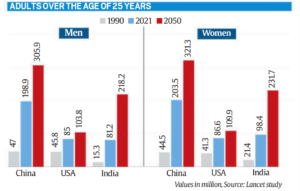
Introduction
Obesity and overweight are escalating health concerns in India. A Lancet study has revealed a disturbing increase in obesity prevalence, particularly among children and adolescents. The issue is compounded by lifestyle shifts and dietary changes, and reversing this trend requires a multi-pronged approach.
Key Features
-
Who Is Considered Obese?
Obesity is measured using Body Mass Index (BMI). A BMI of 30 or greater qualifies as obese. Those with BMI between 25 and 30 are considered overweight. For children and adolescents aged 5 to 19, the measurement considers weight-for-height and gender norms recommended by the International Obesity Task Force. -
What Do the Estimates Say?
The number of overweight and obese people in India is on the rise. By 2050, India may overtake China in obesity numbers:- Adults over 25 years:
India may have the highest number of obese adults by 2050. - Children & Adolescents (5-19 years):
India is predicted to have the highest prevalence, with an expected 244% increase over the next 30 years. - Older Adolescents (15-19 years):
A 121% increase is forecasted by 2050.
- Adults over 25 years:
-
Who Is Most at Risk, and Where in the World?
According to Lancet data:-
Children and Young Adolescents (5-14 years)
- Boys:
- 1990: China (13M), USA (4.3M), India (4.1M)
- 2022: China (18.3M), India (13.9M), USA (7.5M)
- 2050 (Projected): India (16.1M), China (13.3M), Nigeria (8.1M)
- Girls:
- 1990: China (5.4M), India (4.5M), USA (3.1M)
- 2022: China (12.4M), India (12.4M), USA (7.5M)
- 2050 (Projected): India (15.6M), China (10.6M), Egypt (10.1M)
- Boys:
-
Older Adolescents (15-19 years)
- Young Men:
- 1990: China (9.1M), USA (6.1M), India (3.9M)
- 2022: China (16.8M), India (16.3M), USA (10.5M)
- 2050 (Projected): India (19.5M), China (14.8M), Nigeria (11.9M)
- Young Women:
- 1990: USA (7.7M), China (6.2M), India (3.3M)
- 2022: China (15.0M), India (10.9M), USA (10.1M)
- 2050 (Projected): India (16.9M), China (11.9M), USA (11.9M)
- Young Men:
-
Adults Over Age 25
- Men (Values in millions):
- 1990: China (47M), USA (45.8M), India (31M)
- 2022: China (305.9M), USA (85.6M), India (103.8M)
- 2050 (Projected): China (529.7M), USA (124.4M), India (228.2M)
- Women (Values in millions):
- 1990: China (44.5M), USA (45.8M), India (31.2M)
- 2022: China (308.9M), USA (86.9M), India (103.2M)
- 2050 (Projected): China (531.9M), USA (130.8M), India (231.7M)
- Men (Values in millions):
-
Specific Impacts or Effects
- Obesity significantly increases the risk of infections and severe diseases.
- Higher healthcare costs are inevitable due to chronic conditions associated with obesity, such as Type 2 diabetes, heart disease, and joint disorders.
- Premature deaths and complications are common among obese individuals.
- Economic productivity may decline due to health issues caused by obesity.
Challenges and the Way Forward
Challenges
- Shift towards processed foods, high in sugar, salts, and fats.
- Multinational food and beverage corporations aggressively market unhealthy foods in countries like India.
- Regulatory gaps have been exploited, leading to a higher per-capita increase in ultra-processed food consumption.
- Inadequate healthcare access and quality treatment remain obstacles.
- Rising treatment costs due to suboptimal health outcomes.
Steps Forward
- Coordinated Action
National policies are needed to regulate food production and distribution. - Improving Diet
Encourage consumption of healthy diets, limit sugary beverages, and introduce taxes on unhealthy food products. - Promote Physical Activity
Increased awareness and physical activity campaigns are necessary to curb obesity rates. - Focus on Clinical Management
Enhancing treatment quality and early intervention is critical, particularly for economically disadvantaged populations.
Conclusion
India faces a growing obesity epidemic, particularly among children and adolescents. Without intervention, obesity rates are expected to rise dramatically by 2050. A concerted effort involving policy changes, dietary shifts, and healthcare improvements is crucial to reversing this trend.
Questions and Answers
-
What is BMI, and why is it important in determining obesity?
BMI (Body Mass Index) is a measure of body fat based on weight and height. A BMI over 30 is classified as obese. -
Which countries are projected to have the highest number of obese adults by 2050?
China, India, and the USA. -
What factors are driving the obesity epidemic?
Diets high in sugars, salts, and fats, along with sedentary lifestyles and aggressive food marketing. -
What health risks are associated with obesity?
Increased risk of infections, Type 2 diabetes, heart disease, and premature death. -
What are the projections for overweight/obese children in India by 2050?
India is projected to have 16.1 million obese boys and 15.6 million obese girls aged 5-14 years. -
What is the expected increase in obesity prevalence among adolescents in India?
A 244% increase is forecasted over the next 30 years. -
How does obesity impact healthcare costs?
It raises treatment costs due to chronic diseases and the need for prolonged care. -
What role do multinational corporations play in rising obesity rates?
They market high-calorie foods aggressively in countries like India, contributing to dietary shifts. -
What regulatory actions are recommended?
Implementing taxes on unhealthy foods, regulating advertising, and promoting healthy food distribution. -
Why is early intervention in obesity treatment important?
It reduces healthcare costs and improves long-term health outcomes.

