
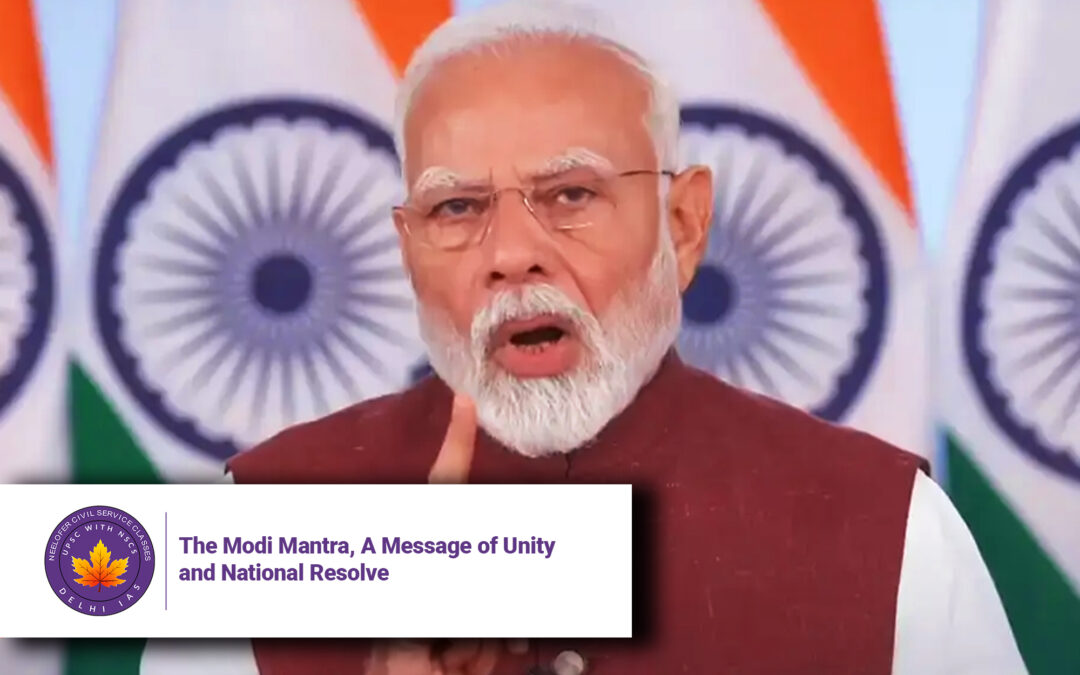
The Modi Mantra, A Message of Unity and National Resolve
Why in News?
In the backdrop of escalating tensions with Pakistan and internal divisions among political factions, Prime Minister Narendra Modi delivered a powerful and uncompromising message. His recent address not only emphasized national security but also called for political unity and warned both left-wing critics and right-wing hyper-nationalists to not weaken the national cause. 
Introduction
Prime Minister Modi’s strong and clear message serves as a strategic response to Pakistan’s aggression and also to internal voices of discontent. His speech, centered around the importance of unity, resilience, and national integrity, strikes a balance between strategic assertiveness and domestic political discipline.
Key Issues and Background
-
Backdrop: Pakistan’s Escalation and Indian Response
-
Tensions flared up due to Pakistan’s involvement in a terror attack in Jammu.
-
India responded with Operation Shatru, and the use of high-tech drone and missile warfare.
-
Pakistan’s provocations were condemned, and the need for national consensus was reiterated.
-
-
PM Modi’s Clear Communication Strategy
-
Modi avoided dramatic rhetoric or direct threats. Instead, he highlighted India’s calm and calculated strength.
-
His statement — “This is not an India that will bow down to pressure” — reinforced a strong international and domestic signal.
-
-
Balancing the Political Narrative
-
PM Modi criticized both:
-
The left/liberal critics who constantly accuse the government of overreach or nationalism.
-
The ultra-nationalists on the right who push for aggressive retaliation without considering broader consequences.
-
-
His core message: Strategic patience backed by preparedness is the true strength of modern India.
-
-
India’s Preparedness and Strategic Clarity
-
He emphasized military readiness and firm intelligence coordination.
-
The government’s calm response to Pakistani aggression reflects maturity and long-term vision, not weakness.
-
-
Appeal for Unity Over Division
-
Modi warned against internal bickering at a time of external threats.
-
Urged political leaders, media, and citizens to put national interest above partisan politics.
-
Five Key Takeaways
-
India will not be provoked into impulsive reactions—the response will be strategic and strong.
-
National unity is essential during times of external aggression.
-
Criticism without constructive support weakens national morale.
-
Hyper-nationalism can be just as damaging as defeatism.
-
Political maturity, restraint, and readiness define New India’s strength.
Challenges and the Way Forward
Challenges:
-
Growing political polarization and media sensationalism.
-
Difficulty in building consensus during national security emergencies.
-
Managing public expectations driven by emotional nationalism.
Way Forward:
-
Establish a unified national security doctrine supported by all parties.
-
Promote responsible media coverage during conflict situations.
-
Encourage bipartisan cooperation in Parliament during crises.
-
Invest further in military modernization and cyber defense.
Conclusion
Prime Minister Modi’s address is not just a diplomatic or military message—it is a moral and strategic call for unity. In an era of high-speed information warfare and real-time provocations, India must remain calm, decisive, and united. The Modi mantra is simple yet powerful: Act with strength, but not in anger.
Q&A Section
1. What triggered PM Modi’s recent strong statement?
It came in response to Pakistan’s provocation through terror attacks and military aggression, and internal political bickering during a time of crisis.
2. What is the central message of ‘The Modi Mantra’?
The message is about national unity, strategic calmness, and internal discipline, rejecting both extreme nationalism and constant criticism.
3. Why did Modi criticize both left and right factions?
He believes both excessive criticism and blind hyper-nationalism weaken India’s strength and distract from the real goal: protecting the nation.
4. How did Modi frame India’s military response?
He emphasized that India is ready, but responses will be measured and strong, not emotional or reactive.
5. What is expected of citizens and leaders in such times?
They should put the nation first, avoid divisive debates, and stand behind strategic decisions made for national security.
