
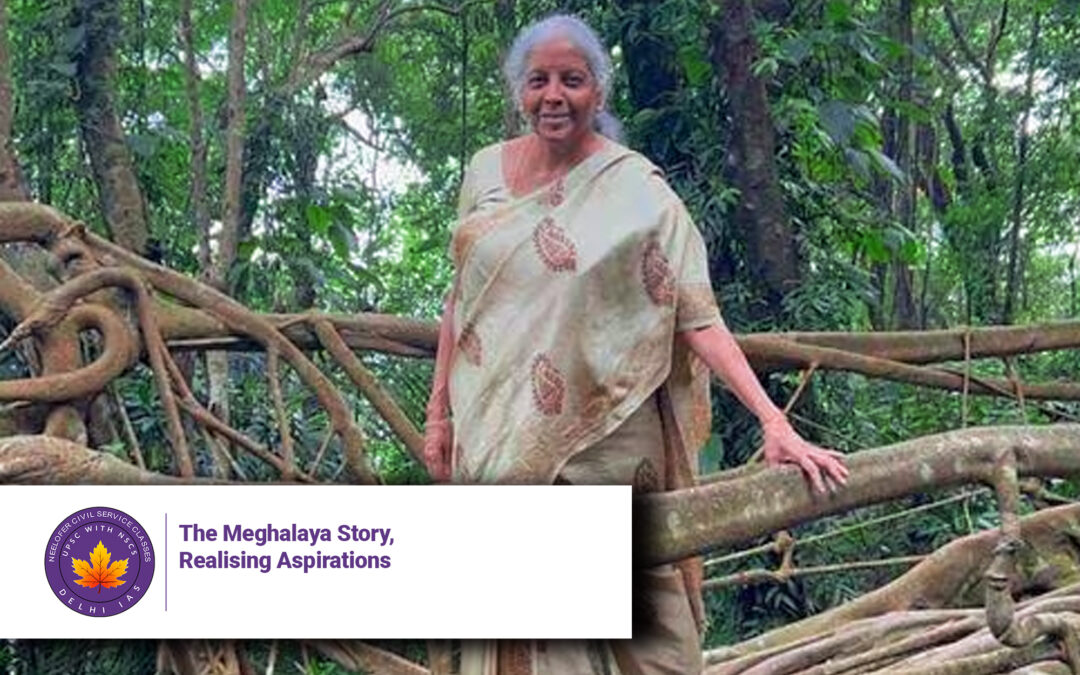
The Meghalaya Story, Realising Aspirations
Why in News?
The Union Finance Minister, Nirmala Sitharaman, recently shared her insights in The Hindu about her visit to Meghalaya and the visible transformation taking place across the state. From border village development to youth empowerment, and from innovative farming techniques to women-led entrepreneurship, Meghalaya is crafting a unique development narrative. The Finance Minister’s observations shed light on how central government initiatives, combined with local leadership and community participation, are helping Meghalaya realise its aspirations and serve as a model for sustainable and inclusive growth in India’s northeastern region. 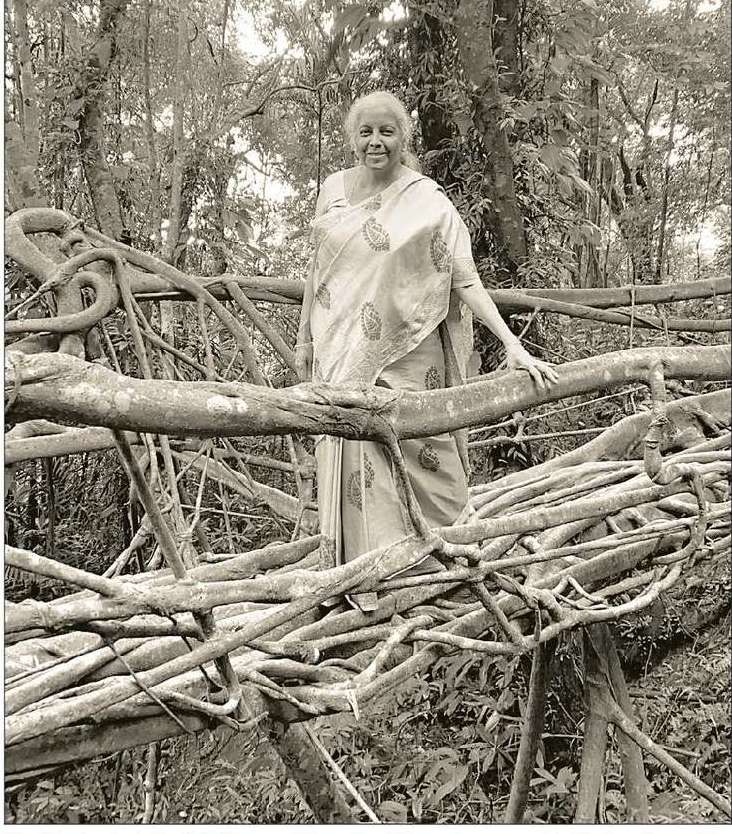
Introduction
Meghalaya, nestled in the lap of the Eastern Himalayas, has long captivated India with its natural beauty, cultural richness, and strong tribal heritage. However, in recent years, it has also emerged as a beacon of rural transformation, youth mobilisation, and women empowerment. The state’s progress is not accidental but the result of deliberate policy execution, grassroots governance, and the untiring spirit of its people. The Finance Minister’s firsthand account of her visit highlights several key aspects of this transformation, including better roads, empowered youth, revitalised border villages, thriving SHGs (Self Help Groups), and agricultural innovation. This signals a broader shift from geographical isolation to economic integration, from aspiration to achievement.
Key Issues
1. Historical Infrastructure Gaps
Meghalaya’s challenging geography and scattered settlement patterns historically created major logistical issues. Poor road connectivity and underdeveloped transportation links restricted access to education, healthcare, and markets. The road from Guwahati to Shillong itself used to be narrow, traffic-laden, and risky. Villages closer to the Bangladesh border were especially neglected in infrastructure investments, leading to underdevelopment and social alienation.
2. Lack of Opportunities for Youth
The youth of Meghalaya and the larger North East have always been full of talent and creativity. However, many lacked the platforms and exposure to turn their talents into livelihoods. Skilled in music, art, and crafts, many young people found it difficult to break into mainstream economic avenues due to lack of access to vocational training, mentorship, or startup ecosystems.
3. Agricultural Underutilisation
Despite a wealth of biodiversity, Meghalaya’s farming sector remained underutilised. Traditional methods, low investment in innovation, and weak supply chains hindered the commercialisation of unique crops like Lakadong turmeric, ginger, and mushrooms. Farmers lacked exposure to global markets and struggled with packaging, branding, and value addition.
4. Border Village Neglect
Many of the border villages near Bangladesh were previously left behind in national development efforts. These villages suffered from poor civic infrastructure, limited state presence, and a lack of public services. Such neglect often led to migration, low morale among residents, and weak local economies.
5. Limited Economic Empowerment of Women
Despite the matrilineal nature of Meghalaya’s Khasi society, economic participation of women remained largely informal and unorganised. Though women have traditionally played a strong role in household and community affairs, limited access to formal finance, skill-building, and enterprise support restricted their potential to become drivers of the local economy.
Major Developments and Government Initiatives
1. Transformation of Physical Infrastructure
The Shillong-Guwahati highway is now a wide, smoke-free corridor of progress — an important symbol of infrastructural development. The road has enabled easier transportation of goods, tourism, and administrative outreach. Moreover, interior roads to border villages have been developed, and connectivity is being extended under PM Gati Shakti and the Bharatmala Pariyojana.
In places like Majai, near the Bangladesh border, new roads, drinking water facilities, electricity supply, and community halls have dramatically improved the standard of living.
2. Youth Empowerment through PM Vishwakarma
The PM Vishwakarma Scheme aims to support traditional artisans and young talent by providing modern tools, skill training, credit, and branding support. During her visit, the Finance Minister met a 22-year-old youth named Niko S. Khriem from Nagaland, trained in sound production and passionate about music. Under PM Vishwakarma, young people like him are being equipped to convert their talents into sustainable careers.
Other schemes like PM Kaushal Vikas Yojana and Skill India are playing a major role in channeling youth energy into productive avenues.
3. SHG-led Rural Economy
Women’s SHGs have become a backbone of Meghalaya’s rural economy. Federated and supported through the National Rural Livelihoods Mission (NRLM), these groups have taken over sectors ranging from food processing to garment design and floriculture. In villages like Lahumn Mary Blah, women are running garment stores, bakeries, and flower boutiques. The Finance Minister met SHG members who recounted how they moved from home-makers to entrepreneurs — managing credit, running shops, and creating employment.
The availability of bank credit, financial literacy, and e-commerce platforms has further boosted these ventures.
4. Agricultural Innovation and Export Potential
The Lakadong turmeric of Meghalaya is considered the world’s best in curcumin content. With the help of the Lakadong Mission, farmers are now trained in scientific farming, processing, and packaging. The turmeric is now being branded and marketed outside India, adding value to the entire production chain.
Another inspiring story is that of a young entrepreneur who grows and exports shiitake mushrooms to Europe and Southeast Asia. With minimal inputs and the use of innovative log-based cultivation, he has turned a niche crop into a global business. Similarly, the cultivation of black turmeric and Meghalaya ginger is being supported by the Indian Council of Agricultural Research (ICAR) and agricultural universities.
5. Border Village Vibrancy
Under the Vibrant Villages Programme, India is turning its border habitations into centers of opportunity and pride. In the village of Majai, developments include solar power installations, water supply, community toilets, and internet connectivity. The presence of the Border Security Force (BSF), community-level governance, and empowered panchayats has made residents feel secure and valued.
The Finance Minister’s observation that “the country’s borders are safe when its border villages are strong” underscores this vital shift in border strategy from mere surveillance to integration and development.
Alternative Approaches and Innovations
-
Public-Private Partnerships (PPP) – Involving private sector partners in sectors like agri-tech, tourism, and infrastructure could scale up development and reduce the financial burden on the state.
-
Eco-Tourism Development – Sustainable tourism around Meghalaya’s living root bridges, waterfalls, and cultural hubs can generate local jobs and preserve ecology.
-
Digital Market Access – Promoting SHG products and agricultural goods through platforms like ONDC (Open Network for Digital Commerce) can help rural entrepreneurs directly reach urban and international consumers.
-
Regional Skill Clusters – Establishing cluster-specific training centres focused on music, food processing, textiles, or organic farming would make youth training more relevant and market-oriented.
Challenges and the Way Forward
1. Climate and Environment Risks
Meghalaya is prone to heavy rains, landslides, and deforestation. Climate-smart development must be a priority while pursuing industrial and tourism expansion.
2. Market Access
While production has increased, access to national and international markets remains a bottleneck. Logistics, branding, and compliance with global standards require more support.
3. Retaining Local Talent
Educated youth often migrate to bigger cities for jobs. Meghalaya must continue to improve local employment and entrepreneurship options to prevent brain drain.
4. Bureaucratic Delays
Though many schemes are active on paper, delays in fund release, implementation gaps, and lack of local capacity can hamper success. Strong monitoring and grievance redressal systems are needed.
5. Inclusion of Remote Communities
Special efforts must be made to include especially remote or tribal communities in development programmes. Language, cultural barriers, and geographic distance often lead to exclusion.
Conclusion
The Meghalaya story is one of hope, hard work, and harmonious development. With empowered women, ambitious youth, vibrant villages, and sustainable agriculture, the state is living proof that inclusive growth is possible even in the most geographically challenged regions. The Finance Minister’s visit and the narratives she shared present Meghalaya not as a recipient of charity, but as a contributor to India’s growth engine.
This transformation holds lessons for the entire country — that local culture, community participation, and strategic government intervention can together create a future that is not just aspirational but achievable. Meghalaya’s journey is not yet over, but it is firmly on the path toward becoming a truly Atmanirbhar (self-reliant) and Viksit Bharat (developed India) state.
Five Questions and Answers
Q1. What is the primary objective of the PM Vishwakarma Scheme as observed in Meghalaya?
A: The PM Vishwakarma Scheme aims to empower traditional artisans and young talent with skills, tools, financial aid, and market access to create sustainable livelihoods.
Q2. What role are SHGs playing in Meghalaya’s rural development?
A: SHGs, particularly women-led, are driving rural development by starting businesses in floriculture, bakeries, garments, and other areas, supported by training, credit, and marketing support.
Q3. Why is Lakadong turmeric from Meghalaya special?
A: Lakadong turmeric is known for its exceptionally high curcumin content, making it valuable for health, export, and commercial farming, and is now part of global value chains.
Q4. What transformation has taken place in the border village of Majai?
A: Majai has seen the development of roads, electricity, water supply, solar power, toilets, and community infrastructure, turning it into a model village near the Bangladesh border.
Q5. What are the key challenges facing Meghalaya despite its progress?
A: Major challenges include climate vulnerability, market access barriers, migration of skilled youth, bureaucratic delays, and inclusion of remote tribal communities.

