
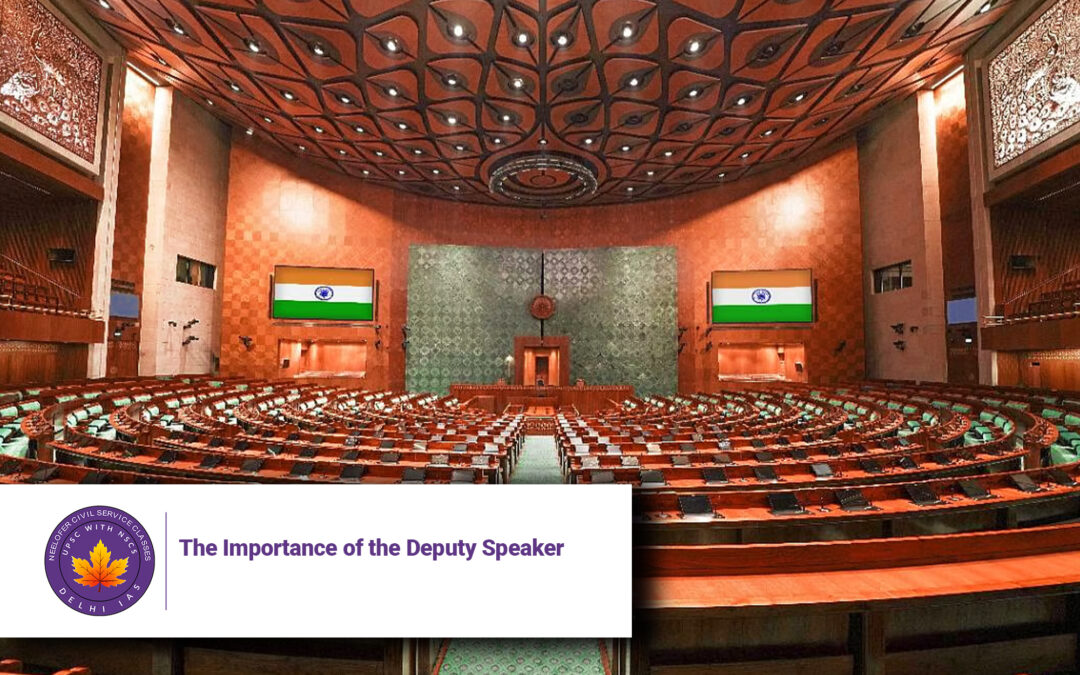
The Importance of the Deputy Speaker
Why in News?
The Deputy Speaker’s post in the Lok Sabha has been lying vacant since 2019, raising serious concerns over constitutional adherence, democratic values, and the smooth functioning of Parliament. The issue has now come under renewed debate as the 18th Lok Sabha begins its work with the position still unfilled. 
Introduction
The Deputy Speaker is not a mere substitute for the Speaker. He plays a vital role in maintaining the continuity of legislative work, especially in the Speaker’s absence. This office has both constitutional backing and parliamentary importance, and conventionally, it is given to a member of the Opposition to ensure balance and bipartisan functioning.
Key Issues
-
Vacancy Since 2019
-
The post has remained vacant throughout the 17th Lok Sabha (2019–24).
-
No Deputy Speaker was appointed, despite Article 93 of the Constitution mandating that the Lok Sabha shall “choose two members… as Speaker and Deputy Speaker.”
-
-
Democratic Concerns
-
Parliament functions on discussions, debates, and the healthy check of powers.
-
The prolonged vacancy raises questions about weakening checks and balances and an erosion of democratic consensus.
-
-
Convention Violated
-
Traditionally, the post is offered to the Opposition, allowing a fair sharing of powers.
-
Withholding this position may signal centralisation of power and deliberate weakening of constitutional customs.
-
Constitutional and Procedural Details
-
Article 93 of the Constitution states that the Lok Sabha shall choose a Speaker and Deputy Speaker “as soon as may be.”
-
However, the Constitution does not specify a deadline.
-
According to Rule 8 of the Rules of Procedure and Conduct of Business in Lok Sabha (1952), the election must be held on such date as the Speaker may fix.
-
Article 180 of the Constitution gives the Deputy Speaker the power to preside in the absence of the Speaker.
Implications of Prolonged Vacancy
-
Undermines the separation of powers and neutral oversight.
-
Weakens the Opposition’s role in Parliament.
-
May lead to constitutional uncertainty and deviation from parliamentary tradition.
-
In case of vacancy or removal of the Speaker, the absence of a Deputy Speaker can cause disruption in legislative business.
Challenges and the Way Forward
-
Challenge: Government reluctance to give the post to the Opposition.
-
Challenge: Ambiguity in the phrase “as soon as may be,” which lacks a defined time frame.
-
Way Forward: Institutional respect for traditions must be upheld by promptly appointing a Deputy Speaker and restoring balance.
Conclusion
The Deputy Speaker’s role is not ceremonial—it is central to the democratic ethos and operational integrity of the Lok Sabha. Prolonged vacancy not only weakens institutional checks but also threatens constitutional conventions. The government must address this issue with urgency to uphold parliamentary credibility and democratic balance.
5 Questions and Answers
Q1: What does Article 93 of the Constitution say about the Deputy Speaker?
A: It mandates that the Lok Sabha shall choose a Speaker and Deputy Speaker “as soon as may be,” but does not specify a timeline.
Q2: Why is the post of Deputy Speaker important?
A: The Deputy Speaker maintains the continuity of legislative work, presides in the absence of the Speaker, and upholds neutrality in debates.
Q3: What is the conventional practice regarding the Deputy Speaker’s post?
A: It is generally given to the Opposition to ensure bipartisan representation and checks on ruling party power.
Q4: What are the concerns arising from the current vacancy?
A: Democratic imbalance, violation of constitutional conventions, and weakening of institutional oversight.
Q5: Has a Deputy Speaker been appointed in the 18th Lok Sabha?
A: No, the Government of India has not appointed a Deputy Speaker in the 18th Lok Sabha as well, continuing the trend from the 17th Lok Sabha.

