
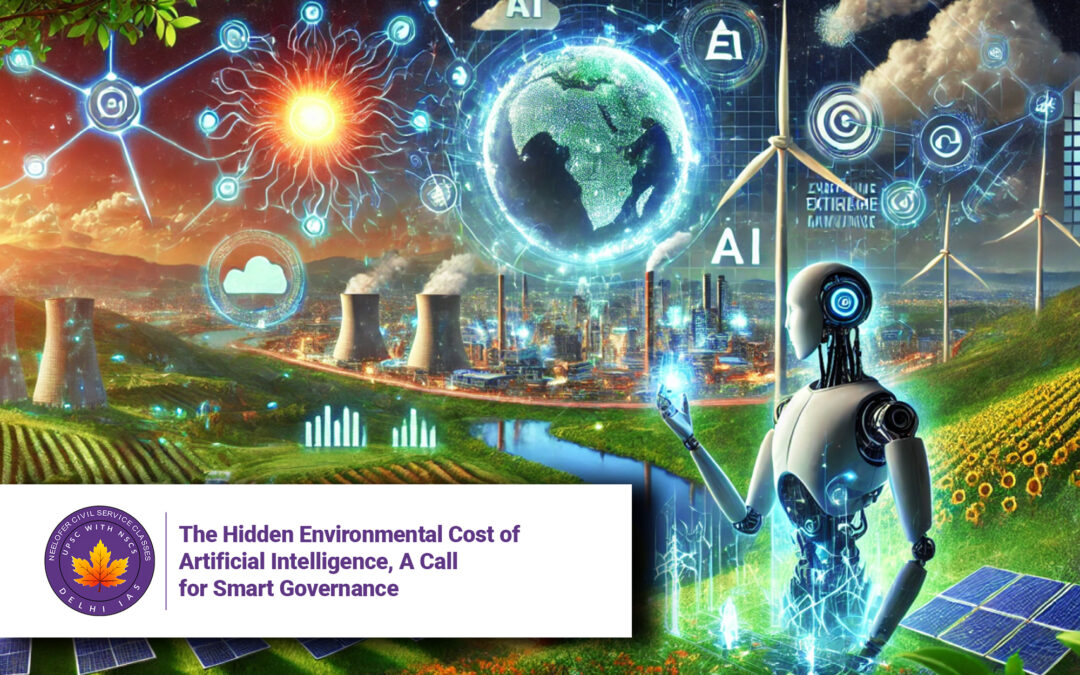
The Hidden Environmental Cost of Artificial Intelligence, A Call for Smart Governance
Why in News?
As Artificial Intelligence (AI) becomes increasingly central to science, industry, and public policy, experts are sounding alarms about its environmental impact. While AI is praised for its problem-solving capabilities and climate-related research, its carbon footprint, energy consumption, and unregulated expansion present serious risks to the planet. An opinion piece by Niyati Anand highlights this growing concern.

Introduction
AI has emerged as a revolutionary force in various domains, helping forecast floods, diagnose diseases, and combat illegal fishing. Its application in environmental research, such as detecting deforestation or soil erosion, has made it a vital ally in climate action.
However, beneath this promising surface lies an uncomfortable truth: AI’s development and deployment come with significant environmental costs. From resource extraction to high energy consumption, AI may be doing more harm than good to the Earth — unless governed wisely.
Key Issues and Institutional Concerns
1. AI’s Profit-Driven Development
The expansion of AI is largely profit-motivated, with corporations investing heavily in AI to maximize returns.
-
AI is used to analyze massive datasets, including energy and resource exploration.
-
Deep learning models aid in identifying untapped oil and gas reserves, promoting overproduction and environmental degradation.
-
Startups and tech giants like Amazon and Google hype AI breakthroughs to attract investors, often hiding environmental trade-offs.
2. AI’s Massive Environmental Footprint
Training and running advanced models like ChatGPT and GenAI consume vast amounts of electricity.
-
According to the UN Environment Programme, a single AI query uses far more energy than a Google search.
-
Complex models require more computation and have a larger carbon footprint.
-
Once trained, AI models continue to use electricity every time they operate.
-
The expansion of data centers, which need large volumes of water for cooling, adds further stress on environmental resources.
3. Carbon Emissions & Sustainability Trade-offs
As more powerful AI tools are released frequently, greenhouse gas emissions are surging — often outweighing the potential emissions saved by AI-assisted solutions.
Challenges and the Way Forward
4. Need for Smart Governance
If left unregulated, AI could be misused for short-term profits, accelerating unsustainable consumption.
The author suggests that to counter these risks:
-
Governments must prioritize public interest, focusing on sustainability and environmental impact.
-
State-funded AI initiatives should promote low-carbon technologies.
-
Scientific and academic institutions must lead AI use in climate resilience and sustainable development.
5. Redefining AI’s Purpose
We are not passive recipients of AI. By actively shaping its direction, we can redefine AI’s role — from a tool of exploitation to a sustainable ally.
Conclusion
AI offers immense benefits, but its unchecked growth poses environmental threats that cannot be ignored. The solution lies not in halting innovation but in governing it wisely — aligning AI development with environmental protection and social welfare. With smart governance and responsible use, AI can become part of the solution, not the problem.
Q&A Section
Q1. What environmental concerns are associated with AI technology?
A1. AI consumes massive energy, contributes to carbon emissions, and promotes unsustainable resource extraction, especially during the training and operation of large models.
Q2. How does AI development encourage overproduction?
A2. AI is often used by corporations to find new oil and gas reserves or automate industrial production, which leads to overconsumption of limited natural resources.
Q3. Why is AI more energy-intensive than traditional search engines?
A3. According to the UN Environment Programme, a single AI search uses far more energy than a basic Google search due to complex computations required in AI models.
Q4. What governance measures are suggested to control AI’s impact?
A4. Governments should regulate AI use, support public-interest research, fund low-carbon AI projects, and prevent corporate misuse for profit-driven agendas.
Q5. What is the article’s main message regarding AI and the environment?
A5. While AI has potential, it must be governed responsibly to ensure it contributes positively to sustainability goals rather than accelerating environmental degradation.

