
About The Future of Ukraine, Europe, and US Relations:
Diplomacy in the Spotlight
On February 28, the world witnessed a dramatic diplomatic moment when Ukrainian President Volodymyr Zelenskyy met with US President Donald Trump and Vice President JD Vance at the Oval Office. Unlike traditional high-level meetings, this one played out under the full glare of the press, with cameras capturing every moment. 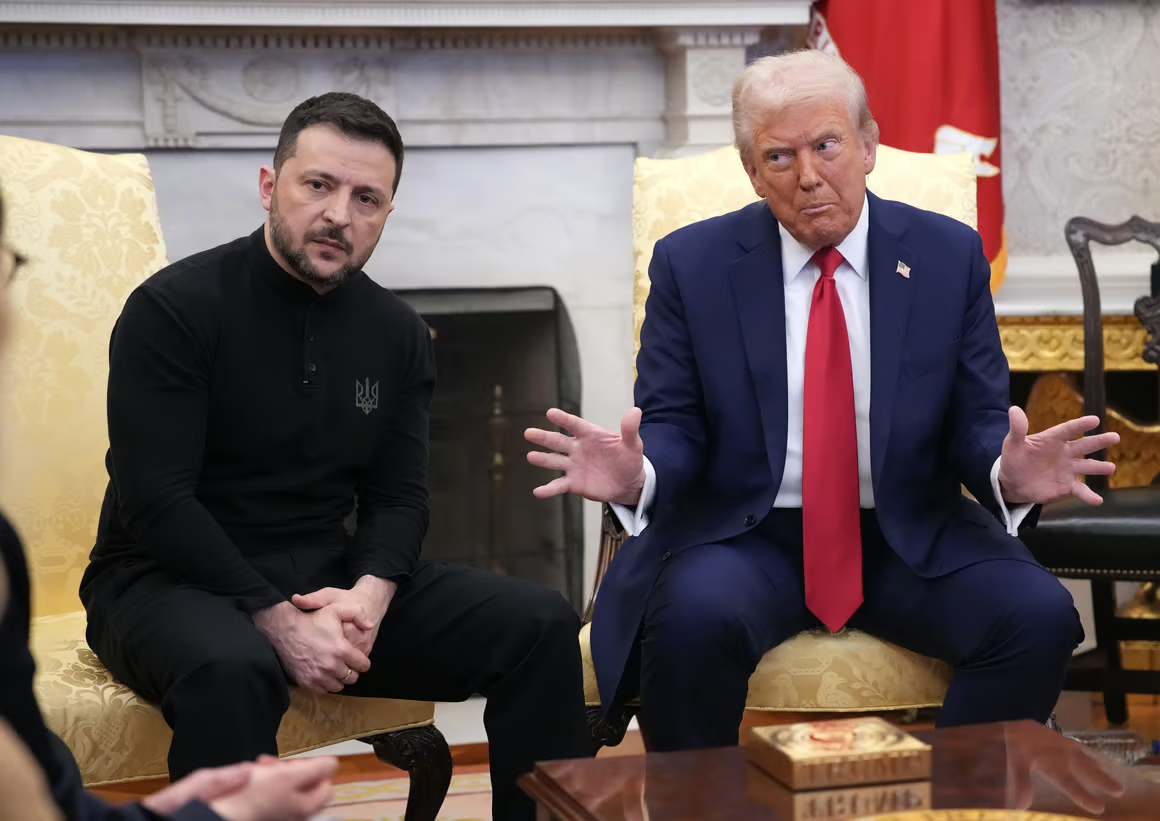
What started as a seemingly amicable exchange between Trump and Zelenskyy quickly unraveled into a heated debate. When a journalist questioned Vice President Vance about the Biden administration’s Ukraine policies, he launched into a harsh critique, dismissing the previous government’s approach and suggesting that Trump had a more effective diplomatic strategy.
Zelenskyy, sensing the need to defend his country’s position, questioned Trump’s diplomatic efforts, which quickly escalated into a three-way exchange of sharp words. The Ukrainian delegation, expecting a productive lunch meeting, was instead left in shock and dismay as tensions flared in full public view.
Republican Support for Trump’s Foreign Policy Shift
Following the Oval Office confrontation, most Republican leaders backed Trump’s stance, seeing his tough approach to Ukraine as a necessary recalibration of US foreign policy. While some members of the Republican Party remained silent, others openly criticized Zelenskyy’s stance.
One rare exception was Senator James Lankford of Oklahoma, who had previously criticized Russian President Vladimir Putin on national television. However, even Lankford supported Trump’s broader efforts to engage Russia in diplomatic talks, signaling that Republican priorities may be shifting.
This episode sends a strong message to Ukraine—Washington is no longer offering unconditional support. The Trump-Vance policy now emphasizes diplomacy with Russia over prolonged conflict. For Ukraine, this raises an urgent question: Can it rely on the US as a steadfast ally?
Trump’s Stance on Russia: A Fundamental Shift?
Unlike previous US administrations, Trump has shown a willingness to seek dialogue with Putin, a position that has both supporters and detractors. His approach to Russia is shaped by three key factors:
- Admiration for strong leaders– Trump has, in the past, expressed respect for authoritarian figures like Putin, Viktor Orbán (Hungary), and Xi Jinping (China).
- A shift in ideological alliances– Trump’s preference for nationalist, Christian, and conservative leaders has shaped his foreign policy lens.
- A pragmatic approach to global geopolitics– Trump sees the conflict in Ukraine as a drain on US resources and views negotiation with Russia as a potential solution.
This stance puts European nations in a difficult position. If the US pulls back its support, Europe will have to either step up its commitments to Ukraine or seek alternative diplomatic solutions.
Europe’s Dilemma: Should It Lead or Follow?
Faced with growing US reluctance to back Ukraine unconditionally, European leaders are stepping in to fill the void. Recently, French President Emmanuel Macron and UK Prime Minister Keir Starmer have explored ways to ensure Ukraine’s security without full reliance on Washington.
During a recent high-level meeting in London, Macron and Starmer signaled their commitment to Ukraine, yet stopped short of making sweeping military promises. They hope to pressure Trump into maintaining some level of US involvement, but recognize that Europe must start taking greater responsibility for its own security.
However, this presents a major challenge:
- Europe lacks a unified military command– Unlike the US, European nations have separate defense strategies, making coordinated action difficult.
- Economic constraints– Sustaining long-term military aid to Ukraine requires significant funding, which not all European nations are willing to commit.
- Political divisions– Some European leaders, like Italy’s Giorgia Meloni and Hungary’s Viktor Orbán, favor a softer stance on Russia, further complicating European unity.
The Future of the Transatlantic Alliance
Historically, the transatlantic alliance between the US and Europe has endured challenges. Despite policy disagreements over the decades, including disputes over NATO contributions, military interventions, and economic policies, the alliance has remained strong.
However, Trump’s unpredictable foreign policy approach is raising doubts about the stability of US-European relations. Many European leaders fear that Trump’s “America First” philosophy could permanently weaken the transatlantic partnership.
After World War II, the US and Europe faced serious crises that tested their alliance, such as:
- The Suez Crisis (1956)– The US pressured Britain, France, and Israel to withdraw from Egypt, leading to diplomatic tensions.
- The Iraq War (2003)– The US invasion of Iraq, led by George W. Bush, created major rifts between America and key European allies like Germany and France.
Yet, these crises did not break the alliance—instead, they often strengthened cooperation over time. The question now is whether the US and Europe can weather the current uncertainty over Ukraine.
The High Cost of Uncertainty: What Comes Next?
In the wake of Trump’s wavering stance on Ukraine, the risk of European instability is growing. If Trump continues to push for reduced US involvement, Europe may face:
- Increased pressure from Russia– A weakened transatlantic alliance could embolden Putin, increasing security risks for Eastern European nations.
- Financial strain– European governments may be forced to increase defense spending, straining national budgets.
- Geopolitical uncertainty– A fractured alliance between the US and Europe could create an opportunity for China to expand its influence in global affairs.
At a recent security conference in London, UK Prime Minister Keir Starmer summed up the current reality:
“We are at a crossroads in history.”
Starmer’s remarks reflect the growing recognition that Europe must take on greater responsibility for Ukraine’s future. However, doing so will come at a high cost—one that European leaders must carefully weigh in the coming months.
Conclusion: A Defining Moment for Global Diplomacy
The Oval Office confrontation between Trump, Vance, and Zelenskyy has brought deep geopolitical rifts into full public view. With the US reassessing its global commitments, Europe seeking greater autonomy, and Ukraine fighting for survival, the world is witnessing a major shift in international relations.
The coming months will determine whether:
- The US maintains its leadership role in global security, or
- Europe steps up to fill the void left by Washington’s retreat.
As global powers navigate this high-stakes diplomatic transformation, one thing is certain—the decisions made today will shape the geopolitical landscape for years to come.

