
The Forced Sterilisations of Emergency, A Dark Chapter of Indian Democracy
Why in News?
India marks the 50th anniversary of the Emergency, a time remembered for one of the most egregious human rights violations in the country’s democratic history — the forced sterilisation drive of 1975–77. The campaign, masked as a population control measure, left a deep scar on the public psyche and is now being revisited as part of historical reflection. 
Introduction
The Emergency (1975–77), declared by then Prime Minister Indira Gandhi, is infamous for the suspension of civil liberties, mass detentions, press censorship, and, most shockingly, state-sponsored forced sterilisations. Carried out under the leadership of Sanjay Gandhi and his allies, the sterilisation campaign was presented as a population control measure, but its execution revealed a eugenic, coercive, and deeply violent form of governance.
Key Events and Historical Context
Past Global Instances
Forced sterilisation was not unique to India. It had precedents globally — from Nazi Germany sterilising 400,000 people under eugenics laws, to Peru’s sterilisation of 3 million Indigenous people in the 1990s. The United States also sterilised over 60,000 people under similar laws.
India’s Emergency Years
In India, the Emergency provided authoritarian legitimacy for mass sterilisation, with poor, marginalised, and minority communities targeted. Data from the Shah Commission revealed 1,778 sterilisation-related deaths and numerous injuries.
Scale of the Operation
India saw a rapid surge in vasectomies:
-
1.3 million (1975),
-
2.6 million (1976),
-
And a total of 8.3 million sterilisations by 1977, making it the largest-ever sterilisation campaign globally.
In particular, Uttar Pradesh, Bihar, Madhya Pradesh, Rajasthan, and Haryana saw the most aggressive campaigns.
Social Impact
People without sterilisation certificates were denied rations, salaries, or jobs. In places like Patna, those without proof of sterilisation couldn’t board buses or trains. Muslim men were targeted in mass killings, such as in Khlapur, Muzaffarnagar (1976).
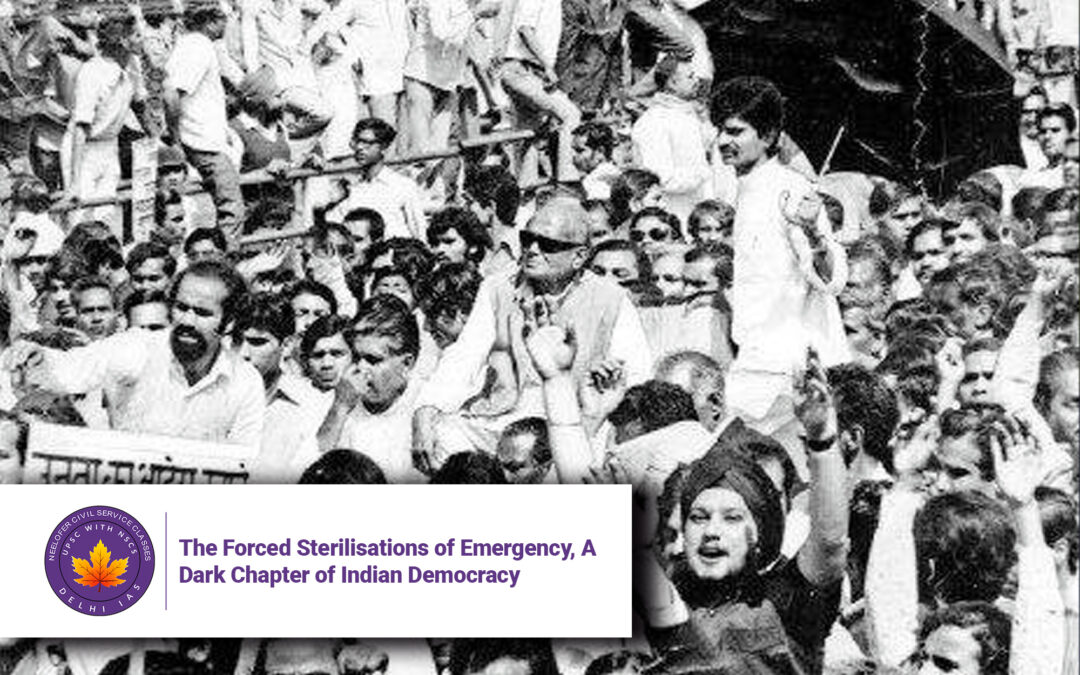
Students, workers, and civil society organised massive protests—especially in Bihar, where Jayaprakash Narayan led resistance movements.
Legacy and Reflections
The sterilisation campaign remains one of the darkest blotches on India’s democratic record. Cultural memory, through films like Nasbandi (1978), captures the public outrage. Politically, it cost Congress its dominance, contributing to the 1977 electoral defeat.
As we reflect on 50 years since the Emergency, it is essential to recall how state power can violate individual bodily autonomy, especially under the veil of public welfare and population control. This chapter is a powerful reminder of why democratic checks and civil liberties must never be undermined.
Conclusion
Forced sterilisation during the Emergency remains a grave warning against the misuse of state power. As India remembers this harrowing chapter, there is a collective call to ensure constitutional safeguards, bodily autonomy, and justice for past victims are prioritised in contemporary policy-making.
Q&A Section
1. What was the main reason given for forced sterilisation during the Emergency?
The campaign was framed as population control, but in reality, it was a coercive state exercise underpinned by eugenic and authoritarian ideology.
2. Who were the main targets of the sterilisation campaign?
The poor, slum dwellers, minorities, rural communities, and daily-wage labourers were disproportionately targeted.
3. How many people were sterilised during the Emergency?
Around 8.3 million people were sterilised by 1977, making it the largest forced sterilisation campaign in history.
4. What role did the Shah Commission play?
The Shah Commission investigated Emergency abuses and recorded 1,778 sterilisation-related deaths and numerous instances of forced procedures.
5. How is this chapter remembered today?
It is remembered as the “Nasbandi ka waqt” (the sterilisation time) and has been depicted in culture and political discourse as a symbol of authoritarian excess and human rights abuse.

