
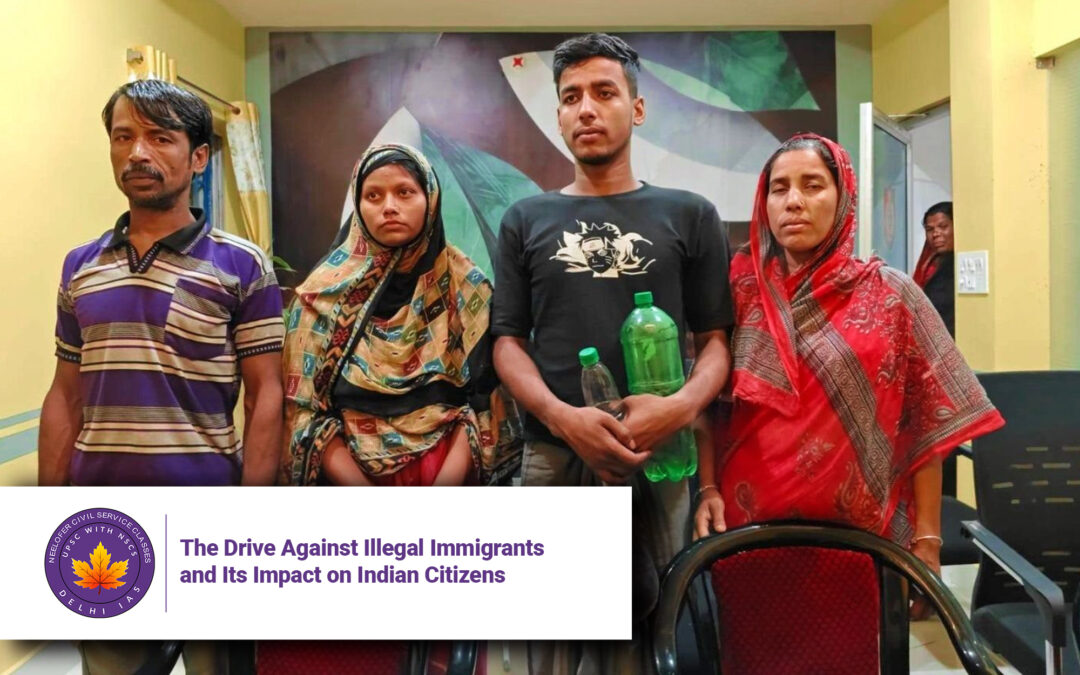
The Drive Against Illegal Immigrants and Its Impact on Indian Citizens
Why in News
In recent times, police authorities in several Bharatiya Janata Party (BJP)-ruled states have intensified their efforts to identify undocumented Bangladeshi immigrants. A controversial method used has been targeting individuals based on their language, particularly Bengali. This drive has not only led to serious errors but has also caused distress among Indian citizens, especially those from West Bengal. The issue has escalated into a political debate, raising concerns about the misuse of immigration control policies, the violation of citizens’ rights, and the social and economic disruptions caused by such measures.
Introduction
The matter of illegal immigration, particularly from Bangladesh, has long been a sensitive subject in India’s socio-political discourse. India shares a long and porous border with Bangladesh, making cross-border migration a recurring challenge. While it is undeniable that illegal immigration raises concerns over security, employment, and demographics, the current strategy of identifying undocumented Bangladeshi migrants by targeting Bengali speakers has created more problems than solutions.
Instances of Indian citizens being mistakenly deported or detained have surfaced, exposing flaws in the enforcement of immigration laws. Furthermore, the narrative has shifted from addressing illegal immigration to questioning linguistic identity, which threatens to destabilize inter-state harmony and the fabric of Indian federalism. With West Bengal being at the center of this debate, the issue has acquired a strong political dimension, especially as the 2026 Assembly elections approach.
Key Issues and Background
1. Targeting Bengali Speakers
The approach of identifying Bangladeshis by language has led to absurd situations. In Delhi, police went as far as listing “Bangladeshi” as a language, a glaring linguistic blunder. Since Bengali is India’s second-largest language by number of speakers, such measures disproportionately affect Indian citizens who legally belong to West Bengal, Assam, and Tripura.
2. Harassment of Indian Citizens
Numerous documented cases reveal that Indian citizens were forcibly pushed across the border into Bangladesh under suspicion of being illegal immigrants. Many of them had valid documents and were only repatriated after intervention by state governments or the judiciary. These cases caused immense trauma for families, embarrassment for the government, and highlighted systemic flaws in the process.
3. Impact on Migrant Workers
The immediate victims of this policy are migrant workers from West Bengal, many of whom travel across states for livelihood. Fearing wrongful detention and deportation, workers have abandoned their jobs, leading to financial instability. This has not only harmed individuals but has also disrupted industries dependent on migrant labor.
4. Political Fallout in West Bengal
The ruling Trinamool Congress in West Bengal has framed the drive as an “attack on Bengali identity,” sparking a language movement and strengthening regional identity politics. This backlash could influence electoral outcomes, complicating BJP’s position in the upcoming 2026 Assembly elections.
5. Historical Context of Immigration
Bangladeshi migration to India is not new. For decades, individuals from Bangladesh have crossed into India for economic opportunities, social reasons, or political asylum. Colonial borders and conflicts have historically contributed to migration patterns. Thus, the issue is deeply rooted in history, not merely a matter of present-day enforcement.
Specific Impacts or Effects
Social Impacts
-
Rising fear and insecurity among Bengali-speaking citizens.
-
Heightened regional identity movements in West Bengal.
-
Tensions between states due to alleged harassment of migrants.
Economic Impacts
-
Loss of livelihood for migrant workers who left jobs due to fear of deportation.
-
Disruption of labor supply in states dependent on Bengali migrant labor.
-
Economic instability in poor families already struggling with livelihood issues.
Political Impacts
-
Escalation of the “Bengali identity” debate, giving political mileage to regional parties like Trinamool Congress.
-
BJP faces criticism for alienating Bengali voters despite aiming to strengthen its base in West Bengal.
-
The issue could shape the narrative for the 2026 Assembly elections.
Legal Impacts
-
Violation of citizens’ fundamental rights through wrongful detention and deportation.
-
Weaknesses in due legal process exposed, as courts had to intervene multiple times.
-
Misinterpretation of language as evidence of nationality raises constitutional concerns.
Challenges and the Way Forward
Challenges
-
Identification Problem – Language cannot be a reliable basis for distinguishing citizens from foreigners.
-
Legal Safeguards – Due process of law is being bypassed, undermining constitutional protections.
-
Political Exploitation – Parties may use the issue for electoral gains, further polarizing communities.
-
Border Management – Long, porous borders make enforcement difficult, often leading to arbitrary action.
-
Humanitarian Concerns – Deporting individuals without ensuring their foreign nationality risks human rights violations.
The Way Forward
-
Policy Reform – Immigration control must be based on proper documentation, biometric systems, and legal checks, not language profiling.
-
Citizen Protection – Special safeguards must be established to prevent wrongful harassment of Indian citizens.
-
Judicial Oversight – Courts should establish fast-track mechanisms to review wrongful detentions.
-
Bilateral Cooperation – India and Bangladesh must strengthen treaties to deal with genuine illegal immigration cases.
-
Awareness and Training – Law enforcement agencies need training in sensitive handling of such cases to avoid errors that cause public outrage.
Conclusion
The drive against illegal immigrants, while necessary from a national security standpoint, must be pursued with caution and fairness. Language cannot be used as a substitute for legal proof of nationality. The ongoing harassment of Bengali-speaking Indian citizens is not only unjust but also counterproductive, leading to fear, livelihood losses, and political unrest.
India’s democratic framework requires a balance between protecting sovereign borders and safeguarding the rights of citizens. Heavy-handed approaches that target linguistic identity undermine national unity and create avoidable conflicts. Going forward, the central government must refine its strategy to ensure that genuine law enforcement does not turn into harassment of its own citizens.
5 Questions and Answers
Q1. What recent approach has been used by authorities to identify undocumented immigrants in India?
Authorities in some BJP-ruled states have attempted to identify undocumented Bangladeshi immigrants based on their language, specifically targeting Bengali speakers.
Q2. Why has this approach sparked controversy?
Because Bengali is India’s second-largest language with millions of speakers in West Bengal and other states, many Indian citizens have been wrongly detained or deported under suspicion of being foreigners.
Q3. How has this issue affected migrant workers from West Bengal?
Many migrant workers have abandoned their jobs in other states due to fear of wrongful detention and deportation, leading to economic instability for their families and labor shortages for industries.
Q4. What political implications does this issue carry?
The controversy has been framed as an “attack on Bengali identity” by the Trinamool Congress, escalating into a political movement that could influence the 2026 Assembly elections in West Bengal.
Q5. What is the suggested way forward to address this issue?
The government should implement documentation-based verification systems, ensure judicial oversight, improve bilateral cooperation with Bangladesh, and safeguard citizens’ rights while controlling illegal immigration.

