
The Debate Over Caste Census and Its Impact on Indian Politics
Why in News?
The Central government’s decision to include caste enumeration in the next national Census marks a dramatic policy shift and has ignited political and ideological debates across party lines. This follows BJP’s prior resistance and signals major electoral and social consequences, especially with upcoming state elections like in Bihar. 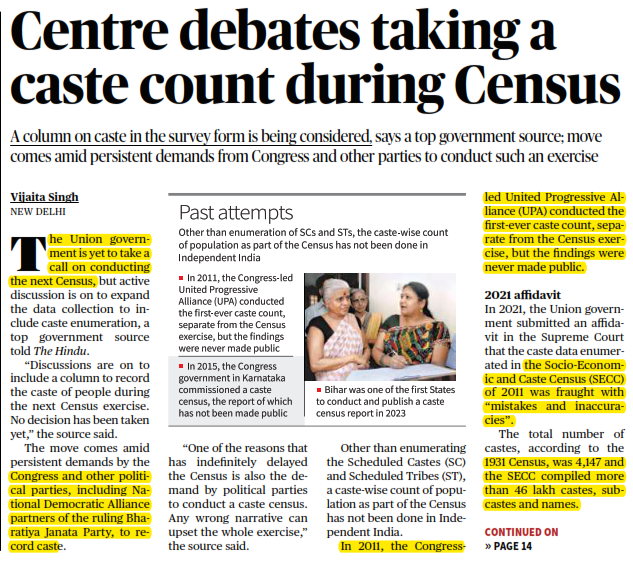
Introduction
Caste Census, the counting of various caste groups in India, has become a contentious issue. While supporters view it as a tool for achieving caste justice and inclusive policymaking, critics warn it may reinforce rigid social divisions and undermine broader national unity.
Key Issues and Background
1. BJP’s Shift on Caste Census
-
In 2024, PM Narendra Modi criticized the Congress’s demand for a caste census, associating it with “urban Naxal” ideology.
-
However, after setbacks in state elections (Maharashtra, Haryana), BJP appears to have softened its stance, now supporting caste enumeration, especially in light of the upcoming Bihar elections.
2. Political Realignments and Electoral Impact
-
BJP’s earlier dominance was built on uniting castes under the umbrella of Hindu identity, marginalizing caste-based appeals.
-
Opposition parties, especially Congress under Rahul Gandhi, have begun promoting “caste justice” and demanding caste-based data to restructure reservations.
3. Historical and Legal Context
-
The last caste-based census was in 1931. Since then, India has refrained from including caste data (except for SC/STs) in its Census.
-
Article 16(4) of the Constitution allows reservation for socially and educationally backward communities only when inadequately represented in public services.
4. Risks of Caste Census
-
Critics argue a caste census may harden caste identities instead of resolving inequality.
-
It could trigger political demands for increased quotas, challenge the 50% reservation ceiling (as laid down in Indra Sawhney judgment), and provoke inter-group tensions.
-
Risks repeating colonial mistakes—where British-era caste categorization led to deeper segmentation.
The Core of the Concern
A caste census could shift focus from poverty- and development-based policies to identity-based entitlement politics. While it can highlight under-representation, there’s fear it may ossify caste distinctions and encourage further political polarization rather than promote genuine equality.
Key Observations
-
BJP’s openness to caste enumeration is a political necessity driven by ground-level realities.
-
Congress seeks to leverage caste census to rebuild support among OBCs and challenge the 50% reservation cap.
-
Both national parties have moved from resisting caste-based appeals to embracing them under the banner of justice and representation.
Conclusion
India stands at a crossroads between data-driven inclusion and identity-based politics. A caste census, if done, must be used for promoting equality—not reinforcing caste lines. It should guide social justice policies without becoming a tool for narrow vote-bank politics. The nation must avoid turning this tool into a source of deeper division.
5 Questions and Answers
Q1. What is a caste census and why is it controversial?
Answer: A caste census records the caste identities of individuals in the population. It is controversial because it may reinforce caste divisions, although it can help in better targeting affirmative action.
Q2. Why has the BJP changed its stance on the caste census?
Answer: After electoral setbacks and growing demands from OBC and Dalit communities, the BJP now sees caste enumeration as politically unavoidable, especially with elections in caste-sensitive states like Bihar.
Q3. What are the legal provisions related to caste-based reservations?
Answer: Article 16(4) allows reservation for backward classes in public services if they are underrepresented. The 50% ceiling on reservation was established by the Supreme Court in the Indra Sawhney case.
Q4. What are the concerns against holding a caste census?
Answer: It may lead to hardened caste identities, inter-community competition for quotas, and a shift from merit-based to caste-based politics.
Q5. How are political parties using the caste census issue?
Answer: Congress is promoting it under the idea of caste justice, while BJP, initially opposed, is now embracing it as a political strategy to retain or regain backward caste support.

