
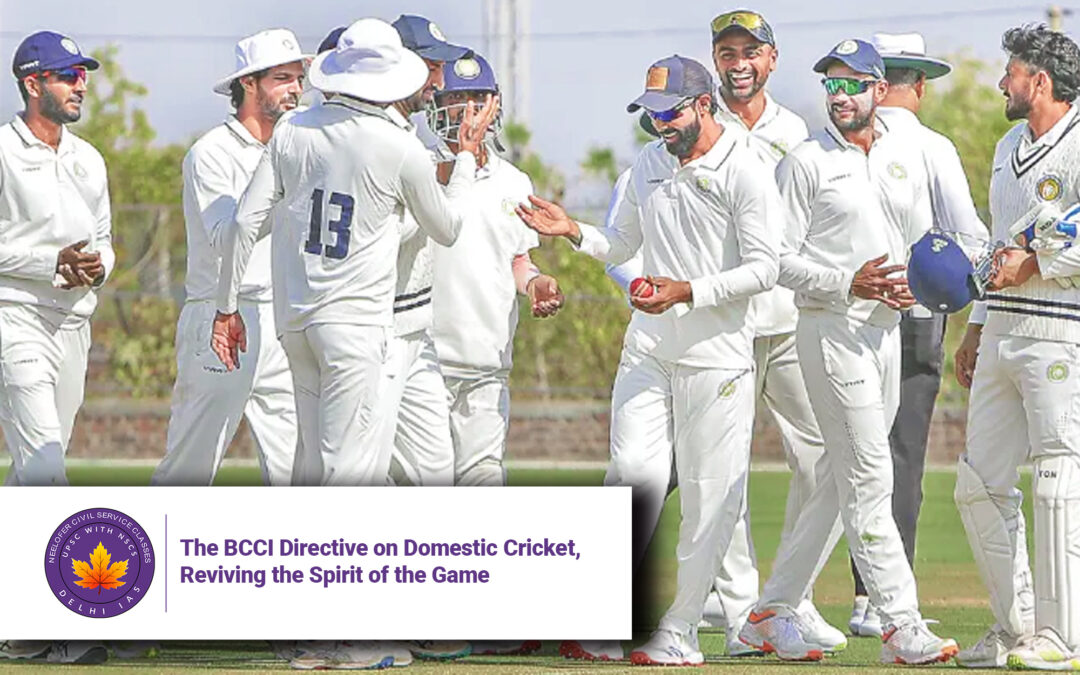
The BCCI Directive on Domestic Cricket, Reviving the Spirit of the Game
Why in News?
The Board of Control for Cricket in India (BCCI) has reiterated its directive for centrally contracted cricketers to participate in domestic tournaments like the Duleep Trophy when not on national duty. This move comes in the wake of India’s mixed performances in Test cricket, including a 3-1 loss in the Border-Gavaskar Trophy in Australia and a shocking 0-3 defeat to New Zealand at home. Despite a resilient 2-2 series draw in England under Shubman Gill’s captaincy, the BCCI is pushing top players like K L Rahul and Mohammed Siraj to engage in domestic red-ball cricket to maintain form and readiness for upcoming Test matches. This analysis explores the implications of this policy, its impact on player development, and the broader significance for Indian cricket.
Introduction
Cricket in India is not just a sport; it is a passion that unites millions. The structure of Indian cricket, from grassroots to the international arena, relies heavily on domestic tournaments like the Ranji Trophy, Duleep Trophy, and Vijay Hazare Trophy. These competitions serve as breeding grounds for talent, offering players the opportunity to hone their skills and stake their claim for national selection. However, with the advent of lucrative T20 leagues and a packed international calendar, many top players have increasingly neglected domestic cricket. The BCCI’s recent directive mandating participation in domestic matches aims to address this trend, ensuring that players remain connected to their roots and prepared for the demands of international cricket. This analysis delves into the rationale, challenges, and potential outcomes of this policy, emphasizing its importance for the future of Indian cricket.
Key Issues
1. The Decline of Domestic Cricket Participation
-
Shift in Priorities: The rise of T20 leagues like the Indian Premier League (IPL) has shifted players’ focus from domestic red-ball cricket to shorter formats, which offer financial rewards and global visibility.
-
Injury Management: Players often skip domestic matches to manage workloads and avoid injuries, especially with back-to-back international series.
-
National Duty vs. Domestic Commitment: While representing the country is the ultimate goal, neglecting domestic cricket can lead to a disconnect from the fundamentals of the game, particularly in Test cricket.
2. BCCI’s Directive: A Necessary Intervention
-
Mandatory Participation: In early 2024, the BCCI issued a diktat requiring centrally contracted players to play domestic cricket when not on national duty. This was reinforced after India’s losses to Australia and New Zealand.
-
Recent Enforcement: Despite the Test team’s commendable performance in England, the BCCI has reminded players to feature in the Duleep Trophy. For instance, Shubman Gill (North Zone) and Yashasvi Jaiswal (West Zone) are set to participate, while K L Rahul and Mohammed Siraj have been urged to join their respective zonal teams.
-
Rationale: The policy aims to ensure that players gain valuable match practice, especially in red-ball cricket, which is crucial for success in Test matches.
3. Impact on Player Performance and Team Success
-
Skill Development: Domestic cricket provides a platform for players to work on technical deficiencies, such as handling spin or pace in home conditions, as seen in the New Zealand series loss.
-
Match Readiness: Regular game time helps players maintain rhythm and fitness, reducing the need for extended acclimatization during international series.
-
Team Momentum: The Indian team’s drawn series in England showcased resilience, but consistent participation in domestic cricket can help sustain this momentum.
4. Challenges in Implementation
-
Player Reluctance: Star players may resist due to fatigue, personal commitments, or focus on T20 leagues.
-
Scheduling Conflicts: The cramped cricket calendar makes it difficult to balance international duties, domestic matches, and rest periods.
-
Injury Risks: Increased participation raises concerns about player burnout and injuries, which could affect national team prospects.
5. Broader Implications for Indian Cricket
-
Grassroots Inspiration: When top players feature in domestic tournaments, they inspire young cricketers and elevate the standard of competition.
-
Balancing Formats: While T20 cricket is financially rewarding, Test cricket remains the ultimate test of a player’s skill and temperament. The BCCI’s move reinforces the importance of red-ball cricket.
-
Global Standards: Countries like Australia and England emphasize domestic cricket for national team selection. India’s policy aligns with these best practices.
Alternative Approaches
-
Incentivizing Participation:
-
Offer financial incentives or bonuses for players who regularly participate in domestic cricket.
-
Recognize domestic performance in central contract gradations.
-
-
Strategic Rest and Rotation:
-
Manage player workloads through a rotation policy, ensuring they get adequate rest while also playing key domestic matches.
-
-
Enhancing Domestic Tournaments:
-
Improve the quality of domestic cricket by upgrading facilities, increasing match fees, and ensuring competitive pitches.
-
Introduce more day-night matches to attract audiences and make games more engaging.
-
-
Integration with National Training:
-
Use domestic matches as part of the national team’s preparation for upcoming series, similar to how Australia uses the Sheffield Shield.
-
-
Player Communication and Buy-in:
-
Engage with players to explain the long-term benefits of domestic cricket, fostering a sense of duty and pride in representing their zones or states.
-
Challenges and the Way Forward
-
Player Compliance: Ensuring that top players adhere to the directive without resentment requires careful communication and mutual understanding.
-
Scheduling Reforms: The BCCI must work with the International Cricket Council (ICC) and other boards to create a more balanced calendar that accommodates domestic cricket.
-
Monitoring and Evaluation: Regularly assess the impact of this policy on player performance and team results to make necessary adjustments.
The Way Forward:
-
Consistent Enforcement: The BCCI must consistently apply the rule to all contracted players, regardless of stature, to avoid perceptions of favoritism.
-
Focus on Red-Ball Cricket: Prioritize participation in multi-day tournaments like the Ranji Trophy and Duleep Trophy to strengthen Test cricket.
-
Stakeholder Collaboration: Involve players, coaches, and state associations in designing a sustainable approach to domestic cricket participation.
Conclusion
The BCCI’s directive for top players to participate in domestic cricket is a timely and necessary step to preserve the integrity and competitiveness of Indian cricket. While the allure of T20 leagues and the demands of international cricket pose challenges, the long-term benefits of this policy—for player development, team success, and the health of the sport—are undeniable. By reaffirming the importance of domestic cricket, the BCCI is not only addressing immediate performance issues but also investing in the future of Indian cricket. As the team prepares for upcoming Test series against the West Indies and South Africa, and with the T20 World Cup on the horizon, this move could be the catalyst for a new era of excellence and consistency.
5 MCQs Based on the Article
Q1. What prompted the BCCI to issue the directive for top players to participate in domestic cricket?
A) Loss in the T20 World Cup
B) Losses in Test series against Australia and New Zealand
C) Poor performance in the IPL
D) Player requests for more game time
Answer: B) Losses in Test series against Australia and New Zealand
Q2. Which tournament are players like Shubman Gill and Yashasvi Jaiswal participating in due to the BCCI’s directive?
A) Indian Premier League
B) Duleep Trophy
C) Vijay Hazare Trophy
D) Syed Mushtaq Ali Trophy
Answer: B) Duleep Trophy
Q3. What is a key benefit of top players participating in domestic cricket?
A) Increased IPL revenues
B) Better preparation for Test matches
C) More rest for international series
D) Higher attendance in domestic matches
Answer: B) Better preparation for Test matches
Q4. Which of the following is a challenge in implementing the BCCI’s directive?
A) Lack of domestic tournaments
B) Player reluctance due to fatigue or other commitments
C) Opposition from state associations
D) Poor quality of domestic pitches
Answer: B) Player reluctance due to fatigue or other commitments
Q5. How does the BCCI’s policy align with global best practices?
A) By focusing only on T20 cricket
B) By emphasizing domestic cricket for national team selection, as in Australia and England
C) By reducing the number of international matches
D) By increasing the number of IPL teams
Answer: B) By emphasizing domestic cricket for national team selection, as in Australia and England

