
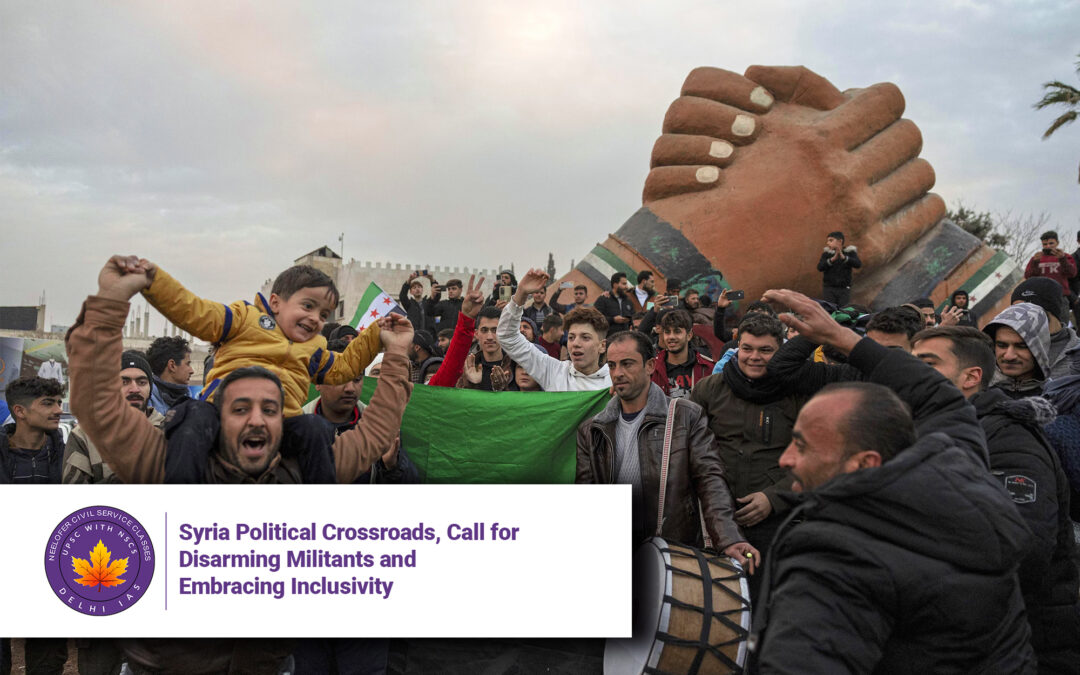
Syria Political Crossroads, Call for Disarming Militants and Embracing Inclusivity
Why in News?
Recent political developments in Syria, including international recognition for opposition leader Ahmed al-Sharaa and efforts toward rebuilding war-torn Syria, have sparked renewed discussions on the need to dismantle armed groups and adopt an inclusive constitution. 
Introduction
Syria has endured over a decade of devastating civil war. Amid global and regional shifts, there’s a renewed opportunity for peace and reconstruction. However, for Syria to stabilize and progress, it must disband armed militias and commit to inclusive governance.
Key Issues and Background
1. The Rise of Islamist Leaders
-
Ahmed al-Sharaa, previously known as Abu Mohammad al-Jolani, was the head of the jihadist group Hayat Tahrir al-Sham (HTS), affiliated with al-Qaeda.
-
HTS captured Damascus in 2014 by toppling the Assad regime but has a controversial past with links to extremist violence.
2. Rebranding and Diplomatic Recognition
-
In 2024, al-Sharaa rebranded himself as a political leader. He met with U.S. President Donald Trump and received praise and support from regional and international leaders, including France’s Emmanuel Macron and Saudi Crown Prince Mohammed bin Salman.
-
His recent diplomacy includes meeting with Qatar’s Emir and receiving backing from Turkey.
The Core of the Concern
1. HTS’s Violent History
-
HTS has been responsible for sectarian violence, including attacks on Alawites, Christians, and Druze.
-
There is deep skepticism over whether al-Sharaa’s transformation is genuine or tactical.
2. The Risk of Extremism
-
While al-Sharaa promises inclusivity and peace, concerns persist about his group’s history of violence and its ongoing control over Syrian regions.
Key Observations
1. Economic Incentives for Peace
-
Sharaa has proposed opening Syria to American and Gulf investments.
-
War-torn Syria urgently needs funding for reconstruction, and normalization could pave the way.
2. Syria’s Complex Ethnic and Religious Makeup
-
Syria’s future peace depends on ensuring the rights of minorities, including Alawites, Kurds, Druze, and Christians.
-
The Kurdish population in the northeast has also called for federalism and democratic reforms.
Challenges and the Way Forward
Challenges
-
Armed groups still dominate large regions of Syria.
-
Sectarian mistrust runs deep due to years of violence.
-
The Assad regime remains a key player and must also be part of any peace framework.
Steps Forward
-
Disband all armed militias, including HTS, and integrate their members into civilian life where appropriate.
-
Adopt a new inclusive constitution that guarantees political representation and human rights for all ethnic and religious communities.
-
Involve international mediators to ensure fair elections and power-sharing.
Conclusion
The ongoing transformation in Syria presents a critical opportunity for peace. However, genuine progress will require dismantling extremist militias and adopting an inclusive constitution. Without this, any political rebranding or economic rebuilding will remain fragile and short-lived.
5 Questions and Answers
Q1. Who is Ahmed al-Sharaa and why is he in the news?
A: Formerly known as Abu Mohammad al-Jolani, he led the jihadist group HTS and is now rebranding himself as a political leader seeking international legitimacy.
Q2. What are the concerns surrounding al-Sharaa’s transformation?
A: Despite diplomatic outreach, HTS’s violent past, including sectarian attacks, raises doubts about the sincerity of al-Sharaa’s commitment to peace and inclusion.
Q3. Which global leaders have recently supported al-Sharaa?
A: He has received support from U.S. President Trump, French President Macron, Qatar’s Emir, and Saudi Crown Prince Mohammed bin Salman.
Q4. Why is dismantling armed groups essential for Syria’s peace?
A: Armed groups perpetuate instability and violence. Disarming them is crucial for rebuilding trust, securing minority rights, and achieving sustainable governance.
Q5. What is the role of a new constitution in Syria’s future?
A: A new inclusive constitution would ensure minority rights, political representation, and the rule of law—forming the foundation for long-term peace.
