
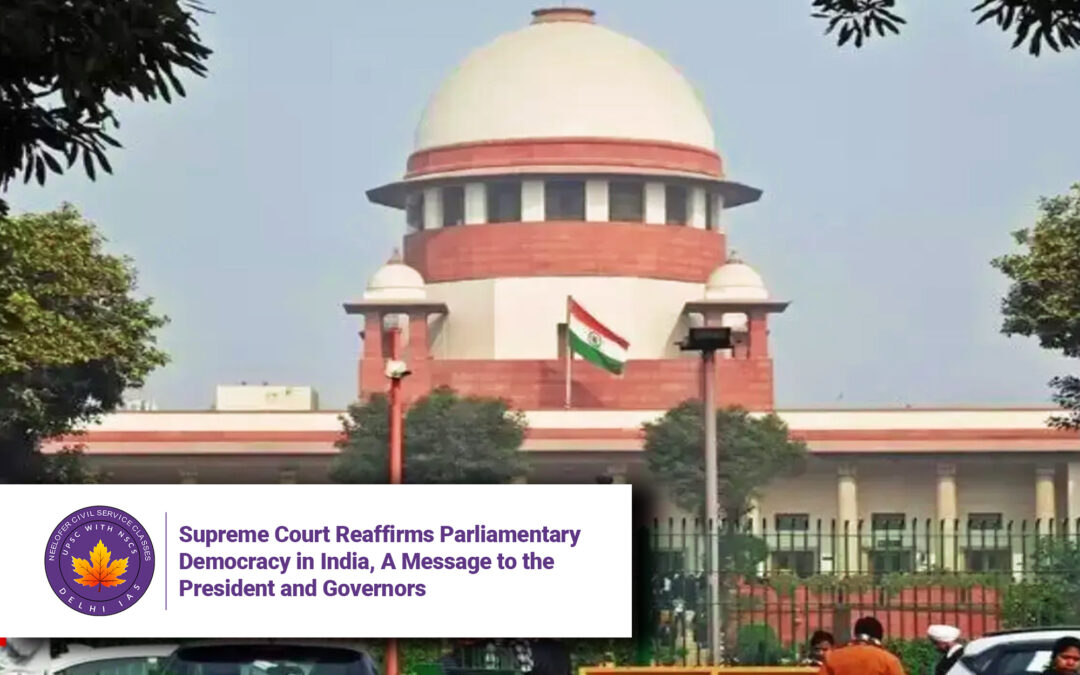
Supreme Court Reaffirms Parliamentary Democracy in India, A Message to the President and Governors
Why in News?
The Supreme Court’s recent judgment in State of Tamil Nadu v. Governor of Tamil Nadu (2025) reaffirms the fundamental constitutional principle that India follows a parliamentary system, emphasizing the limited role of Governors and the President in legislative matters. The judgment clarifies that executive powers lie with the elected representatives, not constitutional heads like Governors or the President. 
Introduction
In the wake of increasing conflicts between State Governments and Governors, the Supreme Court’s ruling serves as a timely constitutional reminder. It underscores the vision of Dr. B.R. Ambedkar and the Constituent Assembly: India is a parliamentary democracy where real power resides with the elected Council of Ministers.
Key Issues and Background
Ambedkar’s Original Vision
-
Ambedkar stated in 1948 that the Indian Constitution deliberately avoids a Presidential system.
-
The President is the head of the State, not the Executive.
-
The Executive power lies with the Council of Ministers, headed by the Prime Minister at the Centre and Chief Ministers in the States.
Draft Constitution Debate
-
There was a proposal to make the President or Governor act independently.
-
However, this was rejected by the Constituent Assembly, emphasizing collective responsibility of the Council of Ministers.
The Core of the Concern
The 2025 Supreme Court Judgment
-
In State of Tamil Nadu v. Governor of Tamil Nadu, the court held that:
-
The Governor must act on the aid and advice of the Council of Ministers.
-
Delays in giving assent to Bills are unconstitutional.
-
Governors are not political authorities; they are bound by constitutional morality.
-
Abuse of Discretion
-
Recent incidents where Governors delayed bills or withheld assent have raised concerns of overreach and misuse of office.
Key Observations
-
Article 163: Governors must act as advised unless specifically empowered otherwise by the Constitution.
-
Article 74: Same applies to the President — they must act on advice from the Prime Minister and Council of Ministers.
-
Democracy Is Not a Symbolic Idea: The President/Governor is not a ruler but a symbolic figure representing unity.
Conclusion
The Supreme Court’s decision is a strong defense of democratic values. It reminds constitutional heads that their role is not to challenge the elected governments but to act within their defined constitutional boundaries. The judgment ensures democracy functions as envisioned by the framers — with elected leaders responsible to the people, not ceremonial heads acting independently.
Q&A Section
Q1. What was the Supreme Court’s recent verdict in the State of Tamil Nadu v. Governor of Tamil Nadu about?
Ans: It reaffirmed that Governors must act on the aid and advice of the elected State Government and cannot withhold or delay assent to Bills arbitrarily.
Q2. What did Dr. B.R. Ambedkar emphasize about India’s executive system?
Ans: Ambedkar clarified that India is a parliamentary democracy, where executive power lies with the Council of Ministers, not with the President or Governors.
Q3. Can the President or Governor act independently in India?
Ans: No. They must act on the advice of the Council of Ministers, except in rare, constitutionally specified circumstances.
Q4. Why was the original proposal for Governors to act independently rejected?
Ans: The Constituent Assembly believed that such power would undermine democratic principles and parliamentary accountability.
Q5. What is the broader impact of this judgment?
Ans: It strengthens federalism, democratic governance, and ensures that elected governments are not obstructed by unelected constitutional heads.
