
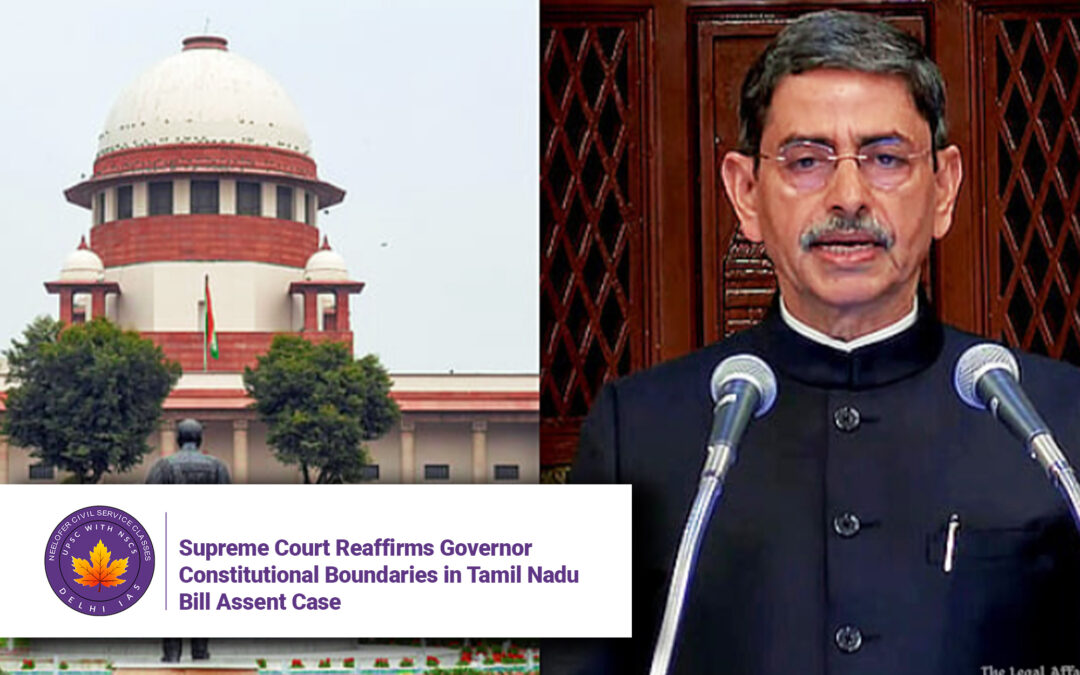
Supreme Court Reaffirms Governor Constitutional Boundaries in Tamil Nadu Bill Assent Case
Why in News?
In a landmark ruling in The State of Tamil Nadu vs The Governor of Tamil Nadu and Anr., the Supreme Court of India has reaffirmed constitutional limitations on gubernatorial authority. This judgment marks a crucial moment in India’s federal structure, emphasizing that the Governor is not above the legislature and must act according to constitutional duties, not personal discretion. 
Introduction
Governors in Indian states have often found themselves at the center of political controversies, especially when withholding assent to state legislature-passed bills. The Supreme Court’s judgment addresses one such episode in Tamil Nadu, where a political deadlock emerged over 10 state bills pending with the Governor.
Key Issues and Institutional Concerns
1. Prolonged Delay in Assent to Bills
The Governor of Tamil Nadu delayed assent to 10 bills, some originally introduced as far back as 2020, without offering clear reasoning or communication, raising serious concerns about executive overreach.
2. Re-enactment of Bills by the Assembly
After a long wait and silence from the Governor, the Tamil Nadu Legislative Assembly re-enacted all 10 bills and sent them again to the Governor. The Governor then rejected one, assented to one, and left the rest pending—further delaying governance.
3. Constitutional Interpretation of Article 200
The judgment revolved around Article 200 of the Constitution, which deals with a Governor’s options on a bill: grant assent, withhold assent, or reserve it for the President. The Court clarified that the Governor cannot simply ignore or delay decision-making, nor can they add a non-existent fourth option of “inaction.”
4. Reaffirmation of Judicial Review
The Court emphasized that discretionary power exercised by the Governor is subject to judicial review, especially if it obstructs the legislative process and democratic will.
5. Federalism and Democratic Norms
The judgment strengthens India’s federal balance by upholding that the Governor must work as a constitutional head under the advice of the Council of Ministers and within the framework of the Constitution.
Challenges and the Way Forward
-
Institutional Clarity: Governors need clear operational boundaries in legislative matters to prevent constitutional crises.
-
Speedy Assent Mechanism: Legal timeframes could be introduced for gubernatorial decisions on bills.
-
Checks on Misuse of Discretion: Judicial review acts as a necessary safeguard against arbitrary withholding of assent.
-
Reinforcing Representative Democracy: The people’s will, expressed through elected assemblies, must take precedence over unelected offices.
-
Training for Constitutional Functionaries: Governors must be oriented towards constitutional roles, not political strategies.
Conclusion
This Supreme Court ruling serves as a reminder that the Governor’s office is not a parallel power center but a constitutional institution bound by law, legal norms, and democratic spirit. It ensures that legislative intent cannot be stalled by executive delay and reinstates the supremacy of elected bodies in India’s democratic framework.
Q&A Section
Q1. What was the main issue in the Tamil Nadu Governor case?
The issue was the Governor’s delay and selective assent to 10 bills passed by the Tamil Nadu Legislative Assembly, raising questions about constitutional responsibility.
Q2. What does Article 200 of the Constitution deal with?
Article 200 allows a Governor to either grant assent, withhold assent, or reserve a bill for the President’s consideration. It does not permit indefinite delay or inaction.
Q3. What did the Supreme Court say about the Governor’s role?
The Court stated that a Governor is not an independent power center but a constitutional head, constrained by democratic principles and legal obligations.
Q4. Was the Governor’s inaction justified?
No. The Court held that such inaction is not part of constitutional provisions and undermines the democratic process.
Q5. What is the larger message of this judgment?
The judgment reinforces federal principles, emphasizes legislative supremacy, and ensures that the Governor acts on the advice of the state government—not as a roadblock to democracy.
