
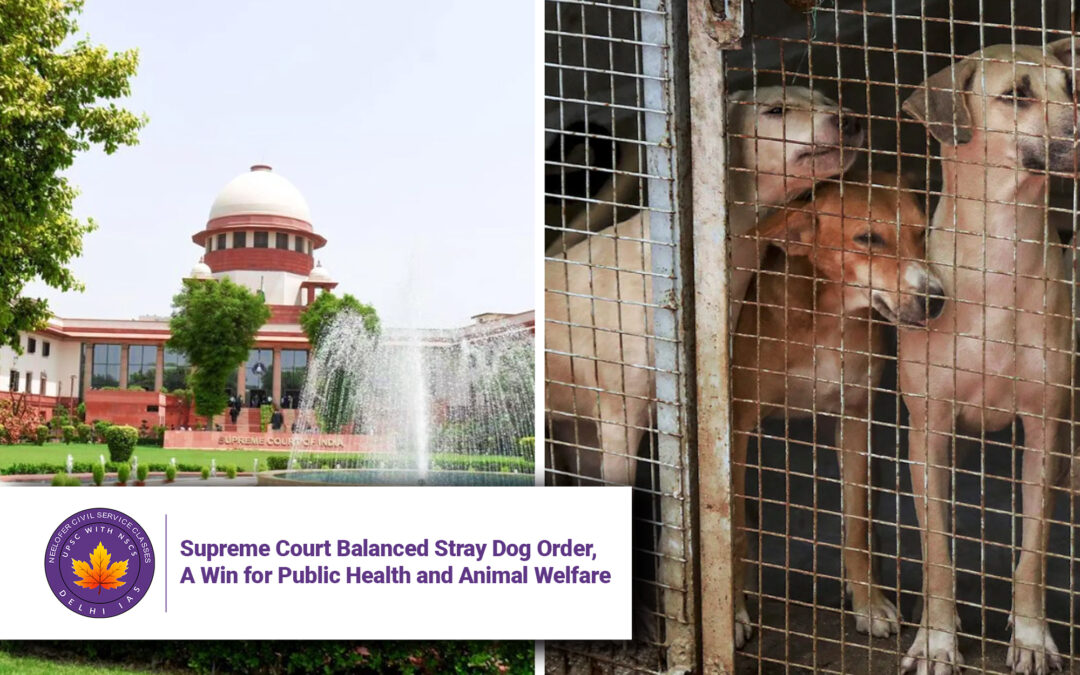
Supreme Court Balanced Stray Dog Order, A Win for Public Health and Animal Welfare
Why in News?
In a significant reversal of its earlier directive, the Supreme Court of India on August 22, 2025, issued a scientifically grounded order on stray dog management, emphasizing vaccination, sterilization, and release over mass culling or incarceration. The court mandated that municipalities vaccinate, deworm, and release stray dogs back to their original territories, while only isolating rabid or dangerously aggressive dogs in designated shelters. This judgment underscores the importance of the Animal Birth Control (ABC) Rules and places responsibility on local authorities to implement them effectively. The ruling comes amid rising public concern over human-dog conflicts and India’s goal to eliminate rabies by 2030. This analysis examines the implications of the order, the challenges in its implementation, and its potential to reshape urban animal welfare and public health strategies.
Introduction
Stray dogs are an inseparable part of India’s urban landscape, yet their management has long been a contentious issue, balancing animal welfare with public health concerns. The Supreme Court’s recent order marks a paradigm shift from its earlier August 11 directive, which advocated mass sheltering—a move criticized as impractical and inhumane. By reaffirming the ABC program’s “vaccinate-sterilize-release” model, the court has aligned with global best practices and scientific evidence. However, the success of this approach depends on robust municipal action, community participation, and clear guidelines to prevent misuse. This analysis explores the judicial, administrative, and societal dimensions of the order, highlighting its potential to foster coexistence while safeguarding public health.
Key Issues
1. The Supreme Court Order: Key Directives
-
Vaccination and Deworming: All stray dogs must be vaccinated against rabies and dewormed before release into their original territories.
-
Handling Aggressive Dogs: Only rabid or dangerously aggressive dogs should be isolated in shelters after immunization.
-
Feeding Zones: Municipalities must establish designated feeding areas in consultation with caregivers to reduce human-dog conflicts.
-
Financial Penalties: The court imposed deposits of ₹25,000 on individual dog lovers and ₹2 lakh on NGOs involved in the case, a move that has raised questions about its rationale.
2. Scientific and Ethical Foundations
-
ABC Program Efficacy: Studies show that sterilization reduces stray dog populations by curbing reproduction, while vaccination lowers rabies transmission. The World Health Organization (WHO) endorses this approach.
-
Ecological Role: Stray dogs control rodent populations and serve as scavengers, contributing to urban hygiene.
-
Ethical Considerations: Mass culling or sheltering violates animal rights and often exacerbates problems by creating ecological vacuums filled by new dogs.
3. Public Health Imperatives
-
Rabies Elimination: India accounts for 36% of global rabies deaths. The ABC program is critical to achieving the 2030 rabies-free target.
-
Zoonotic Diseases: Deworming and vaccination reduce the risk of other zoonotic diseases like leptospirosis and echinococcosis.
-
Conflict Mitigation: Designated feeding zones and awareness campaigns can minimize conflicts, reducing dog bite incidents.
4. Municipal Responsibilities and Failures
-
Legal Mandate: The ABC Rules, 2023, require municipalities to implement sterilization and vaccination programs. However, inadequate funding, corruption, and apathy have led to poor compliance.
-
Resource Gaps: Many municipalities lack the infrastructure, veterinary staff, and funds to execute ABC effectively.
-
Accountability: The court’s order explicitly holds municipalities accountable for lapses, urging time-bound action.
5. Community Involvement and Challenges
-
Role of Caregivers: Feeders and NGOs play a vital role in identifying dogs, supporting ABC efforts, and maintaining feeding zones. However, they often face opposition from residents.
-
Misuse of ‘Aggressive’ Label: Without clear criteria, terms like “dangerously aggressive” could be misused to target harmless dogs.
-
Financial Penalties Controversy: The imposed deposits on caregivers and NGOs could discourage voluntary efforts, undermining the order’s goals.
6. Global Perspectives
-
Successful Models: Countries like Turkey and Bhutan have effectively used ABC programs to manage stray populations and eliminate rabies.
-
Sheltering vs. Release: Western nations often prioritize sheltering, but this is impractical in India due to the vast stray population and limited resources.
Alternative Approaches
-
Strengthening ABC Infrastructure:
-
Municipalities should establish ABC centers in every district, equipped with veterinary clinics and mobile units.
-
Leverage technology like GPS tracking to monitor vaccinated and sterilized dogs.
-
-
Public Awareness Campaigns:
-
Educate communities on responsible feeding, rabies prevention, and conflict resolution.
-
Use schools and local media to disseminate information.
-
-
Public-Private Partnerships:
-
Engage corporate sponsors under CSR initiatives to fund ABC programs.
-
Collaborate with veterinary colleges for manpower and expertise.
-
-
Legislative Reforms:
-
Amend municipal laws to include penalties for neglecting ABC duties.
-
Introduce incentives for communities that successfully manage stray populations.
-
-
Research and Data Collection:
-
Conduct studies to define “aggressive behavior” scientifically, preventing misuse.
-
Maintain databases on dog populations, vaccination coverage, and bite incidents.
-
Challenges and the Way Forward
-
Implementation Hurdles: Municipalities may lack the will or capacity to execute the order, requiring oversight mechanisms.
-
Community Resistance: Conflicts between caregivers and residents need mediation through local committees.
-
Financial Constraints: The court’s deposits on NGOs and caregivers could strain resources, necessitating review.
The Way Forward:
-
National Task Force: Establish a cross-ministerial body to monitor ABC implementation and allocate funds.
-
Standard Operating Procedures (SOPs): Develop clear guidelines for identifying aggressive dogs and managing feeding zones.
-
Grassroots Engagement: Empower RWAs and NGOs to participate in decision-making and execution.
-
Judicial Oversight: High Courts should form committees to ensure compliance with the Supreme Court’s directives.
Conclusion
The Supreme Court’s order is a landmark step toward reconciling animal welfare with public health imperatives. By endorsing the ABC program, it acknowledges the scientific and ethical validity of managing stray dogs through sterilization and vaccination rather than persecution. However, the order’s success hinges on municipalities shedding their inertia and embracing their responsibilities. Community participation, coupled with clear policies and adequate resources, will be crucial in creating harmonious urban spaces where humans and animals coexist. As India strives to become rabies-free by 2030, this judgment could be the catalyst for a more humane and effective approach to stray dog management, setting a precedent for other nations grappling with similar challenges.
5 MCQs Based on the Article
Q1. What is the core directive of the Supreme Court’s recent order on stray dogs?
A) Mass culling of aggressive dogs
B) Vaccination, sterilization, and release
C) Permanent sheltering of all stray dogs
D) Relocation to forests
Answer: B) Vaccination, sterilization, and release
Q2. What is the primary goal of India’s ABC program?
A) Eliminate all stray dogs
B) Achieve rabies-free status by 2030
C) Promote pet adoption
D) Export stray dogs to other countries
Answer: B) Achieve rabies-free status by 2030
Q3. What financial penalty did the Supreme Court impose on NGOs?
A) ₹25,000
B) ₹50,000
C) ₹1 lakh
D) ₹2 lakh
Answer: D) ₹2 lakh
Q4. Which international organization endorses the “vaccinate-sterilize-release” model?
A) UNICEF
B) World Health Organization (WHO)
C) World Bank
D) UNESCO
Answer: B) World Health Organization (WHO)
Q5. What is a key challenge in implementing the ABC program?
A) Lack of scientific evidence
B) Municipal apathy and resource gaps
C) Opposition from international agencies
D) Overpopulation of pets
Answer: B) Municipal apathy and resource gaps

