
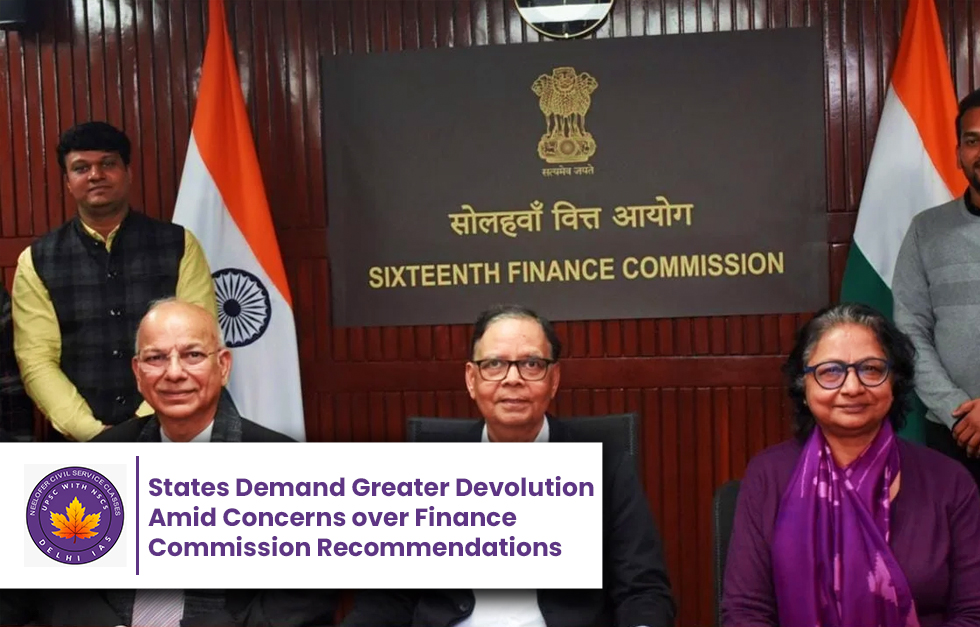
States Demand Greater Devolution Amid Concerns over Finance Commission Recommendations
Why in News?
States across India are raising concerns over the declining share of devolution recommended by the Finance Commissions, especially in the context of the 16th Finance Commission (FC). As the Centre and the states prepare for the 16th FC’s deliberations, several state governments are advocating for a fairer distribution of central taxes, citing disproportionate financial burdens and the growing mismatch between state needs and central transfers. 
Introduction
The Finance Commission is constitutionally tasked with recommending how the net proceeds of taxes should be divided between the Centre and the States. However, recent trends in the percentage share allocated to states, coupled with increasing state expenditure responsibilities, have triggered a fresh debate over the fairness and adequacy of current fiscal arrangements.
Key Issues and Background
1. Historical Trends in Devolution
The share of the divisible pool of taxes allocated to states has seen fluctuations over the years:
-
12th FC: 30.5%
-
13th FC: 32%
-
14th FC: 42%
-
15th FC: 41%
The 15th FC marginally reduced the share to 41%, which sparked criticism from several states. Southern states like Kerala, Tamil Nadu, and Andhra Pradesh, which contribute significantly to national revenue but have smaller populations, have particularly raised objections.
2. Concerns over Shrinking Grants and Discretionary Transfers
A major concern is the shift from plan to non-plan transfers and the reduction in discretionary grants. The 13th FC allocated 32% of the divisible pool, while the 14th FC raised it to 42%, compensating by abolishing plan grants. However, states argue that the actual funds received under various heads have declined.
Post-devolution revenue deficit grants, disaster management grants, and sectoral grants (especially for rural bodies) have seen lower allocations or delayed releases. As of October 2024, the Union government had released only 66.75% of the total transfer recommended under three critical heads (₹569,698 crore out of ₹845,026 crore), affecting states’ fiscal planning.
3. Disparities in States’ Own Revenue Capacities
Most developed states depend significantly on central transfers to meet their budgetary requirements. For instance:
-
Maharashtra: Own revenue covers only 74% of its needs (2024-25)
-
Karnataka: 78%
-
Andhra Pradesh: 57%
-
Telangana: 72%
-
West Bengal: 46%
These gaps are bridged by central devolutions and grants. However, the mismatch in state needs and central transfers forces many to rely on borrowing or cutbacks.
4. Emerging Regional Discontent
Tamil Nadu’s Chief Minister M.K. Stalin, during the 10th NITI Aayog meeting, demanded a minimum 50% devolution to states. He argued that the Centre’s hesitation to enhance states’ fiscal space hampers development. Similar sentiments have been echoed by other southern states, particularly regarding the weightage given to population data in devolution formulas.
5. Formula Concerns and Population Weightage
The 15th FC gave 45% weight to population, which several states argue unfairly penalizes those who have achieved population control. The demand is now to consider performance-linked metrics such as fiscal discipline, education, and health outcomes rather than population alone.
Specific Impacts or Effects
States argue that inadequate and delayed releases:
-
Hinder implementation of welfare schemes
-
Lead to under-utilisation of budgeted funds
-
Widen fiscal deficits
-
Create administrative bottlenecks
In addition, rural and urban local bodies face fund shortages due to shrinking grants, hampering grassroots development.
Challenges and the Way Forward
Challenges
-
Shrinking central grants and unpredictable transfers
-
Population-based allocation penalizing performing states
-
Weak coordination between Centre and States
-
Fiscal constraints preventing full implementation of schemes
Steps Forward
-
Reconsider the population-based weightage in devolution
-
Restore and timely release of grants-in-aid
-
Provide states a larger say in deciding fiscal formulas
-
Mandate a higher devolution (at least 50%) from the divisible pool
-
Transparent criteria to determine fair share
Conclusion
The debate over fiscal federalism has gained new urgency as the 16th Finance Commission begins its work. For meaningful Centre-State relations and effective development across India, the devolution formula must balance equity, performance, and need. Without reforms in devolution frameworks and timely fund transfers, the states’ ability to deliver on their welfare commitments will remain strained.
5 Questions and Answers
Q1: What triggered recent concerns among states about fiscal devolution?
A: The reduced and delayed transfers under the 15th Finance Commission and the upcoming review by the 16th FC.
Q2: Why are states like Tamil Nadu and Kerala especially vocal about devolution?
A: These states feel penalized for controlling population and performing well on socio-economic indicators but receiving less due to population-based allocation.
Q3: What are the key recommendations from the 15th Finance Commission?
A: 41% share of divisible taxes, weightage to population (45%), and reduced reliance on plan grants.
Q4: What specific financial issues are states facing?
A: Revenue shortfalls, growing expenditure obligations, and delayed or insufficient grants from the Centre.
Q5: What are states demanding ahead of the 16th Finance Commission’s report?
A: At least 50% devolution, a shift away from population-heavy formulas, timely grants, and inclusion of performance metrics in the devolution formula.

