
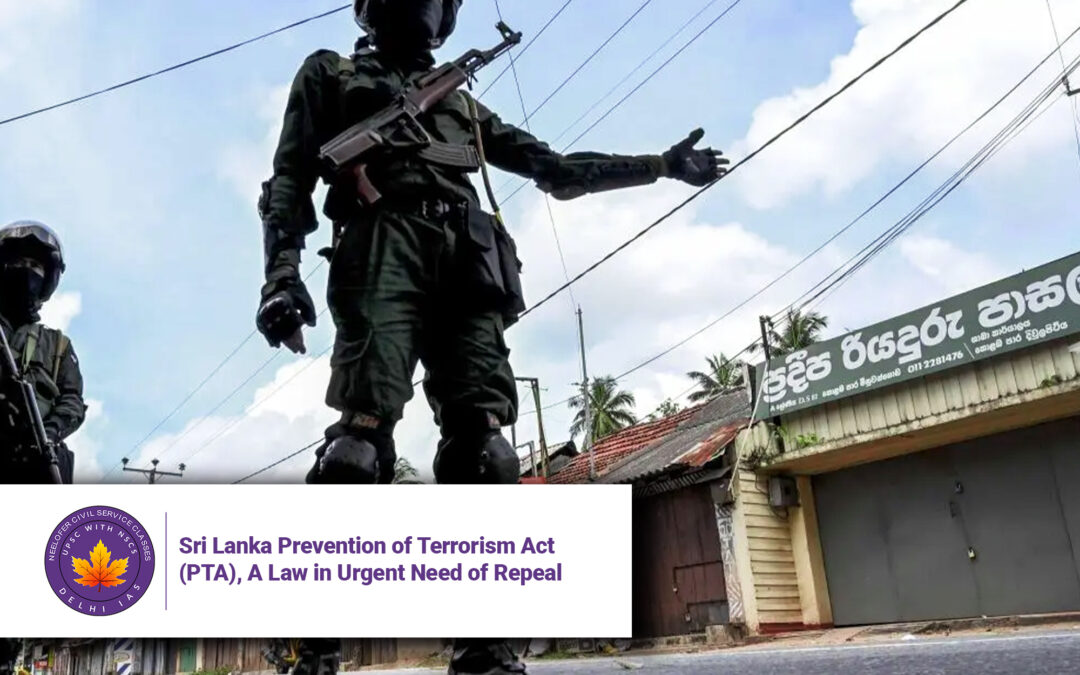
Sri Lanka Prevention of Terrorism Act (PTA), A Law in Urgent Need of Repeal
Why in News?
Sri Lanka’s controversial Prevention of Terrorism Act (PTA), enacted in 1979, has come under renewed criticism for its misuse and abuse against minorities, political opponents, and journalists. Despite promises by the current government to repeal the law, action remains delayed, prompting widespread calls for its complete removal from the statute books. 
Introduction
The Prevention of Terrorism Act (PTA) of 1979, introduced during the presidency of J.R. Jayawardene, was originally meant as a temporary measure to counter the Liberation Tigers of Tamil Eelam (LTTE). However, the Act became a permanent part of Sri Lankan law by 1982. Modeled after anti-apartheid legislation, the PTA allowed for extensive powers including prolonged detention without trial, which has led to allegations of torture, abuse, and suppression of dissent.
Key Issues and Background
1. A Tool for Repression
The PTA was created with the intent of eliminating separatist movements. Over time, it became a mechanism for silencing Tamil voices and other dissenters. It replaced an older law targeting organizations like the LTTE and has since been used beyond its original purpose.
2. Impunity and Abuse
The PTA permits administrative detention for extended periods without judicial review. Police confessions—even if forced or fabricated—are admissible in court. Numerous cases have revealed that suspects were tortured, coerced into confessions, or kept imprisoned despite evidence of innocence.
3. Targeting of Journalists and Opponents
Journalists, human rights activists, and political opponents have all faced detention under the PTA. A notable example is J.S. Tissainayagam, a journalist sentenced to 20 years under the PTA for reporting on government action against Tamil civilians. He was later released, but only after global pressure.
The Core of the Concern
Even after the civil war, the PTA remained in effect and was used to target the Muslim community after the 2019 Easter Sunday attacks. It has outlived its original purpose and has been viewed as a legal cover for violating fundamental rights.
The Janatha Vimukthi Peramuna (JVP)-backed National People’s Power (NPP) party had suffered under the PTA during its insurgency years and had promised to repeal it. Despite that, the NPP has not taken clear action, with concerns that the security establishment is resisting change.
Key Observations
-
Widespread Misuse: From torture to arbitrary detention, the PTA has been heavily misused without accountability.
-
Delayed Repeal: Despite successive governments pledging reforms or repeal, actual legislative progress has been minimal.
-
International Pressure: The continued enforcement of the PTA has threatened Sri Lanka’s access to international trade benefits like the EU’s GSP+.
-
No Real Reform: Even amendments to the PTA under previous governments were seen by experts as making the law worse, not better.
Conclusion
The Prevention of Terrorism Act is no longer fit for purpose and represents a significant threat to democratic rights and freedoms in Sri Lanka. Repealing the PTA is not only a legal necessity but also a moral imperative. The NPP must prove its commitment by turning rhetoric into action. Only then can Sri Lanka begin to heal from its legacy of state-sponsored injustice and move toward genuine democratic reform.
5 Questions and Answers
Q1. When was the Prevention of Terrorism Act (PTA) enacted in Sri Lanka?
A) 1982
B) 1979
C) 2009
D) 1995
Answer: B) 1979
Q2. What was the original intention behind the PTA?
A) To reform judicial procedures
B) To suppress economic fraud
C) To eliminate Tamil separatist movements like the LTTE
D) To regulate media freedoms
Answer: C) To eliminate Tamil separatist movements like the LTTE
Q3. Which party currently in power had promised to repeal the PTA but has yet to act?
A) United National Party (UNP)
B) Sri Lanka Podujana Peramuna (SLPP)
C) Janatha Vimukthi Peramuna (JVP)-backed NPP
D) Tamil National Alliance (TNA)
Answer: C) Janatha Vimukthi Peramuna (JVP)-backed NPP
Q4. Who was the journalist sentenced under the PTA for reporting on Tamil civilian suffering?
A) M.A. Sumanthiran
B) Gotabaya Rajapaksa
C) J.S. Tissainayagam
D) Mahinda Rajapaksa
Answer: C) J.S. Tissainayagam
Q5. What is the main criticism of recent amendments to the PTA by previous governments?
A) They made the PTA easier to understand
B) They completely removed the detention powers
C) They were drafted without human rights consultation and worsened the Act
D) They improved judicial oversight
Answer: C) They were drafted without human rights consultation and worsened the Act

