
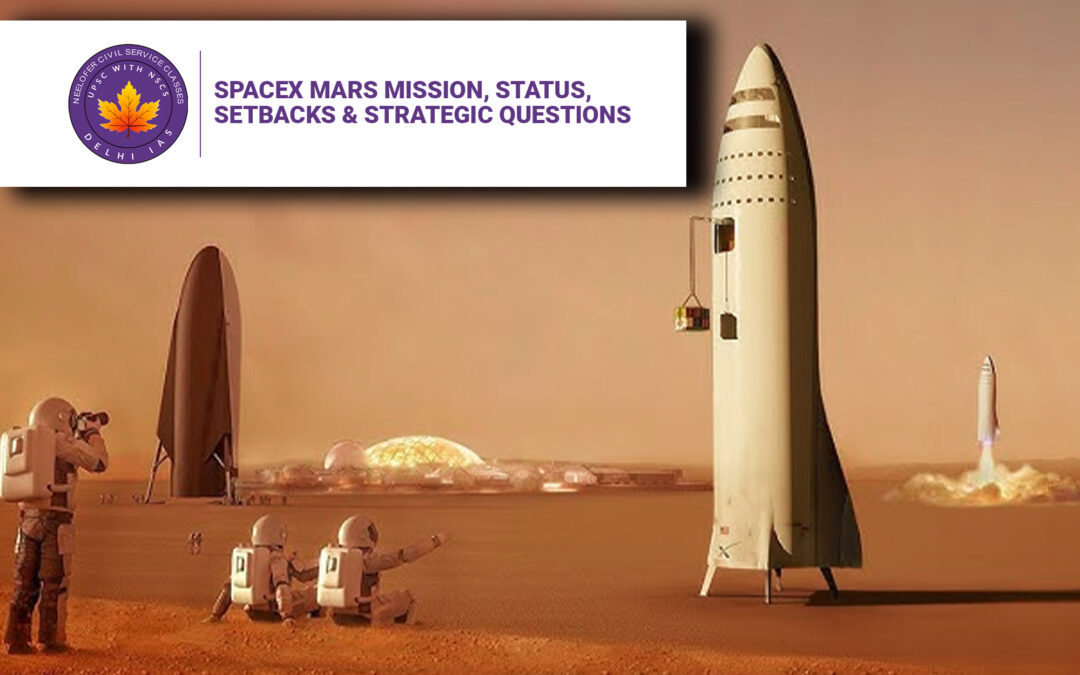
SpaceX Mars Mission, Status, Setbacks & Strategic Questions
Why in News?
On March 15, Elon Musk, CEO of SpaceX, announced on X (formerly Twitter) that an uncrewed Mars landing using Starship would take place by the end of 2024, sparking global attention and concerns regarding its feasibility, technical readiness, and potential conflict of interest due to Musk’s political involvement. 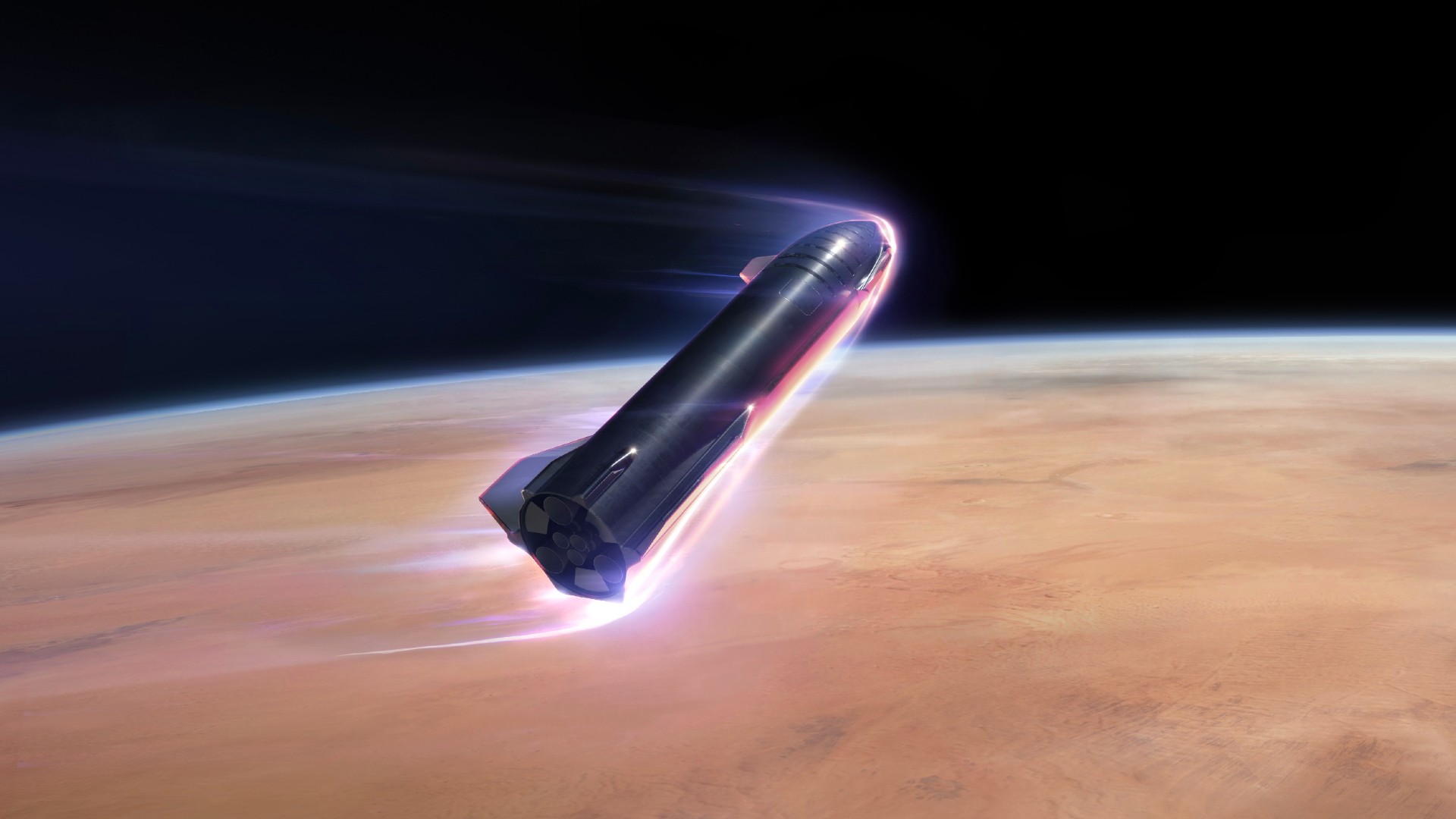
Introduction
SpaceX’s Mars mission represents one of humanity’s most ambitious space goals — the first step towards colonizing Mars. However, despite the optimism of Elon Musk, a series of technical failures, delays, and ethical concerns have made this mission the center of both fascination and skepticism.
Key Issues and Developments
-
Updated Timeline & Announcement
-
Elon Musk announced that an uncrewed Mars landing mission will happen by the end of 2024.
-
The mission will feature Optimus, a robot developed by Tesla, aboard the spacecraft.
-
Musk stated, “If those landings go well, human landings may start as soon as 2029, although 2031 is more likely.”
-
-
Delays & Technical Setbacks
-
Originally planned for September 2024, the mission has faced delays due to technical and logistical hurdles.
-
SpaceX has suffered two major Starship failures, or as Musk calls them, “rapid unscheduled disassemblies.”
-
The company is still testing the Starship’s reusable super heavy-lift vehicle, which is critical for Mars missions.
-
-
Major Technical Challenges
-
Fuel and refuelling in space remains a significant hurdle. SpaceX plans to launch a tanker spacecraft to refuel Starship mid-flight using a layer of super-cooled liquid oxygen and methane, but this has yet to be tested.
-
Timing is critical: Earth and Mars are closest every 26 months, creating a narrow “launch window.” Missing it could delay the mission by over two years.
-
The Starship second stage must travel 5.5 crore kilometers, a feat yet unaccomplished.
-
-
Landing Mechanism Issues
-
Musk envisions Starship as a vessel for human settlement. While earlier plans included a surface landing, Starship currently lacks the vertical catching systems it uses on Earth, like the “Chopsticks” catch arms.
-
The spacecraft has suffered high failure rates during tests, showing it is not yet ready for such a critical mission.
-
-
Conflict of Interest & NASA Concerns
-
According to The Guardian, NASA officials are worried about conflicts of interest between Musk’s SpaceX role and his advisory role to the Department of Governmental Efficiency (DOGE) under former President Donald Trump.
-
The closure of NASA’s Office of Technology, Policy, and Strategy, and the Office of the Chief Scientist has raised ethical concerns.
-
Skeptics question whether Musk’s dual roles (government advisor + private contractor) could undermine transparency and fairness in space policy and funding allocation.
-
5 Key Takeaways
-
Elon Musk plans an uncrewed Mars landing by 2024, but delays make this timeline doubtful.
-
Refueling in space via a tanker spacecraft is critical but untested.
-
SpaceX’s Starship failures and structural design are major technical roadblocks.
-
NASA officials are concerned about conflict of interest and ethical issues due to Musk’s political ties.
-
The success of the mission will depend on solving engineering, fuel, and ethical hurdles—not just ambition.
Challenges and the Way Forward
-
Technological Preparedness: SpaceX must prove its Starship is reliable for long-range interplanetary travel.
-
Infrastructure Development: Successful testing of in-space refueling and landing mechanisms on Mars is vital.
-
Governance & Ethics: Clear separation between government influence and private contracts is crucial to maintain trust and transparency in space research.
-
Collaboration with NASA: Open coordination and oversight from NASA scientists and global space agencies could ensure better success and accountability.
-
Public Confidence: Musk must shift from showmanship to scientific credibility, ensuring that promises are supported by evidence and testing.
Conclusion
The SpaceX Mars mission embodies human ambition, but ambition alone cannot land a rocket on Mars. From technical failures to ethical controversies, the mission still faces a long journey before reaching the Red Planet. While 2024 may be too soon, the developments set the stage for a transformative future in space exploration—if guided by science, ethics, and strategy.
Q&A Section
Q1. What did Elon Musk announce about the Mars mission?
Musk announced that an uncrewed Mars landing using Starship will take place by the end of 2024, with human missions possibly starting in 2029 or 2031.
Q2. What technical issues are delaying the Mars mission?
The project faces Starship test failures, issues with in-space refueling, and a lack of Mars-specific landing systems, casting doubt on the mission timeline.
Q3. What is the concern about in-space refueling?
SpaceX plans to launch a tanker spacecraft to refuel Starship mid-flight, but this technology is still untested, making it a critical challenge.
Q4. Why are NASA officials worried?
They fear a conflict of interest due to Musk’s dual role as a CEO of SpaceX and advisor to a government body (DOGE), raising ethical questions.
Q5. How likely is a Mars landing by 2024?
Given the multiple delays, technical failures, and pending tests, experts believe a 2024 landing is highly unlikely, though not impossible.

