
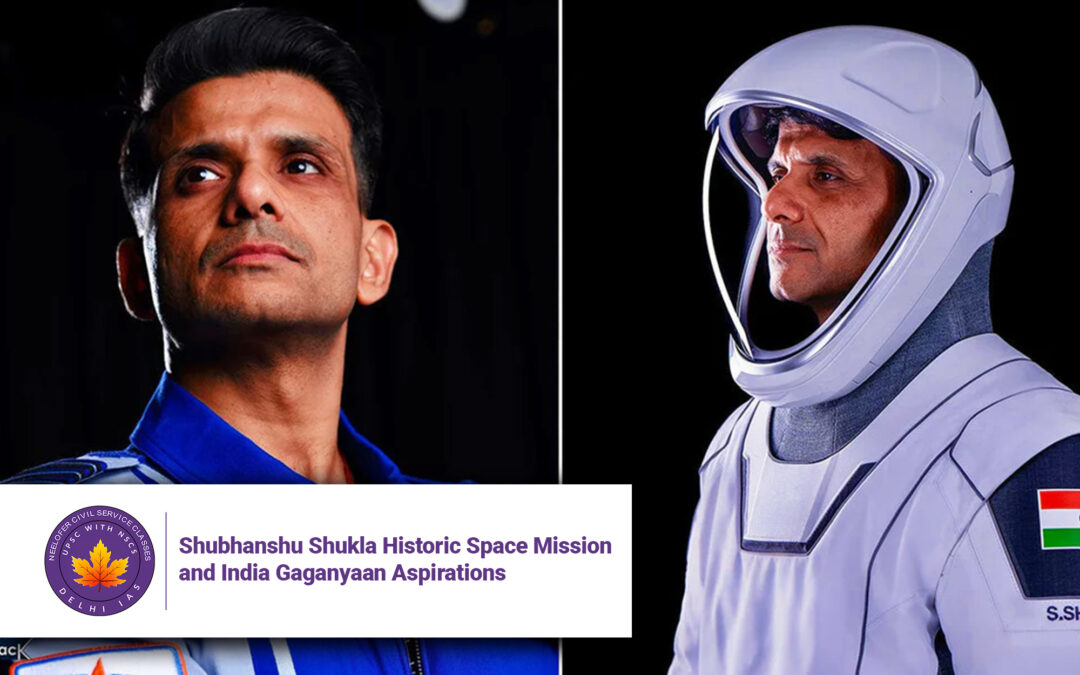
Shubhanshu Shukla Historic Space Mission and India Gaganyaan Aspirations
Why in News?
On June 26, 2025, Shubhanshu Shukla, alongside astronauts from Hungary, Poland, and the US, embarked on a historic journey aboard SpaceX’s Falcon 9 rocket to the International Space Station (ISS). He is the first Indian national to travel to space since Rakesh Sharma’s mission in 1984. His mission is not only a personal achievement but also a significant strategic milestone for India’s space program—especially as it prepares for its ambitious human spaceflight project, Gaganyaan, set for launch in late 2025 or early 2026. 
Introduction
Shukla’s journey to the ISS, aboard a privately chartered Axiom Space mission, symbolizes India’s growing footprint in space collaboration and its advancing space ambitions. With this achievement, India builds upon decades of work by ISRO (Indian Space Research Organisation) and renews its focus on human spaceflight and planetary exploration.
Key Highlights
-
Historic Flight After 40 Years
Shubhanshu Shukla is the first Indian to travel to space since Rakesh Sharma in 1984. His mission holds deep symbolic meaning, marking India’s return to crewed spaceflight efforts. -
Strategic Timing Ahead of Gaganyaan
The mission provides critical inputs for ISRO’s upcoming Gaganyaan project. India plans to send astronauts into low-Earth orbit as part of its first human spaceflight program, with the first launch expected in late 2025. -
India’s Expanding Role in Space Science
ISRO has shifted from a purely satellite-focused organisation to one capable of executing deep space missions, including Chandrayaan, Mangalyaan, and upcoming manned missions. -
International Collaborations and Private Sector Role
Shukla’s flight was part of a privately chartered mission, indicating a growing global trend of public-private partnerships in space. An Indo-RSA collaboration also suggests India is entering new international ventures. -
Building Astronaut Readiness
As space missions become longer and more complex, India must strengthen astronaut training, health research, and in-flight mission control—a focus area of the Gaganyaan programme.
5 Key Observations
-
India’s second spaceflight with a human aboard, after a 40-year gap, marks a historic comeback.
-
Shukla’s journey strengthens Gaganyaan’s feasibility by offering hands-on experience in microgravity, human survival, and emergency response in space.
-
The collaboration with Axiom Space sets a precedent for India’s private sector participation in future missions.
-
India’s long-term strategy includes not just LEO (low-Earth orbit) missions, but also lunar and interplanetary human missions.
-
ISRO’s shift toward crewed missions shows its evolving role from a remote-sensing agency to a space-faring nation.
Challenges and the Way Forward
-
Astronaut Safety and Training
As human spaceflight carries greater risks than robotic missions, India needs stronger astronaut training modules and health research frameworks. -
Infrastructure Upgradation
Facilities such as launch pads, life support systems, crew modules, and command centres must meet global standards for human missions. -
Global Partnerships
Expanding collaborations with international space agencies and private firms can accelerate technological exchange and reduce costs. -
Sustained Funding
Human spaceflight is expensive and demands consistent investment in R&D, simulation labs, and skilled workforce. -
Space Policy Reform
India needs a forward-looking space policy that clearly defines the role of private players and supports commercialisation.
Conclusion
Shubhanshu Shukla’s space journey is more than a personal triumph—it’s a powerful signal of India’s space resurgence and ambition. As Gaganyaan prepares to launch, his experience will act as a guiding light in refining safety protocols, understanding microgravity impacts, and preparing Indian astronauts for longer, more complex missions. India is not just reaching for the stars—it’s preparing to live among them.
Q&A Section
1. Who is Shubhanshu Shukla and why is his space mission significant?
Shukla is the first Indian national to travel to space since 1984. His ISS mission is vital for ISRO as it gears up for its first human spaceflight—Gaganyaan.
2. What is the Gaganyaan mission?
Gaganyaan is India’s human spaceflight program, aiming to send a crew of Indian astronauts into low-Earth orbit by 2025-26.
3. How does Shukla’s mission help Gaganyaan?
It provides real-time data and experiential insights into astronaut health, survival techniques, microgravity adaptation, and crew operations.
4. What are the broader implications of this mission for India?
It showcases India’s growing capability in space science, strengthens ISRO’s international partnerships, and prepares India for crewed lunar and interplanetary missions.
5. What role can private companies play in India’s future space missions?
Private firms can contribute in crew module manufacturing, astronaut training, space R&D, and even commercial space travel, as India moves toward a hybrid public-private space ecosystem.

