
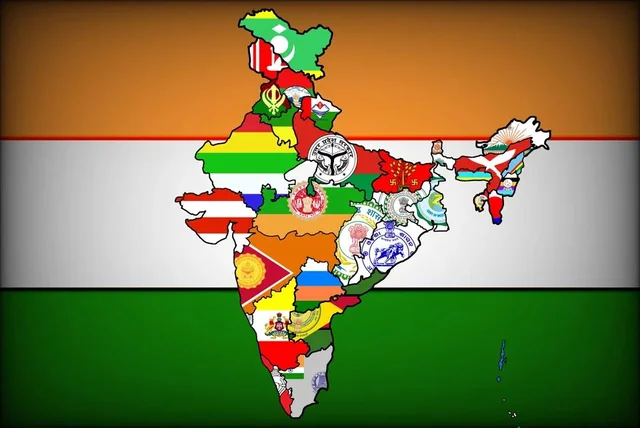
Should Indian States Have Their Own Flags?
Why in News?
The Home Ministry of India has clarified that no Indian state will be permitted to have its own flag. This decision comes in response to demands from Tamil Nadu and other states advocating for a separate state flag, raising concerns over national unity and integrity. 
Introduction
In recent developments, there has been debate about whether Indian states should be allowed to adopt their own flags. The Tamil Nadu Government’s move to remove the national flag from the Inspector-General’s Office and replace it with the state emblem reignited this discussion. However, the Home Ministry has firmly stated that the national flag is the sole flag to be flown on designated government buildings, upholding national integrity and unity.
Key Features
Central Government’s Clarification
- The Home Ministry sources stated there is no provision for any Indian state to have its own flag.
- Only the national flag is permitted to fly atop government buildings across all Indian states and Union Territories.
- The policy reinforces the national spirit, with a single flag and national anthem representing the entire country.
Tamil Nadu’s Plea
- Tamil Nadu has pushed for a separate flag, arguing it reflects the state’s identity.
- The Home Ministry has emphasized that all states are integral parts of the Indian Union, and separate flags could encourage fissiparous tendencies.
Context of Recent Events
- The Tamil Nadu Government removed the national flag from the Inspector-General’s Office and replaced it with the state emblem.
- The Home Ministry clarified that the IG’s office was never on the list of buildings mandated to fly the national flag.
- A 1958 circular to all states outlined regulations regarding the use of the national flag, reaffirmed in the current context.
Specific Impacts or Effects
- The move to have separate flags for states could threaten national unity and promote separatist sentiments.
- The Home Ministry fears that state-specific flags could lead to regionalism and undermine the federal structure of India.
- Reinforcing the one-nation, one-flag policy helps maintain the integrity and sovereignty of the Indian state.
Challenges and the Way Forward
Challenges
- Addressing regional aspirations without compromising national integrity.
- Countering political movements that may push for symbolic separatism.
- Ensuring uniform adherence to the regulations on the national flag.
Steps Forward
- Educate states on the importance of national symbols in promoting unity.
- Reaffirm and communicate the legal position regarding the national flag and its exclusive status.
- Encourage cooperative federalism, where regional identities are respected without compromising national unity.
Conclusion
The central government’s decision to prohibit states from having their own flags underscores the priority placed on national unity over regional symbolism. While respecting cultural and regional diversity, India’s federal structure must maintain its integrity and oneness, as represented by the national flag and anthem.
Questions and Answers
-
What decision did the Home Ministry announce regarding state flags?
No Indian state will be allowed to have its own flag. -
Which state recently reignited the debate on separate flags?
Tamil Nadu. -
Why did Tamil Nadu remove the national flag from the Inspector-General’s Office?
To replace it with the state emblem on the office standard. -
What concern does the Home Ministry have about states adopting their own flags?
It could promote fissiparous tendencies and threaten national unity. -
What does the 1958 circular clarify?
It outlines the policy on the use of the national flag on certain government buildings. -
What was the Home Ministry’s clarification about the IG’s office?
It was not on the list of buildings required to fly the national flag. -
What does the Home Ministry emphasize about states in the Union?
All states are integral parts of India and cannot have separate flags. -
What principle does the policy on flags uphold?
The spirit of national unity and integrity. -
What potential risk comes from allowing states to have their own flags?
It could lead to regional separatism and weaken national cohesion. -
What should be the way forward according to the Home Ministry’s stance?
Maintain a single national flag policy to promote unity, and educate states on its importance.

