
Should Immigrants Have the Same Right to Protest as Citizens?
Why in News?
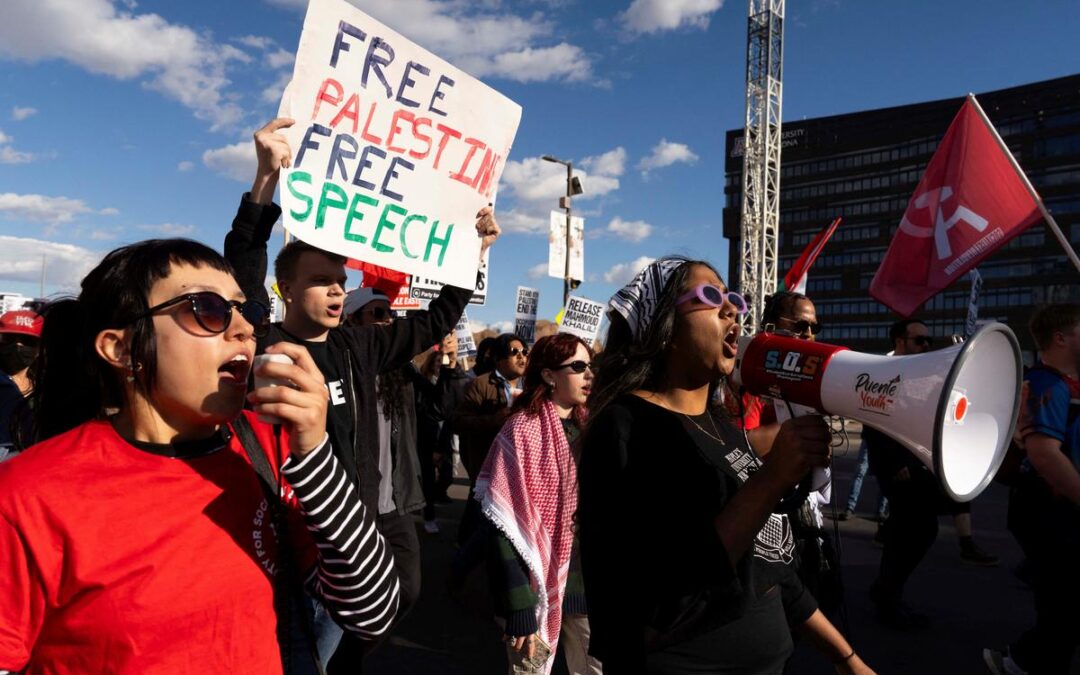
The recent deportation of Ranjani Srinivasan, an Indian doctoral student at Columbia University, has reignited the debate over immigrants’ rights to protest in the United States. Srinivasan was deported on March 1, 2024, after her student visa was revoked by the U.S. State Department. The incident followed her participation in protests on campus, where she was accused of being a “pro-Hamas sympathizer” by Immigration and Customs Enforcement (ICE).
Similarly, Mahmoud Khalil, a Palestinian student activist and green card holder, was also detained by immigration authorities for allegedly violating his terms of residency by supporting a U.S.-designated terrorist organization.
-
These incidents raise questions about whether immigrants should have the same right to protest as U.S. citizens.

Introduction
The right to protest is considered a fundamental human right.
-
According to Article 9 of the International Covenant on Civil and Political Rights (ICCPR), the right to freedom of expression and peaceful assembly applies to both citizens and immigrants.
-
However, Article 19(3) allows governments to impose restrictions in the name of national security or public order.
-
This legal flexibility gives U.S. authorities the power to detain or deport immigrants who participate in protests that are deemed disruptive or linked to extremist groups.
Key Issues
-
Do immigrants have the same right to protest as citizens under international human rights law?
-
Prabhash Ranjan, an expert on international law, argues that the ICCPR extends the right to protest to both citizens and immigrants.
-
However, in practice, the U.S. government frequently imposes special restrictions on immigrants, especially in cases involving national security or political dissent.
-
The U.S. Supreme Court has repeatedly ruled that non-citizens do not have the same constitutional protections as citizens, allowing the government to restrict their participation in protests.
-
This creates a legal gray area, where immigrant protestors face greater risks of detention and deportation.
-
-
Does the crackdown on protesting foreign students violate First Amendment rights?
-
The U.S. Immigration and Nationality Act, 1952 (INA) grants the government the power to deport non-citizens who engage in or support activities deemed a threat to public order or U.S. interests.
-
While citizens have greater protections under the First Amendment, non-citizens face legal vulnerabilities.
-
The January 2025 surge in federal actions against student protestors has highlighted the imbalance of rights between citizens and immigrants.
-
Critics argue that such actions violate fundamental human rights, as immigrants face harsher consequences for exercising the same freedom of speech as citizens.
-
-
U.S. immigration judges operate under the Department of Justice (DOJ), allowing the Attorney General the authority to remove them. Could this influence or compromise their independence?
-
Yes. The DOJ’s control over immigration judges creates a potential conflict of interest.
-
Unlike federal judges, immigration judges are subject to political pressures.
-
PR notes that this system can lead to biased rulings, particularly in cases involving protest-related deportations.
-
The lack of judicial independence undermines the fairness of deportation hearings, making it harder for immigrants to defend their rights.
-
-
The Trump administration’s use of the 1952 Act to prosecute foreign protestors is under scrutiny. Could this allow the U.S. government to selectively target dissenting immigrants?
-
Yes.
-
The Trump-era application of the 1952 Act has expanded the government’s power to deport immigrants for alleged political activities, even if they are non-violent.
-
Cases like Holder v. Humanitarian Law Project (2010) demonstrate how “material support” laws can be used to criminalize peaceful activism, including protest-related fundraising or association with banned groups.
-
This creates a dangerous precedent, where immigrant protestors risk being labeled as security threats, even if they engage in peaceful demonstrations.
-
-
Impact on U.S. Global Reputation
-
The U.S. has long promoted itself as a defender of free speech and human rights.
-
However, the targeting of foreign protestors undermines its credibility on the international stage.
-
According to Happymon Jacob, this could weaken America’s diplomatic influence, particularly in multilateral forums like the United Nations.
-
Countries with poor human rights records could use U.S. actions as justification for their own crackdowns on foreign dissenters.
-
Proposed Reforms
-
Strengthening Legal Protections for Immigrant Protestors:
-
Reforming the 1952 Act to prevent its misuse against peaceful protestors.
-
Implementing stricter oversight of immigration judges to ensure judicial independence.
-
Granting greater legal representation to foreign students and immigrants facing deportation.
-
-
Balancing National Security with Free Speech:
-
Introducing clear legal distinctions between peaceful protest and material support for terrorism.
-
Preventing the misuse of immigration laws to silence dissent.
-
-
Enhancing International Oversight:
-
The United Nations and international human rights organizations should monitor and report on the U.S. government’s treatment of immigrant protestors.
-
This would increase accountability and pressure the U.S. to align its practices with international norms.
-
Conclusion
The deportation of immigrant protestors in the U.S. raises serious human rights concerns.
-
The legal disparities between citizens and immigrants create an unequal playing field, where non-citizens face harsher consequences for engaging in peaceful dissent.
-
The U.S. government’s crackdown on immigrant activists could damage its global reputation as a defender of free speech.
-
Moving forward, reforms are needed to protect immigrant protestors’ rights while balancing national security concerns.
Q&A Section
-
Q: Why are immigrant protestors in the U.S. more vulnerable to deportation?
A: Immigrant protestors face fewer legal protections than citizens, making it easier for the U.S. government to detain or deport them under national security laws like the Immigration and Nationality Act, 1952. -
Q: How does the lack of judicial independence in immigration courts affect deportation cases?
A: Since immigration judges operate under the Department of Justice (DOJ), they are subject to political pressures, which can lead to biased rulings against immigrant protestors. -
Q: What impact could the crackdown on immigrant protestors have on the U.S. international reputation?
A: The U.S. could face international criticism for violating human rights standards, weakening its diplomatic influence in global forums like the United Nations. -
Q: What reforms are necessary to protect immigrants’ right to protest?
A: Reforms should include:-
Stronger legal protections for immigrant protestors.
-
Ensuring judicial independence in immigration courts.
-
International oversight to hold the U.S. accountable for human rights violations.
-

