
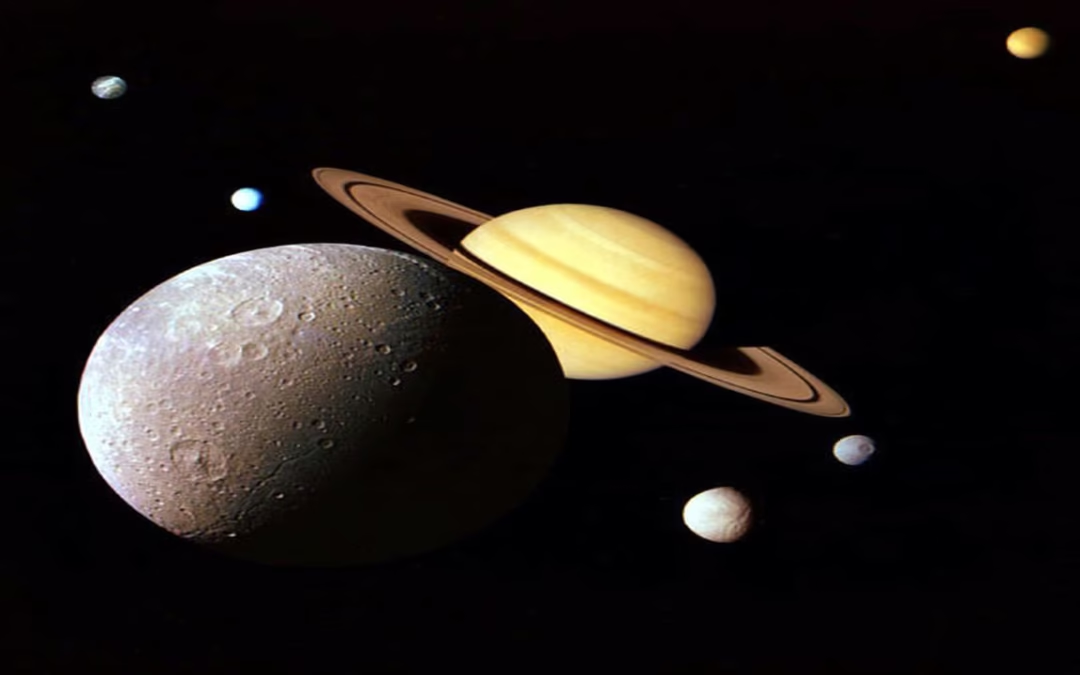
Saturn Moon Count Reaches a Record 274 After Discovery of 128 New Moons
Why in News?
In a groundbreaking astronomical development, scientists have confirmed the discovery of 128 new moons orbiting Saturn, taking its total moon count to a staggering 274 — the most of any planet in our solar system. This remarkable feat was recognized and validated by the International Astronomical Union (IAU) in 2023, placing Saturn far ahead of other gas giants in terms of satellite count. The discovery underscores Saturn’s dominance not just in terms of its iconic rings, but also in its complex and crowded orbital environment. 
Key Issues
Historical Context of Saturn’s Moon Discoveries
Saturn has fascinated astronomers for centuries, with its rings and extensive moon system offering rich ground for study.
-
The first moons of Saturn were discovered in the 1600s.
-
Over the centuries, advancements in telescope technology have allowed scientists to spot increasingly smaller and more distant moons.
-
In recent years, planetary scientists have shifted their attention to smaller, irregular moons that were previously undetectable due to their size and distance.
With this latest discovery, Saturn has now surpassed Jupiter (which has 95 moons) by a significant margin.
The Discovery: How and Where?
-
The 128 new moons were identified using data from the Canada-France-Hawaii Telescope (CFHT) located atop Mauna Kea in Hawaii.
-
These observations were carried out in 2023, and researchers used a technique called “shift and stack” to detect faint, distant objects moving in Saturn’s orbit.
-
Most of these moons are extremely small, with diameters as little as 2.5 miles (4 km), and are irregular in shape and orbit.
The analysis and classification were led by Edward Ashton and his team at the Academia Sinica Institute of Astronomy and Astrophysics in Taiwan, which now holds naming rights for these moons.
Scientific Significance and Theories
Astronomers believe that many of Saturn’s moons were formed as a result of massive collisions between ancient moons or between moons and comets/asteroids. These collisions likely shattered larger bodies into smaller fragments, which remained in orbit around Saturn.
-
These fragments eventually became irregular moons, which are distinguished by their eccentric, inclined, or retrograde orbits.
-
The grouping of these moons into orbital families hints at shared origins, possibly from a single destroyed parent body.
For example, one prominent group of newly discovered moons is the Mundilfari group, consisting of 47 moons, all orbiting in similar retrograde paths.
Unraveling Space Mysteries
The discovery offers new insights into:
-
The violent and chaotic history of the outer solar system.
-
The processes of moon formation and fragmentation.
-
The gravitational influence Saturn has exerted over billions of years, capturing or creating these moons.
Brett Gladman, an astronomer at the University of British Columbia and co-author of the study, highlighted the significance of the find:
“You’re looking at the aftermath of what three great-grandparents were like, five generations later.”
Understanding these small satellites could also help astronomers predict future collisions, track orbital dynamics, and study the evolution of planetary systems.
Challenges and Technological Advances
-
Discovering such small and faint objects orbiting nearly 2 million miles away from Saturn is technically demanding.
-
The success of this discovery is largely attributed to advanced data processing algorithms and the use of high-resolution ground-based telescopes.
Future missions like the James Webb Space Telescope are expected to provide even more detailed observations of these moons, potentially revealing surface characteristics and compositional data.
What Next?
-
The newly confirmed moons will be named and catalogued in the coming months by the team at Academia Sinica.
-
Further studies will aim to determine their chemical composition, surface properties, and orbital mechanics.
-
These findings will also influence future space missions and models of moon formation and planetary dynamics.
The discovery opens new avenues for research into the origins of the solar system, the possibility of habitability on icy moons, and the long-term stability of such dense satellite systems.
Q&A Section
Q1. How many moons does Saturn have now?
A: Saturn has 274 officially confirmed moons, the most in the solar system.
Q2. How were these 128 new moons discovered?
A: They were discovered using the Canada-France-Hawaii Telescope in 2023 through a technique called “shift and stack”, which detects faint, slow-moving objects.
Q3. Why are these moons significant?
A: These moons provide evidence of ancient moon collisions, helping scientists understand how planetary systems evolve over time.
Q4. Are these moons natural or captured objects?
A: Most of them are natural, likely fragments from earlier moons or asteroids that broke apart due to collisions or gravitational forces.
Q5. Who is responsible for naming the new moons?
A: The Academia Sinica Institute of Astronomy and Astrophysics in Taiwan has been granted naming rights.
Q6. What is the Mundilfari group?
A: It’s a group of 47 newly discovered moons that share similar orbits, suggesting a common origin from a shattered parent moon.
Q7. What does this mean for space exploration?
A: These discoveries will guide future missions, inform models of planetary system formation, and help identify potential target moons for exploration.
Q8. Could these moons have water or life?
A: While most of the new moons are small and irregular, larger moons like Titan are already known to have liquid methane and subsurface oceans, making them candidates for astrobiological research.
